383 posters, 2 videos, 1 audios, 8 topics, 28 sessions, 328 authors, 225 institutions
ePostersLive by SciGen Technologies S.A. All rights reserved.
50th Annual Regional Anesthesiology and Acute Pain Medicine Meeting
May 1 - 3, 2025 | Orlando, Florida

6825
ACUTE PAIN SERVICE UTILIZATION AND OUTCOMES: A RETROSPECTIVE STUDY FROM AN URBAN SAFETY-NET HOSPITAL
Poster Presenter
Authors
Affiliations
Part of Topic
Scientific Abstracts > Acute Pain
Acute Pain Service Utilization and Outcomes: A Restrospective Study from Urban Safety-Net Hospital
Introduction
Acute Pain Services (APS) are a cornerstone in perioperative pain management and have been shown to improve patient satisfaction and outcomes.
Individually tailored utilization of APS can minimize postoperative opioid-related complications, decrease hospital length of stay (LOS), and decrease healthcare costs.
Comprehensive analyses of APS utilization and outcomes in perioperative settings are limited but disparities in pain management exist.
This study aimed to evaluate the patient demographic profile and potential disparities in acute pain management at an urban academic safety-net hospital.
Methods
This retrospective study, approved by the Institutional Review Board, analyzed data from electronic chart reviews of patients followed on the Acute Pain Service between January 1, 2020 and November 1, 2022.
Descriptive statistics summarized the demographic and baseline characteristics of the study population.
Two-sample t-tests, chi-square tests, and Fisher’s exact tests were used to assess differences between subgroups.
Linear regression, logistic regression, and multinomial regression models were employed to identify predictors of LOS, disposition, and final hospital discharge disposition.
Results
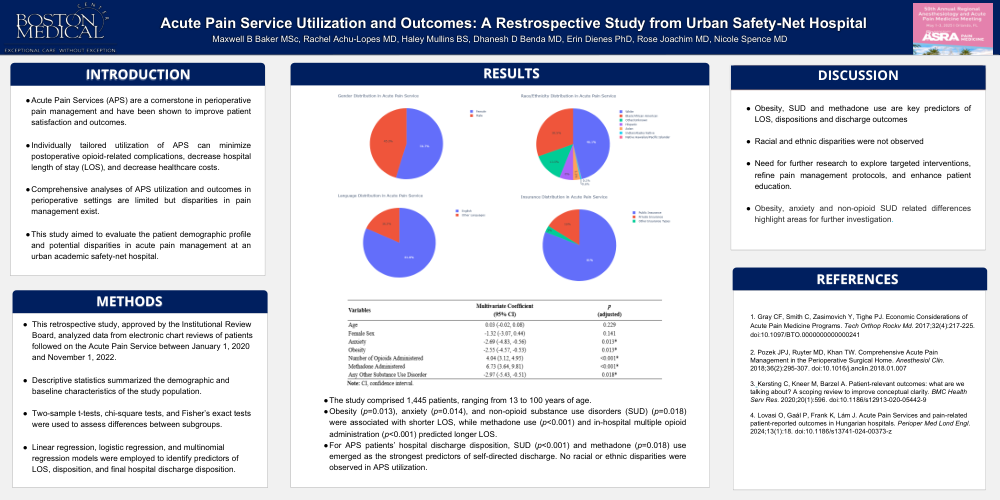
The study comprised 1,445 patients, ranging from 13 to 100 years of age.
Obesity (p=0.013), anxiety (p=0.014), and non-opioid substance use disorders (SUD) (p=0.018) were associated with shorter LOS, while methadone use (p<0.001) and in-hospital multiple opioid administration (p<0.001) predicted longer LOS.
For APS patients’ hospital discharge disposition, SUD (p<0.001) and methadone (p=0.018) use emerged as the strongest predictors of self-directed discharge. No racial or ethnic disparities were observed in APS utilization.
Discussion
Obesity, SUD and methadone use are key predictors of LOS, dispositions and discharge outcomes
Racial and ethnic disparities were not observed
Need for further research to explore targeted interventions, refine pain management protocols, and enhance patient education.
Obesity, anxiety and non-opioid SUD related differences highlight areas for further investigation.