383 posters, 2 videos, 1 audios, 8 topics, 28 sessions, 328 authors, 225 institutions
ePostersLive by SciGen Technologies S.A. All rights reserved.
50th Annual Regional Anesthesiology and Acute Pain Medicine Meeting
May 1 - 3, 2025 | Orlando, Florida

6796
WERE GABAPENTINOID-OPIOID CO-PRESCRIPTIONS AFFECTED BY THE UNITED STATED FOOD AND DRUG ADMINISTRATION’S SAFETY COMMUNICATIONS?
Poster Presenter
Authors
Affiliations
Part of Topic
Scientific Abstracts > Acute Pain
Introduction
In December 2019, the FDA issued a Drug Safety Communication:
Serious risk of respiratory depression when co-prescribed gabapentinoids with other central nervous system depressants, particularly opioids.
In this study, the impact of such a warning on gabapentinoid-opioid co-prescription rates was investigated.
Methods
The Merative MarketScan Commercial Claims database was examined for pharmaceutical claims of all patients aged ≥ 18 years from February 2018 to December 2022.
Objective: Assessing gabapentinoid-opioid co-prescription rates (defined as any overlapping supply of opioids and gabapentin/pregabalin) before (23 months) and after (36 months) the FDA Communication.
We analyzed co-prescription rates on a patient level and performed an interrupted time series analysis to test the “real-world” effect of the FDA Communication.
Results
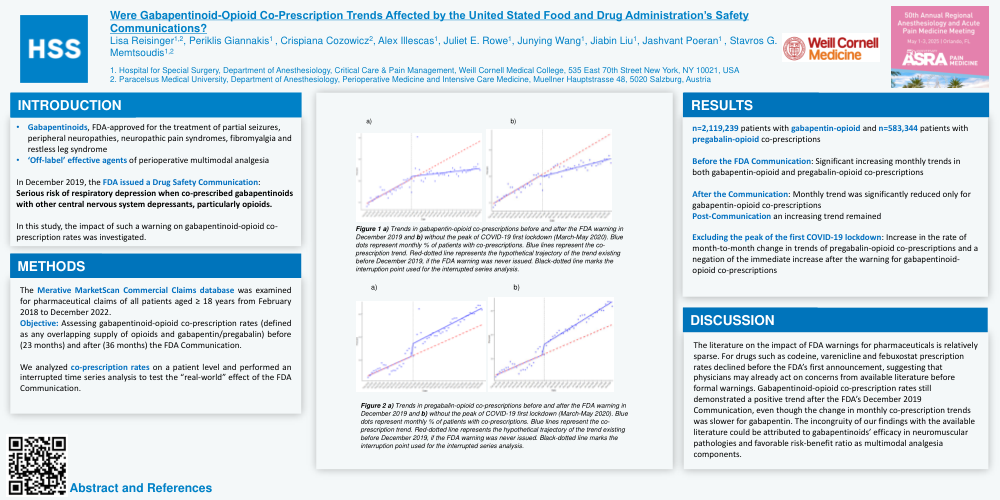
n=2,119,239 patients with gabapentin-opioid and n=583,344 patients with pregabalin-opioid co-prescriptions
Before the FDA Communication: Significant increasing monthly trends in both gabapentin-opioid and pregabalin-opioid co-prescriptions
After the Communication: Monthly trend was significantly reduced only for gabapentin-opioid co-prescriptions
Post-Communication an increasing trend remained
Excluding the peak of the first COVID-19 lockdown: Increase in the rate of month-to-month change in trends of pregabalin-opioid co-prescriptions and a negation of the immediate increase after the warning for gabapentinoid-opioid co-prescriptions
Discussion
The literature on the impact of FDA warnings for pharmaceuticals is relatively sparse. For drugs such as codeine, varenicline and febuxostat prescription rates declined before the FDA’s first announcement, suggesting that physicians may already act on concerns from available literature before formal warnings. Gabapentinoid-opioid co-prescription rates still demonstrated a positive trend after the FDA’s December 2019 Communication, even though the change in monthly co-prescription trends was slower for gabapentin. The incongruity of our findings with the available literature could be attributed to gabapentinoids’ efficacy in neuromuscular pathologies and favorable risk-benefit ratio as multimodal analgesia components.