383 posters, 2 videos, 1 audios, 8 topics, 28 sessions, 328 authors, 225 institutions
ePostersLive by SciGen Technologies S.A. All rights reserved.
50th Annual Regional Anesthesiology and Acute Pain Medicine Meeting
May 1 - 3, 2025 | Orlando, Florida

6774
CANNABIS USE AND POST-OPERATIVE PAIN SCORES IN PATIENTS UNDERGOING SPORTS MEDICINE PROCEDURES
Poster Presenter
Authors
Affiliations
Part of Topic
Scientific Abstracts > Acute Pain
Cannabis use and post-operative pain scores in patients undergoing sports medicine procedures
Authors: Sophia Madjarova BA, Arjun Khorana BS, William Chan MEng, Answorth Allen MD, Riley Williams MD, Benedict Nwachukwu MD MBA, Alexandra Sideris PhD
Introduction
The efficacy of cannabis and its individual components (like tetrahydrocannabinol or cannabidiol) for pain management remains uncertain with many studies showing mixed results,[1] especially when considering post-operative pain from arthroplasty.[2,3] Literature is particularly scant when considering the role of cannabis use in patients undergoing less-invasive specialized arthroscopic sports medicine procedures.[4] The aim of this study was to quantify the prevalence of self-reported cannabis use within the population of adults undergoing arthroscopic treatment of injury to the hip, knee, and shoulder and investigate the potential association of cannabis use and post-operative pain in this patient population.
Methods
Approval was received from the Institutional Review Board for a retrospective study, and the electronic medical record at a single, high-volume orthopedic specialty hospital was queried for patients undergoing sports medicine procedures including arthroscopic surgery on the hip, knee, or shoulder between January 1, 2023, and December 31, 2023. Demographic variables (age, sex, race/ethnicity), any drug-use reported by the patient pre-operatively, American Society of Anesthesiologist’s classification of Physical Health, primary procedure, and NRS pain scores (0-10, 10 is worst) in the post-anesthesia care unit (PACU) were extracted. Paired t-tests were performed to assess differences in patients reporting cannabis use and those not reporting cannabis use for continuous variables. Chi Square tests were utilized to assess differences in categorical variables.
Results
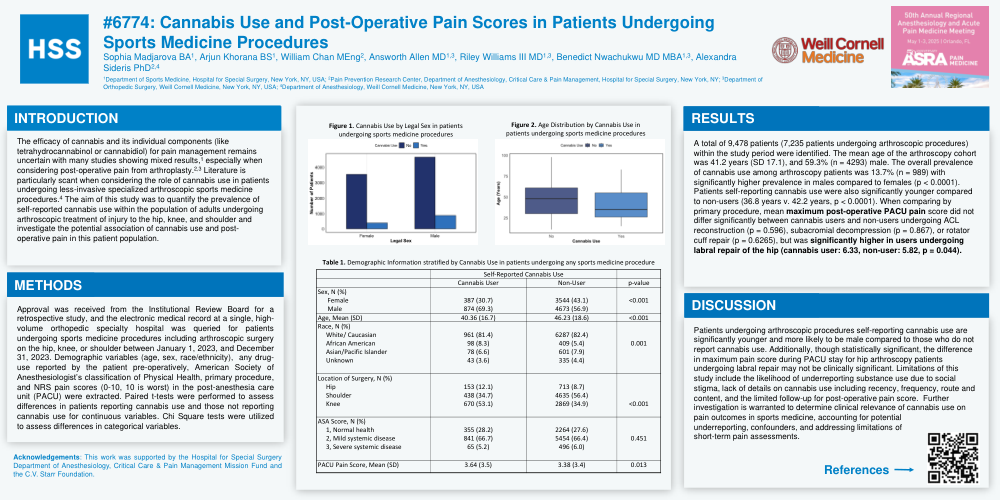
A total of 9,478 patients (7,235 patients undergoing arthroscopic procedures) within the study period were identified. The mean age of the arthroscopy cohort was 41.2 years (SD 17.1), and 59.3% (n = 4293) male. The overall prevalence of cannabis use among arthroscopy patients was 13.7% (n = 989) with significantly higher prevalence in males compared to females (p < 0.0001). Patients self-reporting cannabis use were also significantly younger compared to non-users (36.8 years v. 42.2 years, p < 0.0001). When comparing by primary procedure, mean maximum post-operative PACU pain score did not differ significantly between cannabis users and non-users undergoing ACL reconstruction (p = 0.596), subacromial decompression (p = 0.867), or rotator cuff repair (p = 0.6265), but was significantly higher in users undergoing labral repair of the hip (cannabis user: 6.33, non-user: 5.82, p = 0.044).
Discussion
Patients undergoing arthroscopic procedures self-reporting cannabis use are significantly younger and more likely to be male compared to those who do not report cannabis use. Additionally, though statistically significant, the difference in maximum pain score during PACU stay for hip arthroscopy patients undergoing labral repair may not be clinically significant. Limitations of this study include the likelihood of underreporting substance use due to social stigma, lack of details on cannabis use including recency, frequency, route and content, and the limited follow-up for post-operative pain score. Further investigation is warranted to determine clinical relevance of cannabis use on pain outcomes in sports medicine, accounting for potential underreporting, confounders, and addressing limitations of short-term pain assessments.
References
- Abdallah FW, Hussain N, Weaver T, Brull R. Analgesic efficacy of cannabinoids for acute pain management after surgery: a systematic review and meta-analysis. Reg Anesth Pain Med. 2020 Jul;45(7):509-519. doi: 10.1136/rapm-2020-101340. Epub 2020 May 28. PMID: 32471924.
- Turan OA, Rullan PJ, Pasqualini I, Pumo TJ, Surace PA, Murray TG, Piuzzi NS. Cannabis Use Following Total Joint Arthroplasty is Associated With Increased Risks? A Meta-Analysis. J Arthroplasty. 2024 Feb;39(2):533-540.e6. doi: 10.1016/j.arth.2023.07.008. Epub 2023 Jul 14. PMID: 37454951.
- Hegde V, Bracey DN, Pollet AK, Yazdani-Farsad Y, Dennis DA, Jennings JM. Cannabis Use Does Not Affect Outcomes After Total Hip Arthroplasty. J Arthroplasty. 2023 Sep;38(9):1808-1811. doi: 10.1016/j.arth.2023.03.040. Epub 2023 Mar 20. PMID: 36940759.
- Wood JT, Sambandam S, Wukich DK, McCrum CL. Self-Reported Cannabis Use Is Not Associated With Increased Opioid Use or Costs After Hip Arthroscopy. Arthroscopy. 2022 Jul;38(7):2227-2231.e4. doi: 10.1016/j.arthro.2021.12.040. Epub 2022 Jan 10. PMID: 35026430.