383 posters, 2 videos, 1 audios, 8 topics, 28 sessions, 328 authors, 225 institutions
ePostersLive by SciGen Technologies S.A. All rights reserved.
50th Annual Regional Anesthesiology and Acute Pain Medicine Meeting
May 1 - 3, 2025 | Orlando, Florida

6898
REBOUND PAIN IN AMBULATORY ORTHOPEDIC PATIENTS WITH PERINEURAL CATHETER.
Part of Topic
Scientific Abstracts > Regional Anesthesia
Rebound pain in Ambulatory Orthopedic patients with perineural catheter.
De la Cuadra-Copetta, Juan Cristóbal MD1,
Morrison, Christopher2,
Miranda, Pablo MD1,
Altermatt, Fernando MD1,
De la Cuadra-Fontaine, Juan Carlos MD1
1Division of Anesthesiology
2Medical Student
School of Medicine, Pontificia Universidad Católica de Chile
INTRODUCTION
One side effect of peripheral nerve blocks as an analgesic technique for orthopedic surgery is the sudden onset of disproportionate pain after it ends. This phenomenon is referred to as Rebound Pain (RP). Its incidence varies based on the definition used, but it has been described as affecting 40-60% of patients. Continuous peripheral nerve blocks are believed to reduce its occurrence, but few studies mention it´s incidence.
The primary objective of this study was to assess the incidence of RP in patients undergoing orthopedic surgery who used home perineural catheters, as documented in our prospective postoperative ambulatory REDCap registry. The secondary objective was to identify factors that may be associated with rebound pain in our registry, among those that were available.
METHODS
Our institution's ethics committee approved this study. We reviewed data from our registry covering the period from January 1, 2021, to December 31, 2024. We extracted information from patients who underwent ambulatory orthopedic surgery and had a perineural catheter placed. We defined rebound pain as a patient-reported numeric rating score (NRS) for pain exceeding 7 on a scale of 0 to 10. We excluded patients with chronic pain, those who stayed in the hospital for over 24 hours, and those lost to post-discharge phone follow-up (no data on all 3 days or missing data on day 1 or/and day 2) prior to catheter removal.
RESULTS
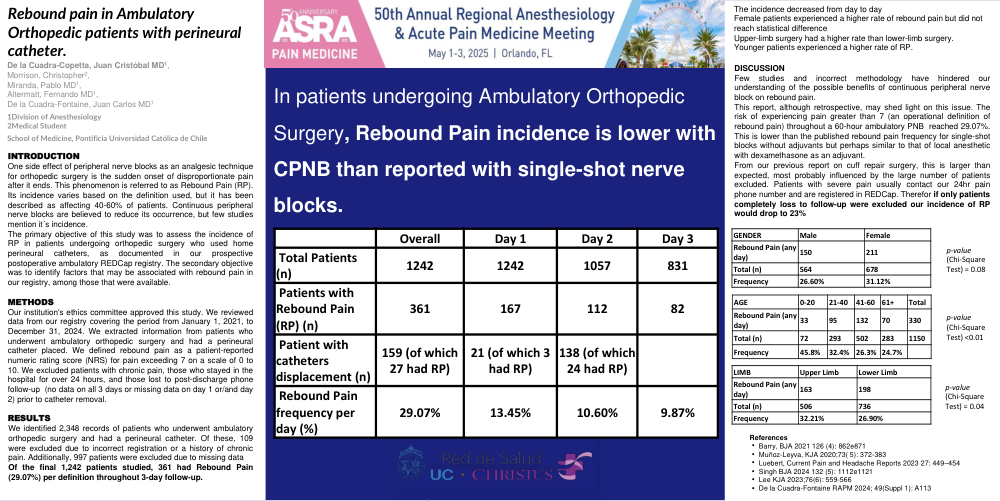
We identified 2,348 records of patients who underwent ambulatory orthopedic surgery and had a perineural catheter. Of these, 109 were excluded due to incorrect registration or a history of chronic pain. Additionally, 997 patients were excluded due to missing data
Of the final 1,242 patients studied, 361 had Rebound Pain (29.07%) per definition throughout 3-day follow-up.
The incidence decreased from day to dayFemale patients experienced a higher rate of rebound pain but did not reach statistical differenceUpper-limb surgery had a higher rate than lower-limb surgery.Younger patients experienced a higher rate of RP.
DISCUSSION
Few studies and incorrect methodology have hindered our understanding of the possible benefits of continuous peripheral nerve block on rebound pain.
This report, although retrospective, may shed light on this issue. The risk of experiencing pain greater than 7 (an operational definition of rebound pain) throughout a 60-hour ambulatory PNB reached 29.07%. This is lower than the published rebound pain frequency for single-shot blocks without adjuvants but perhaps similar to that of local anesthetic with dexamethasone as an adjuvant.
From our previous report on cuff repair surgery, this is larger than expected, most probably influenced by the large number of patients excluded. Patients with severe pain usually contact our 24hr pain phone number and are registered in REDCap. Therefor if only patients completely loss to follow-up were excluded our incidence of RP would drop to 23%
References