383 posters, 2 videos, 1 audios, 8 topics, 28 sessions, 328 authors, 225 institutions
ePostersLive by SciGen Technologies S.A. All rights reserved.
50th Annual Regional Anesthesiology and Acute Pain Medicine Meeting
May 1 - 3, 2025 | Orlando, Florida

6844
TRANSVERSUS ABDOMINIS PLANE BLOCK IN PATIENTS UNDERGOING AUTOLOGOUS BREAST RECONSTRUCTION: A RETROSPECTIVE COHORT STUDY
Poster Presenter
Part of Topic
Scientific Abstracts > Regional Anesthesia
Introduction
Autologous breast reconstruction, particularly utilizing the deep inferior epigastric artery perforator (DIEP) flap technique, is associated with prolonged hospital stays, diverse pain management strategies, and higher initial costs compared to implant-based procedures (1).
Postoperative pain management in these patients is inherently complex due to the involvement of multiple surgical sites. Although transversus abdominis plane (TAP) blocks do not directly address pain at the breast reconstruction site, they are pivotal in managing donor site pain.
As a key component of Enhanced Recovery After Surgery (ERAS) protocols, TAP blocks have demonstrated efficacy in reducing perioperative pain in abdominally based autologous breast reconstruction. This approach has been associated with decreased opioid consumption, shorter hospital stays, and reduced overall costs (2).
The purpose of this retrospective study is to evaluate the efficacy of TAP blocks in minimizing postoperative pain in patients undergoing DIEP flap reconstruction.
Material Method
This retrospective study evaluated patients who underwent autologous breast reconstruction surgery with or without preoperative TAP block between 2013 and 2023. Following Institutional Review Board (IRB) approval, all eligible patients who underwent autologous breast
reconstruction using free flaps were included. Patients were categorized into three groups based on whether they received a TAP block, local anesthetic (LA) infiltration by the surgeon, or neither.
The primary objective was to compare total opioid consumption within the first 24 hours following surgery. Data on intraoperative and postoperative opioid administration were collected and standardized as oral morphine milligram equivalents (MME). Secondary outcomes included the frequency of postoperative nausea and vomiting (PONV), the use of rescue medications for PONV, and the length of hospital stay (LOS).
Results
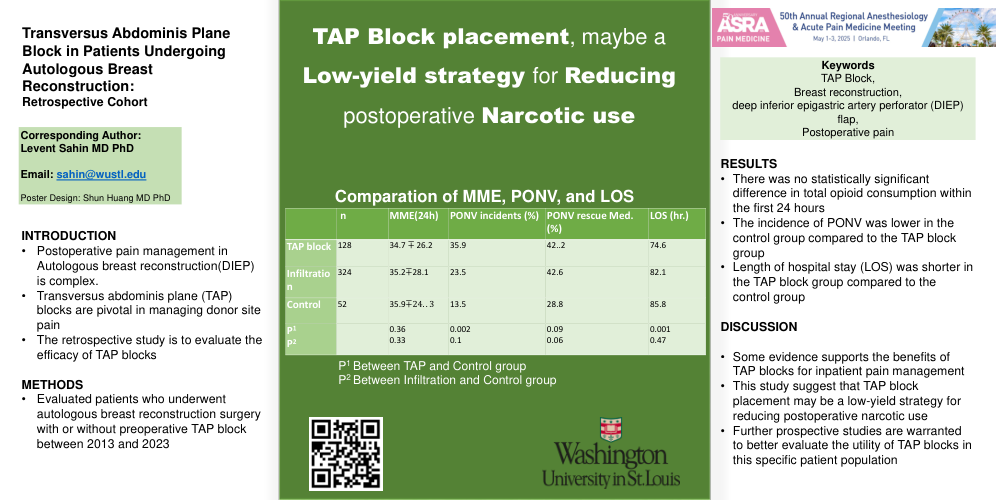
A total of 504 patients were included in the study. Among them, 128 patients received a TAP block, 324 patients had LA infiltration, and 52 patients did not receive either intervention. Regarding the primary outcome, there was no statistically significant difference in total opioid consumption within the first 24 hours among the three groups (Table 1). The incidence of postoperative nausea and vomiting (PONV) was lower in the control group compared to the TAP block group; however, there was no significant difference among the groups in terms of the need for rescue PONV medication. Length of hospital stay (LOS) was shorter in the TAP block group compared to the control group.
Discussion
In this retrospective study of patients undergoing autologous breast reconstruction with abdominally based flaps, TAP blocks did not significantly reduce perioperative MME per day, but reduced the LOS when we compare the control group.
A systematic review by Abdou et al (3). of single-center studies on patients undergoing abdominally based microsurgical breast reconstruction demonstrated a statistically significant reduction in total opioid consumption with the use of TAP blocks in the inpatient setting. However, other studies, such as those by Arhana (4) and Hunter (5), have reported no significant reduction in opioid use.
While some evidence supports the benefits of TAP blocks for inpatient pain management, the findings of this study suggest that TAP block placement may be a low-yield strategy for reducing postoperative narcotic use. Further prospective studies are warranted to better evaluate the utility of TAP blocks in this specific patient population.