383 posters, 2 videos, 1 audios, 8 topics, 28 sessions, 328 authors, 225 institutions
ePostersLive by SciGen Technologies S.A. All rights reserved.
50th Annual Regional Anesthesiology and Acute Pain Medicine Meeting
May 1 - 3, 2025 | Orlando, Florida

6828
CHANGES IN NERVE BLOCK PROCEDURAL VOLUME ASSOCIATED WITH THE IMPLEMENTATION OF A REGIONAL ANESTHESIA CONSULT SERVICE
Poster Presenter
Authors
Affiliations
Part of Topic
Scientific Abstracts > Regional Anesthesia
Changes in Nerve Block Procedural Volume Associated with the Implementation of a Regional Anesthesia Consult Service
Alexander Loji MD, Ruba Sajdeya MD, PhD, Matthew Fuller MS, Becky Schroeder MD, Miriam Treggiari MD, PhD, Austin Traylor MS, Lisa M. Einhorn MD
INTRODUCTION
-Benefits of regional anesthesia (RA): less postoperative opioid requirements, faster recovery time, lower post-operative pain scores, and improved patient satisfaction.1
-RA has continued to expand over the last two decades.2
-Many patient-, provider-, and system-level barriers remain
-To mitigate these constraints, our institution implemented a regional anesthesia consult service (RACS) to allow for broader access
-Study Purpose: retrospectively review the impact of this service on institutional RA procedural volume over time.
METHODS
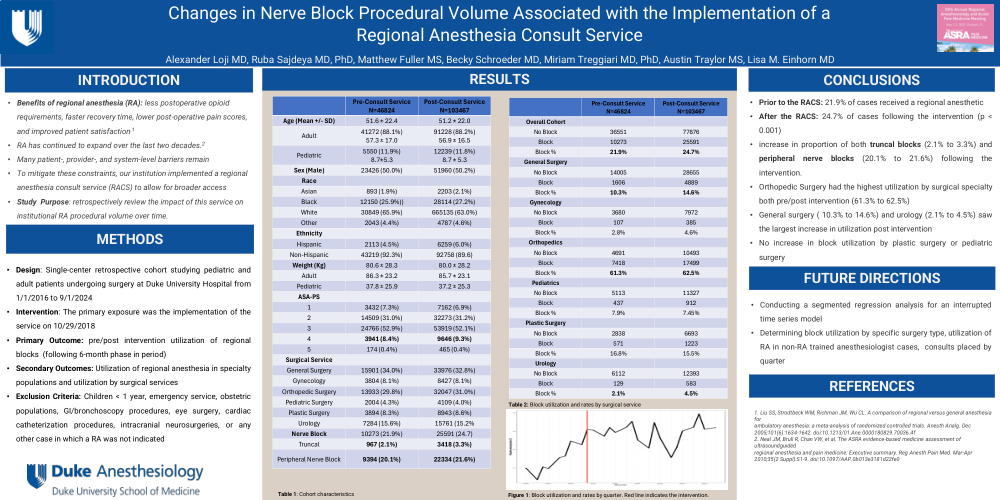
-Design: Single-center retrospective cohort studying pediatric and adult patients undergoing surgery at Duke University Hospital from 1/1/2016 to 9/1/2024
-Intervention: The primary exposure was the implementation of the service on 10/29/2018
-Primary Outcome: pre/post intervention utilization of regional blocks (following 6-month phase in period)
-Secondary Outcomes: Utilization of regional anesthesia in specialty populations and utilization by surgical services
-Exclusion Criteria: Children < 1 year, emergency service, obstetric populations, GI/bronchoscopy procedures, eye surgery, cardiac catheterization procedures, intracranial neurosurgeries, or any other case in which a RA was not indicated
CONCLUSIONS
-Prior to the RACS: 21.9% of cases received a regional anesthetic
-After the RACS: 24.7% of cases following the intervention (p < 0.001)
-increase in proportion of both truncal blocks (2.1% to 3.3%) and peripheral nerve blocks (20.1% to 21.6%) following the intervention.
-Orthopedic Surgery had the highest utilization by surgical specialty both pre/post intervention (61.3% to 62.5%)
-General surgery ( 10.3% to 14.6%) and urology (2.1% to 4.5%) saw the largest increase in utilization post intervention
-No increase in block utilization by plastic surgery or pediatric surgery
FUTURE DIRECTIONS
-Conducting a segmented regression analysis for an interrupted time series model
-Determining block utilization by specific surgery type, utilization of RA in non-RA trained anesthesiologist cases, consults placed by quarter