383 posters, 2 videos, 1 audios, 8 topics, 28 sessions, 328 authors, 225 institutions
ePostersLive by SciGen Technologies S.A. All rights reserved.
50th Annual Regional Anesthesiology and Acute Pain Medicine Meeting
May 1 - 3, 2025 | Orlando, Florida

6667
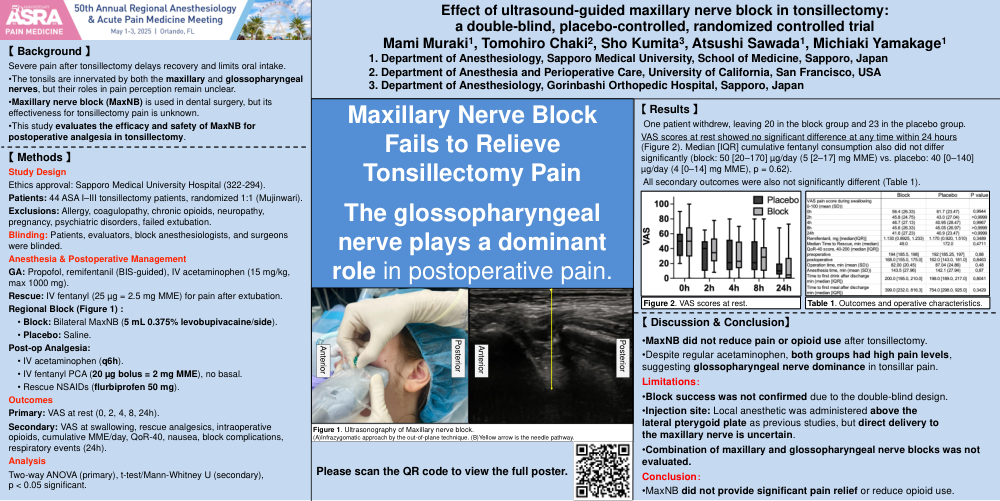
EFFECT OF ULTRASOUND-GUIDED MAXILLARY NERVE BLOCK IN TONSILLECTOMY: A DOUBLE-BLIND, PLACEBO-CONTROLLED, RANDOMIZED TRIAL
Poster Presenter
Part of Topic
Scientific Abstracts > Regional Anesthesia
Background
- Severe pain after tonsillectomy delays recovery and limits oral intake.
- The tonsils are innervated by both the maxillary and glossopharyngeal nerves, but their roles in pain perception remain unclear.
- Maxillary nerve block (MaxNB) is commonly used in dental surgery, but its effectiveness for tonsillectomy pain is unknown.
- This study evaluates the efficacy and safety of MaxNB for postoperative analgesia in tonsillectomy.
Methods
Study Design
- Ethics approval: Sapporo Medical University Hospital (322-294).
- Patients: 44 ASA I–III tonsillectomy patients, randomized 1:1 (Mujinwari).
- Exclusions: Allergy, coagulopathy, chronic opioid use, neuropathy, pregnancy, psychiatric disorders, failed extubation.
Blinding
- Patients, evaluators, block anesthesiologists, and surgeons were blinded.
Anesthesia & Postoperative Management
- General Anesthesia (GA): Propofol, remifentanil (BIS-guided), IV acetaminophen (15 mg/kg, max 1000 mg).
- Rescue Analgesia: IV fentanyl (25 µg = 2.5 mg MME) for pain after extubation.
Regional Block
- Intervention Group: Bilateral MaxNB (5 mL 0.375% levobupivacaine per side).
- Placebo Group: Saline injection.
Postoperative Analgesia
- IV acetaminophen (q6h).
- IV fentanyl PCA (20 µg bolus = 2 mg MME, no basal infusion).
- Rescue NSAIDs (flurbiprofen 50 mg).
Outcomes
- Primary Outcome: VAS at rest (0, 2, 4, 8, 24h).
- Secondary Outcomes:
- VAS at swallowing, rescue analgesic use, intraoperative opioid consumption.
- Cumulative MME/day, QoR-40 score.
- Nausea, block-related complications, respiratory events (24h).
Analysis
- Primary Analysis: Two-way ANOVA.
- Secondary Analysis: t-test / Mann-Whitney U.
- Significance: p < 0.05.
Results
- One patient withdrew, leaving 20 patients in the block group and 23 in the placebo group.
- VAS scores at rest showed no significant difference at any time within 24 hours.
- Median [IQR] cumulative fentanyl consumption also did not differ significantly
- Block: 50 [20–170] µg/day (5 [2–17] mg MME)
- Placebo: 40 [0–140] µg/day (4 [0–14] mg MME)
- p = 0.62
- All secondary outcomes were also not significantly different.
Discussion & Conclusion
- MaxNB did not reduce pain or opioid use after tonsillectomy.
- Despite regular acetaminophen, both groups had high pain levels, suggesting glossopharyngeal nerve dominance in tonsillar pain.
Limitations
- Block success was not confirmed due to the double-blind design.
- Injection site: Local anesthetic was administered above the lateral pterygoid plate, but direct delivery to the maxillary nerve is uncertain.
- Combination of maxillary and glossopharyngeal nerve blocks was not evaluated.
Conclusion
- MaxNB did not provide significant pain relief or reduce opioid use.