383 posters, 2 videos, 1 audios, 8 topics, 28 sessions, 328 authors, 225 institutions
ePostersLive by SciGen Technologies S.A. All rights reserved.
50th Annual Regional Anesthesiology and Acute Pain Medicine Meeting
May 1 - 3, 2025 | Orlando, Florida

6575
EFFECT OF ERECTOR SPINAE PLANE BLOCK ON PACU OPIOID CONSUMPTION IN LAPAROSCOPIC SLEEVE GASTRECTOMY
Poster Presenter
Authors
Affiliations
Part of Topic
Scientific Abstracts > Regional Anesthesia
Effect of Erector Spinae Plane Block on PACU Opioid Consumption in Laparoscopic Sleeve Gastrectomy
Introduction
•Laparoscopic sleeve gastrectomy (LSG) is a bariatric surgery approved for weight-reduction in diabetic patients with a body-mass index (BMI) greater than 35. Most of these patients require opioid-based pain control but postoperative opioid analgesia poses multiple risks to obese patients including pulmonary complications and increased pain scores.1 Minimizing opioid use in patients with obesity may reduce likelihood of adverse respiratory effects.
•Ultrasound-guided erector spinae plane block (ESPB) is a relatively novel anesthetic technique that is widely used in preoperative settings. It’s feasibility and reported overall improvement in intraoperative opioid consumption and postoperative pain has led to its growing popularity.2
•Recent studies have reported conflicting findings regarding the efficacy of ESPB. While some suggest that ESPB enhances postoperative analgesic efficacy,3,4 others indicate that it may not provide additional benefits in laparoscopic sleeve gastrectomy surgery.5
Objective
•To investigate the potential benefits of ESPB in facilitating multimodal analgesia for patients undergoing laparoscopic sleeve gastrectomy.
•Primary Aim: PACU opioid consumption (morphine equivalents)
•Secondary Aim: Intraoperative opioid consumption, presence of PONV, total operative time, pain score in recovery, and length of stay
Methods
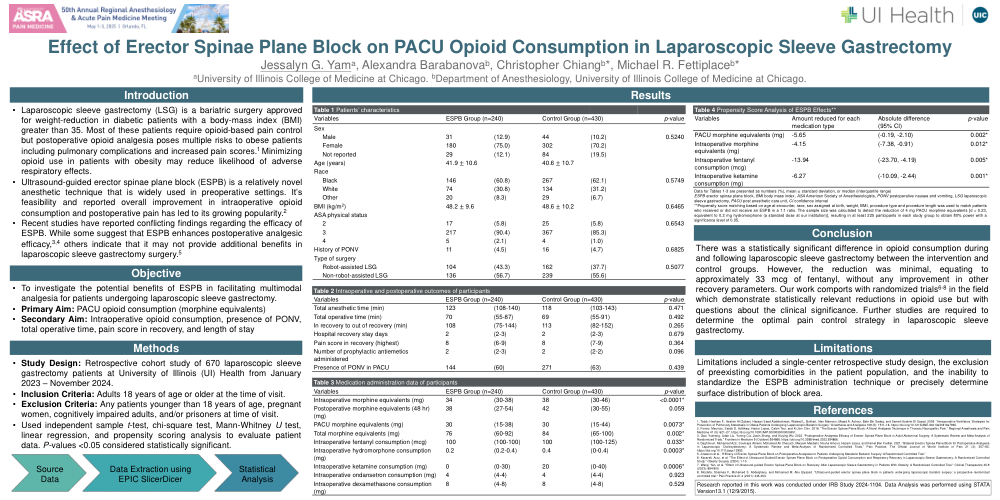
•Study Design: Retrospective cohort study of 670 laparoscopic sleeve gastrectomy patients at University of Illinois (UI) Health from January 2023 – November 2024.
•Inclusion Criteria: Adults 18 years of age or older at the time of visit.
•Exclusion Criteria: Any patients younger than 18 years of age, pregnant women, cognitively impaired adults, and/or prisoners at time of visit.
•Used independent sample t-test, chi-square test, Mann-Whitney U test, linear regression, and propensity scoring analysis to evaluate patient data. P-values <0.05 considered statistically significant.
Conclusion
There was a statistically significant difference in opioid consumption during and following laparoscopic sleeve gastrectomy between the intervention and control groups. However, the reduction was minimal, equating to approximately 33 mcg of fentanyl, without any improvement in other recovery parameters. Our work comports with randomized trials6-8 in the field which demonstrate statistically relevant reductions in opioid use but with questions about the clinical significance. Further studies are required to determine the optimal pain control strategy in laparoscopic sleeve gastrectomy.