383 posters, 2 videos, 1 audios, 8 topics, 28 sessions, 328 authors, 225 institutions
ePostersLive by SciGen Technologies S.A. All rights reserved.
50th Annual Regional Anesthesiology and Acute Pain Medicine Meeting
May 1 - 3, 2025 | Orlando, Florida

6557
A HIP OUTLOOK ON NEURAXIAL: A CASE REPORT EXAMINING A TOTAL HIP ARTHROPLASTY PERFORMED UNDER CONTINUOUS SPINAL ANESTHESIA
Poster Presenter
Authors
Affiliations
Part of Topic
Scientific Abstracts > Regional Anesthesia
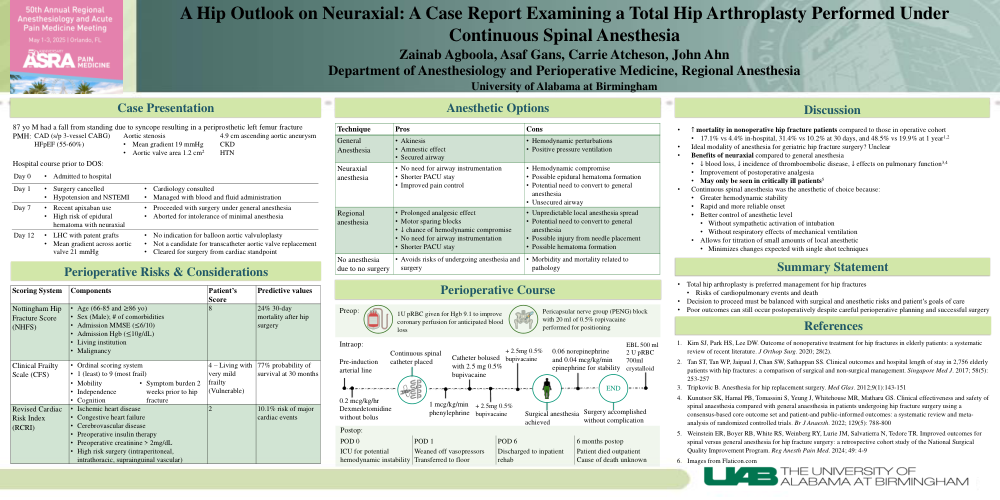
A Hip Outlook on Neuraxial: A Case Report Examining a Total Hip Arthroplasty Performed Under Continuous Spinal Anesthesia
Zainab Agboola, Asaf Gans, Carrie Atcheson, John Ahn
Department of Anesthesiology and Perioperative Medicine, Regional Anesthesia
University of Alabama at Birmingham
Case Presentation
87 yo M had a fall from standing due to syncope resulting in a periprosthetic left femur fracture
PMH: CAD (s/p 3-vessel CABG, HFpEF (55-60%), Aortic stenosis (mean gradient 19 mmHg, aortic valve area 1.2cm2), 4.9 cm ascending aortic aneurysm, CKD, HTN
Hospital course prior to DOS:
Day 0: Admitted to hospital
Day 1: Surgery cancelled; hypotension and NSTEMI; Cardiology consulted; Managed with blood and fluid administration
Day 7: Recent apixaban use; high risk of epidural hematoma with neuraxial; proceeded with surgery under general anesthesia; aborted for intolerance of minimal anesthesia
Day 12: LHC with patent grafts; Mean gradient across aortic valve 21 mmHg; No indication for balloon aortic valvuloplasty; Not a candidate for transcatheter aortic valve replacement; Cleared for surgery from cardiac standpoint
Perioperative Risks and Considerations
Anesthestic Options
Perioperative Course
Discussion
Higher mortality in nonoperative hip fracture patients compared to those in operative cohort
17.1% vs 4.4% in-hospital, 31.4% vs 10.2% at 30 days, and 48.5% vs 19.9% at 1 year1,2
Ideal modality of anesthesia for geriatric hip fracture surgery? Unclear
Benefits of neuraxial compared to general anesthesia
↓ blood loss, ↓ incidence of thromboembolic disease, ↓ effects on pulmonary function3,4
Improvement of postoperative analgesia
May only be seen in critically ill patients5
Continuous spinal anesthesia was the anesthetic of choice because:
Greater hemodynamic stability
Rapid and more reliable onset
Better control of anesthetic level
Without sympathetic activation of intubation
Without respiratory effects of mechanical ventilation
Allows for titration of small amounts of local anesthetic
Minimizes changes expected with single shot techniques
Summary Statement
Total hip arthroplasty is preferred management for hip fractures
Risks of cardiopulmonary events and death
Decision to proceed must be balanced with surgical and anesthetic risks and patient's goals of care
Poor outcomes can still occur postoperatively despite careful perioperative planning and successful surgery
References