383 posters, 2 videos, 1 audios, 8 topics, 28 sessions, 328 authors, 225 institutions
ePostersLive by SciGen Technologies S.A. All rights reserved.
50th Annual Regional Anesthesiology and Acute Pain Medicine Meeting
May 1 - 3, 2025 | Orlando, Florida

6539
PEDIATRIC ORTHOPEDIC SURGICAL PATIENTS REQUIRING PERIOPERATIVE CONSULTATIONS WITH THE COMPLEX PAIN SERVICE: A REGISTRY STUDY
Poster Presenter
Authors
Affiliations
Part of Topic
Scientific Abstracts > Acute Pain
Title: Pediatric Orthopedic Surgical Patients Requiring Perioperative Consultations with the Complex Pain Service: A Registry Study
Author List: Rim F, Colamarino A, Chan W, Kelly M, Kim D, Langford D, Schuessler S, Terry J, Fritz P, Poeran J, Memtsoudis S, Liu J, Waldman S, DelPizzo K, Liu S, Sideris A
Background
The Perioperative Pain Service (POPS) at Hospital for Special Surgery (HSS) specializes in providing personalized pain management plans to patients undergoing orthopedic surgery. The Complex/Chronic Pain Service (CPS) arm of POPS optimizes patients who are chronic opioid users, have a history of substance use disorders, have a history of uncontrolled pain, and/or patients who have an implanted device to help manage their chronic pain condition.[1] While POPS provisions care primarily to adult surgical patients, they also provide support to younger patients. Proper care and treatment of pediatric surgical patients, particularly those with complex pain needs, is paramount given the unique developmental and psychosocial factors that contribute to their lived pain experience and recovery.[2-4] The purpose of this study was to identify and characterize the pediatric patient population requiring a CPS consult and describe their perioperative pain management plans.
Methods
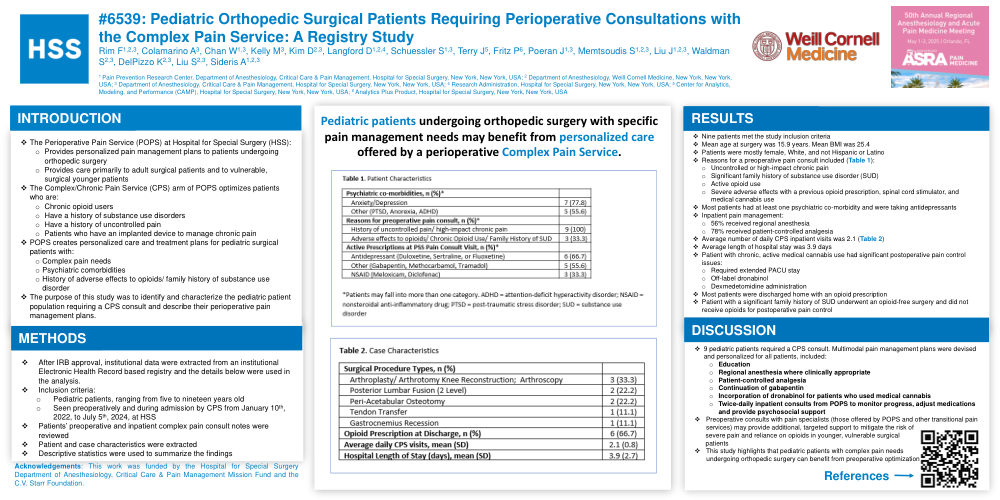
After IRB approval, pediatric patients, ranging from five to nineteen years old, seen preoperatively and during admission by CPS from January 10th, 2022, to July 5th, 2024, at HSS were extracted from an institutional Electronic Health Record-based registry. Patients’ preoperative and inpatient complex pain consult notes were reviewed. Patient and case characteristics were extracted. Descriptive statistics were used to summarize the findings.
Results
Nine patients met the study inclusion criteria. The mean age at surgery was 15.9 years, and mean BMI was 25.4 (table 1). Patients were mostly female, White, and not Hispanic or Latino. Reasons for a preoperative pain consult included uncontrolled or high-impact chronic pain, significant family history of substance use disorder (SUD), active opioid use, severe adverse effects with a previous opioid prescription, spinal cord stimulator, and medical cannabis use. Most patients had at least one psychiatric co-morbidity and were taking antidepressants. Regarding inpatient pain management, 56% received regional anesthesia and 78% received patient-controlled analgesia. The average number of daily CPS inpatient visits was 2.1, and the average length of hospital stay was 3.9 days. The patient with chronic, active medical cannabis use had significant postoperative pain control issues, required an extended PACU stay with dexmedetomidine administration, and was started on off-label dronabinol. Most patients were discharged home with an opioid prescription. The patient with a significant family history of SUD underwent an opioid-free surgery and did not receive opioids for postoperative pain control.
Conclusions & Discussion
In this retrospective study, 9 pediatric patients required a CPS consult. Multimodal pain management plans were devised and personalized for all patients and included education, regional anesthesia where clinically appropriate, patient-controlled analgesia, continuation of gabapentin, incorporation of dronabinol for patients who used medical cannabis, and twice-daily inpatient consults from POPS to monitor progress, adjust medications and provide psychosocial support. While Child Life services are available and important components of hospital-based care, preoperative consults with pain specialists, such as those offered by POPS and other transitional pain services,[5] may provide additional, targeted support to mitigate the risk of severe pain and reliance on opioids in younger, vulnerable surgical patients. This study highlights that pediatric patients with complex pain needs undergoing orthopedic surgery can benefit from preoperative optimization.
References
- Rim F, Liu SS, Kelly M, Kim D, Sideris A, Langford DJ. Preoperative pain screening and optimisation by a perioperative pain service to support complex surgical patients: no patient left behind. Br J Anaesth. 2024 Feb;132(2):437-439.
- Rabbitts JA, Fisher E, Rosenbloom BN, Palermo TM. Prevalence and Predictors of Chronic Postsurgical Pain in Children: A Systematic Review and Meta-Analysis. J Pain. 2017 Jun;18(6):605-614.
- Birnie KA, Chorney J, El-Hawary R; PORSCHE Study Group. Child and parent pain catastrophizing and pain from presurgery to 6 weeks postsurgery: examination of cross-sectional and longitudinal actor-partner effects. Pain. 2017 Oct;158(10):1886-1892.
- Ellyson AM, Gordon G, Zhou C, Rabbitts JA. Trajectories, Risk Factors, and Impact of Persistent Pain After Major Musculoskeletal Surgery in Adolescents: A Replication Study. J Pain. 2022 Jun;23(6):995-1005.
- Isaac L, Rosenbloom BN, Tyrrell J, Ruskin DA, Birnie KA. Development and expansion of a pediatric transitional pain service to prevent complex chronic pain. Front Pain Res (Lausanne). 2023 Nov 2;4:1173675.