383 posters, 2 videos, 1 audios, 8 topics, 28 sessions, 328 authors, 225 institutions
ePostersLive by SciGen Technologies S.A. All rights reserved.
50th Annual Regional Anesthesiology and Acute Pain Medicine Meeting
May 1 - 3, 2025 | Orlando, Florida

6379
EFFORTS TO IMPROVE PERIOPERATIVE PAIN MANAGEMENT IN TOTAL SHOULDER ARTHROPLASTY: MINIMIZING OPIOIDS IN A COHORT OF 377 PATIENTS
Poster Presenter
Authors
Affiliations
Part of Topic
Scientific Abstracts > Acute Pain
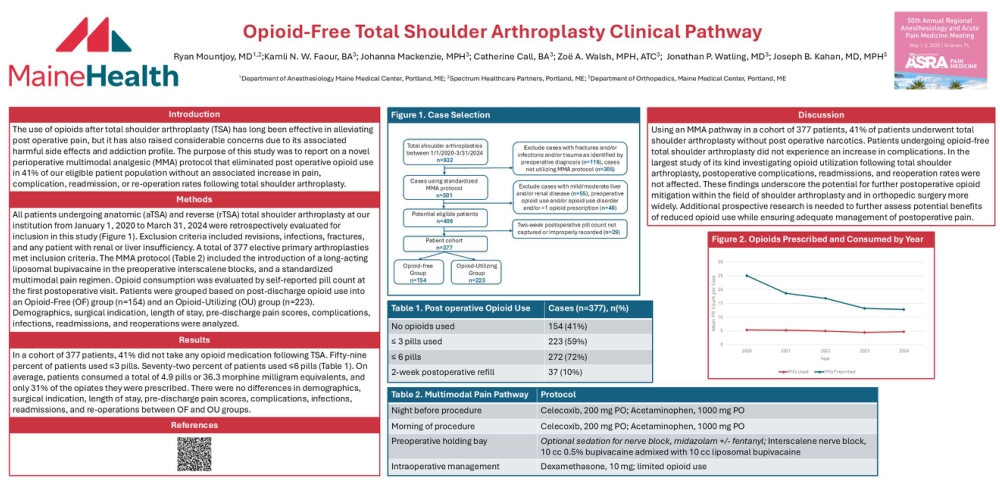
The use of opioids after total shoulder arthroplasty (TSA) has long been effective in alleviating post operative pain, but it has also raised considerable concerns due to its associated harmful side effects and addiction profile. The purpose of this study was to report on a novel perioperative multimodal analgesic (MMA) protocol that eliminated post operative opioid use in 41% of our eligible patient population without an associated increase in pain, complication, readmission, or re-operation rates following total shoulder arthroplasty.
All patients undergoing anatomic (aTSA) and reverse (rTSA) total shoulder arthroplasty at our institution from January 1, 2020 to March 31, 2024 were retrospectively evaluated for inclusion in this study (Figure 1). Exclusion criteria included revisions, infections, fractures, and any patient with renal or liver insufficiency. A total of 377 elective primary arthroplasties met inclusion criteria. The MMA protocol (Table 2) included the introduction of a long-acting liposomal bupivacaine in the preoperative interscalene blocks, and a standardized multimodal pain regimen. Opioid consumption was evaluated by self-reported pill count at the first postoperative visit. Patients were grouped based on post-discharge opioid use into an Opioid-Free (OF) group (n=154) and an Opioid-Utilizing (OU) group (n=223). Demographics, surgical indication, length of stay, pre-discharge pain scores, complications, infections, readmissions, and reoperations were analyzed.
In a cohort of 377 patients, 41% did not take any opioid medication following TSA. Fifty-nine percent of patients used ≤3 pills. Seventy-two percent of patients used ≤6 pills (Table 1). On average, patients consumed a total of 4.9 pills or 36.3 morphine milligram equivalents, and only 31% of the opiates they were prescribed. There were no differences in demographics, surgical indication, length of stay, pre-discharge pain scores, complications, infections, readmissions, and re-operations between OF and OU groups.
Using an MMA pathway in a cohort of 377 patients, 41% of patients underwent total shoulder arthroplasty without post operative narcotics. Patients undergoing opioid-free total shoulder arthroplasty did not experience an increase in complications. In the largest study of its kind investigating opioid utilization following total shoulder arthroplasty, postoperative complications, readmissions, and reoperation rates were not affected. These findings underscore the potential for further postoperative opioid mitigation within the field of shoulder arthroplasty and in orthopedic surgery more widely. Additional prospective research is needed to further assess potential benefits of reduced opioid use while ensuring adequate management of postoperative pain.