383 posters, 2 videos, 1 audios, 8 topics, 28 sessions, 328 authors, 225 institutions
ePostersLive by SciGen Technologies S.A. All rights reserved.
50th Annual Regional Anesthesiology and Acute Pain Medicine Meeting
May 1 - 3, 2025 | Orlando, Florida

6729
PERSISTENT POST-SURGICAL PAIN FOLLOWING OUTPATIENT TOTAL JOINT REPLACEMENT SURGERY: A RETROSPECTIVE STUDY
Poster Presenter
Authors
Affiliations
Part of Topic
Scientific Abstracts > Regional Anesthesia
Persistent Post-Surgical Pain Following Outpatient Total Joint Replacement Surgery: A Retrospective Study
Authors: Tanuj Mahendru, BS, Alice Yu, BS, Katrina Brakoniecki, MD, Daniel Witmer, MD, Sanjay Sinha, MD
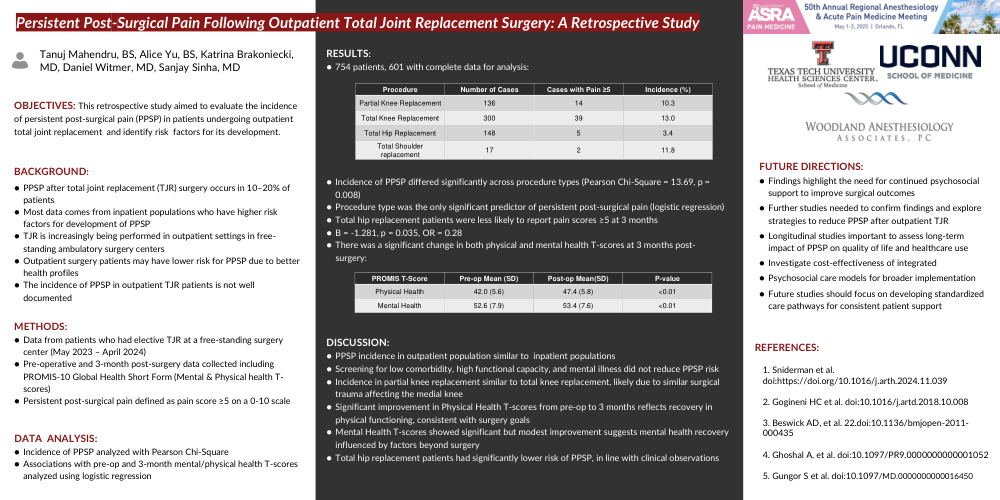
OBJECTIVES: This retrospective study aimed to evaluate the incidence of persistent post-surgical pain (PPSP) in patients undergoing outpatient total joint replacement and identify risk factors for its development
BACKGROUND:
● PPSP after total joint replacement (TJR) surgery occurs in 10–20% of patients
● Most data comes from inpatient populations who have higher risk factors for development of PPSP
● TJR is increasingly being performed in outpatient settings in free- standing ambulatory surgery centers
● Outpatient surgery patients may have lower risk for PPSP due to better health profiles
● The incidence of PPSP in outpatient TJR patients is not well documented
METHODS:
● Data from patients who had elective TJR at a free-standing surgery center (May 2023 – April 2024)
● Pre-operative and 3-month post-surgery data collected including PROMIS-10 Global Health Short Form (Mental & Physical health T-
scores)
● Persistent post-surgical pain defined as pain score ≥5 on a 0-10 scale
DATA ANALYSIS:
● Incidence of PPSP analyzed with Pearson Chi-Square
● Associations with pre-op and 3-month mental/physical health T-scores analyzed using logistic regression
RESULTS:
● Incidence of PPSP differed significantly across procedure types (Pearson Chi-Square = 13.69, p = 0.008)
● Total hip replacement patients were less likely to report pain scores ≥5 at 3 months (B = -1.281, p = 0.035, OR = 0.28)
DISCUSSION:
FUTURE DIRECTIONS:
● Findings highlight the need for continued psychosocial support to improve surgical outcomes
● Further studies needed to confirm findings and explore strategies to reduce PPSP after outpatient TJR
● Longitudinal studies important to assess long-term impact of PPSP on quality of life and healthcare use
● Investigate cost-effectiveness of integrated
● Psychosocial care models for broader implementation
● Future studies should focus on developing standardized care pathways for consistent patient support