383 posters, 2 videos, 1 audios, 8 topics, 28 sessions, 328 authors, 225 institutions
ePostersLive by SciGen Technologies S.A. All rights reserved.
50th Annual Regional Anesthesiology and Acute Pain Medicine Meeting
May 1 - 3, 2025 | Orlando, Florida

6724
COMPARISON OF POSTERIOR AND ANTERIOR QUADRATUS LUMBORUM BLOCK IN INGUINAL HERNIA REPAIR: A SYSTEMATIC REVIEW AND META ANALYSIS
Poster Presenter
Authors
Affiliations
Sγo Luiz Hospital – ITAIM / Rede D’Or – CMA Anesthesia group
Part of Topic
Scientific Abstracts > Regional Anesthesia
Comparison of Posterior and Anterior Quadratus Lumborum Block in Inguinal Hernia Repair: A Systematic Review and Meta Analysis
Introduction: Quadratus lumborum block (QLB) is a widely used block in inguinal hernia repair procedures. However, the superiority of the anterior (QLB 3) or posterior (QLB 2) approach remains unclear.
Objectives: The purpose of this study was to compare the efficacy of QLB 2 and QLB 3 in postoperative analgesia and pain recovery in patients undergoing inguinal hernia repair.
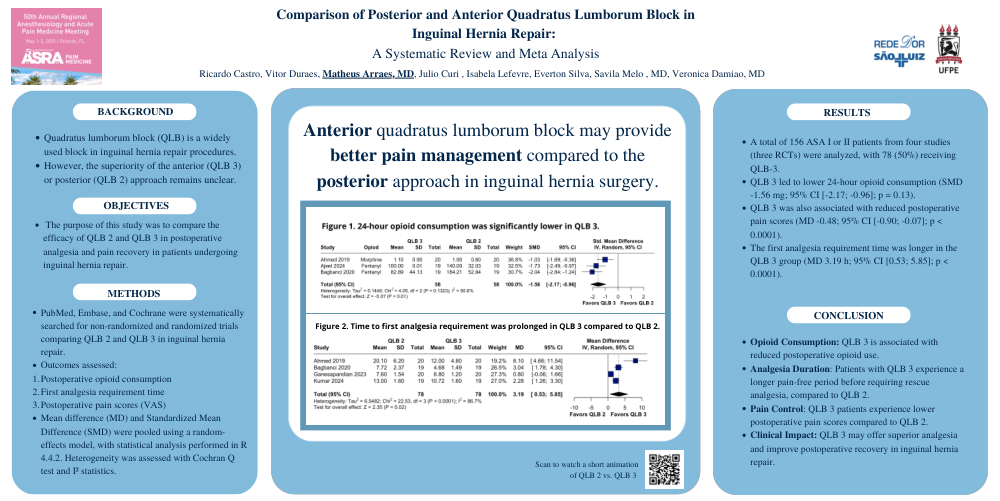
Methods: We systematically searched PubMed, Embase, and Cochrane databases for non-randomized and randomized controlled trials that compared QLB 2 and QLB 3 in patients undergoing inguinal hernia repair and reported the outcomes of (1) postoperative opioid consumption; (2) first analgesia requirement time; (3) postoperative pain scores, using the visual analog scale. We pooled Mean difference (MD) and Standardized mean difference (SMD) for these outcomes. Random-effects model was used and all statistical analyses were performed using R version 4.4.2. Heterogeneity was examined with Cochran Q test and I2 statistics.
Results: We included 4 studies, of which 3 were randomized clinical trials (RCTs). A total of 156 patients, of whom 78 (50%) received an anterior block (QLB-3) were analysed. All patients were classified as I or II according to the American Society of Anesthesiologists (ASA) physical status score. Overall, QLB 3 was associated with a lower 24 hour opioid consumption (SMD -1.56 mg; 95% CI [-2.17; -0.96]; p = 0.13) and postoperative pain score (MD -0.48; 95% CI [-0.90; -0.07]; p < 0.0001). Additionally, we found that the QLB 3 group had an increased first analgesia requirement time (MD 3.19 h; 95% CI [0.53; 5.85]; p < 0.0001).
Conclusion: In conclusion, QLB 3 is associated with reduced postoperative opioid consumption, prolonged time to first analgesia requirement, and lower postoperative pain scores compared to QLB 2 in patients undergoing inguinal hernia repair.