383 posters, 2 videos, 1 audios, 8 topics, 28 sessions, 328 authors, 225 institutions
ePostersLive by SciGen Technologies S.A. All rights reserved.
50th Annual Regional Anesthesiology and Acute Pain Medicine Meeting
May 1 - 3, 2025 | Orlando, Florida

6714
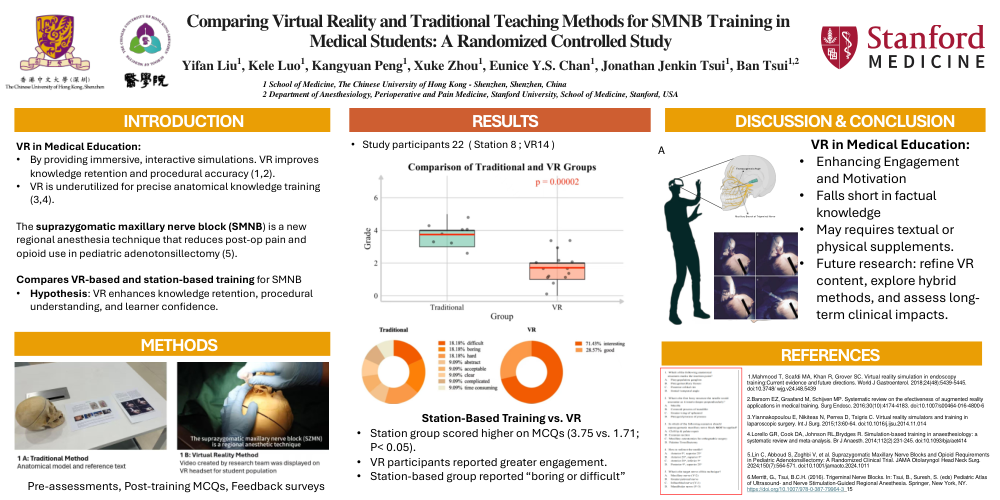
COMPARING VIRTUAL REALITY AND TRADITIONAL TEACHING METHODS FOR SMNB TRAINING IN MEDICAL STUDENTS: A RANDOMIZED CONTROLLED STUDY
Poster Presenter
Part of Topic
Scientific Abstracts > Regional Anesthesia
Comparing Virtual Reality and Traditional Teaching Methods for SMNB Training in Medical Students: A Randomized Controlled Study
Yifan Liu1, Kele Luo1, Kangyuan Peng1, Xuke Zhou1, Eunice Y.S. Chan1, Jonathan Jenkin Tsui1, Ban Tsui1,2
1 School of Medicine, The Chinese University of Hong Kong - Shenzhen, Shenzhen, China
2 Department of Anesthesiology, Perioperative and Pain Medicine, Stanford University, School of Medicine, Stanford, USA
VR in Medical Education:
The suprazygomatic maxillary nerve block (SMNB) is a new regional anesthesia technique that reduces post-op pain and opioid use in pediatric adenotonsillectomy (5).
Compares VR-based and station-based training for SMNB
Station-Based Training vs. VR
VR in Medical Education: