383 posters, 2 videos, 1 audios, 8 topics, 28 sessions, 328 authors, 225 institutions
ePostersLive by SciGen Technologies S.A. All rights reserved.
50th Annual Regional Anesthesiology and Acute Pain Medicine Meeting
May 1 - 3, 2025 | Orlando, Florida

6676
TIMING OF INTRAVENOUS DEXAMETHASONE TO PROLONG BRACHIAL PLEXUS BLOCK ANALGESIA: RANDOMIZED, DOUBLE-BLIND, PLACEBO-CONTROLLED TRIAL
Poster Presenter
Authors
Affiliations
Part of Topic
Scientific Abstracts > Regional Anesthesia
Timing of intravenous dexamethasone
for prolongation of analgesia after
brachial plexus block
A randomized, double-blind, placebo-controlled
trial
PRESENTER:
Ben Goodman
BACKGROUND
Intravenous dexamethasone is frequently used to prolong analgesia
after brachial plexus block following upper extremity surgery. However,
the optimal timing for its administration has not been previously
examined.
METHODS
1. Double-blind, randomized, placebo-controlled trial conducted at a
single tertiary academic health sciences center
2. Patients: 18-80 years old, ASA 1-3, BMI <35 kg/m2, undergoing
unilateral upper extremity surgery with a supraclavicular brachial
plexus block
3. Standardized supraclavicular block: intertruncal technique, 15ml
bupivacaine 0.5% with 1:200,000 epinephrine mixed with 15ml
lidocaine 2%
4. Intervention: Intravenous dexamethasone 8 mg administration
randomized 1:1:1:1 to:
• 1 hour before
• during
• 1 hour after
• 2 hours after the block
5. 6. Placebo (saline) was infused at the other time points to blind
patients, providers, investigators
Primary outcome: time from block to first postoperative pain (pain
diary)
RESULTS
• 414 patients were screened, 220 patients provided consent, 23
excluded. The remaining 197 patients were enrolled, randomized,
received the study intervention.
• However, 39 patients could not be reached for follow-up after hospital
discharge. 158 patients with full data sets were included for outcome
analysis.
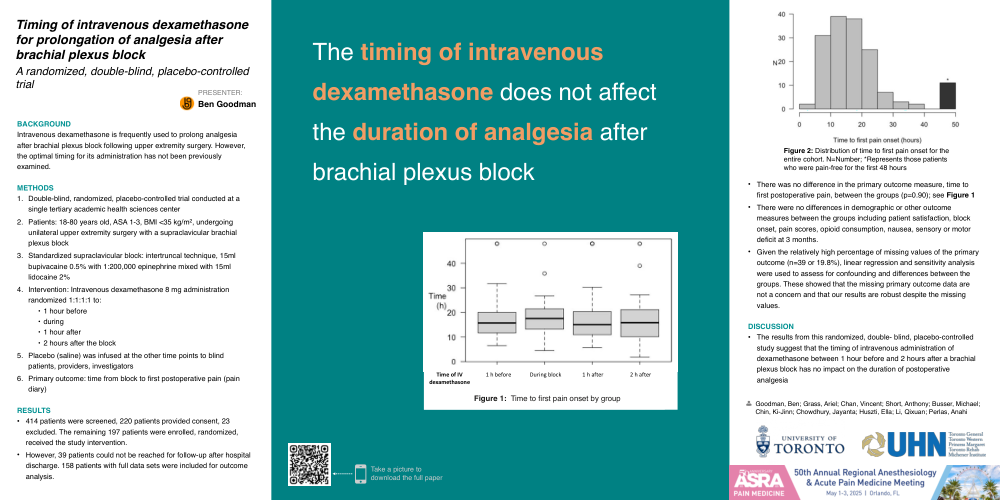
The timing of intravenous
dexamethasone does not affect
the duration of analgesia after
brachial plexus block
Time of IV
dexamethasone
1 h before During block 1 h after 2 h after
Figure 1: Time to first pain onset by group
Take a picture to
download the full paper
Figure 2: Distribution of time to first pain onset for the
entire cohort. N=Number; *Represents those patients
who were pain-free for the first 48 hours
• There was no difference in the primary outcome measure, time to
first postoperative pain, between the groups (p=0.90); see Figure 1
• There were no differences in demographic or other outcome
measures between the groups including patient satisfaction, block
onset, pain scores, opioid consumption, nausea, sensory or motor
deficit at 3 months.
Non-Cognitive Predictors of Student Success:
A Predictive Validity Comparison Between Domestic and International Students
• Given the relatively high percentage of missing values of the primary
outcome (n=39 or 19.8%), linear regression and sensitivity analysis
were used to assess for confounding and differences between the
groups. These showed that the missing primary outcome data are
not a concern and that our results are robust despite the missing
values.
DISCUSSION
• The results from this randomized, double- blind, placebo-controlled
study suggest that the timing of intravenous administration of
dexamethasone between 1 hour before and 2 hours after a brachial
plexus block has no impact on the duration of postoperative
analgesia