383 posters, 2 videos, 1 audios, 8 topics, 28 sessions, 328 authors, 225 institutions
ePostersLive by SciGen Technologies S.A. All rights reserved.
50th Annual Regional Anesthesiology and Acute Pain Medicine Meeting
May 1 - 3, 2025 | Orlando, Florida

6675
CLONIDINE AND DEXMEDETOMIDINE ENHANCING BUPIVACAINE IN SPINAL ANESTHESIA IN LOWER LIMB SURGERIES: SYSTEMATIC REVIEW, META-ANALYSIS
Poster Presenter
Authors
Affiliations
Part of Topic
Scientific Abstracts > Regional Anesthesia
Alpha-2 agonists are widely used to enhance local anesthetics in spinal anesthesia, yet the optimal agent for intra and postoperative outcomes remains unclear.
We conducted a meta-analysis comparing the effects of clonidine and dexmedetomidine added to bupivacaine in lower limb surgeries.
We searched PubMed, Embase and Cochrane Central for studies comparing clonidine to dexmedetomidine in patients undergoing lower limbs surgeries with spinal anaesthesia.
Outcomes searched: mean duration of motor block, mean duration sensory block, mean duration onset motor block, mean duration onset of sensory block, time to reach maximum sensory level, mean time to regression to S1 dermatome and mean time of rescue analgesia. Statistical analysis was performed using R 4.4.2.
Heterogeneity was assessed with I2 statistics, followed by sensitivity analysis. Risk of bias was assessed using the ROBS-2 tool. This meta-analysis utilized data from previously published studies, and as such, does not require Institutional Review Board approval.
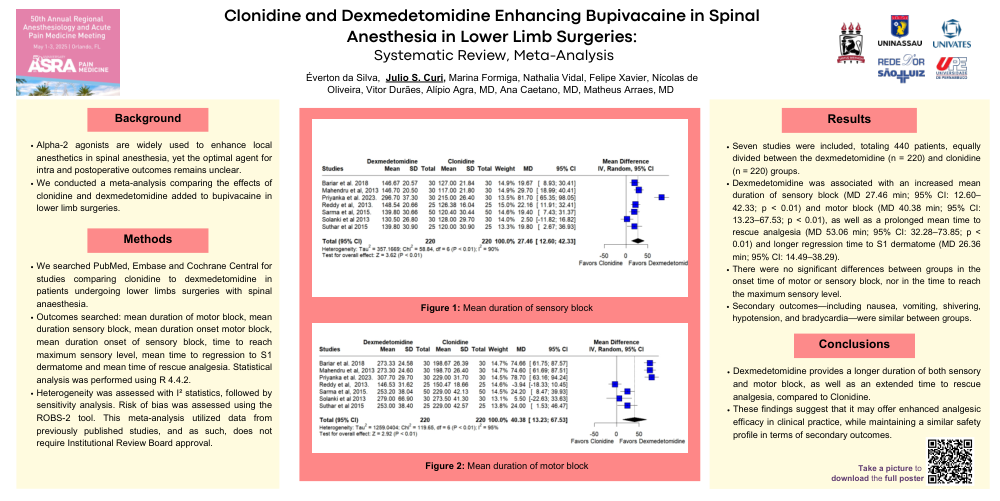
Seven studies were included, totaling 440 patients, equally divided between the dexmedetomidine (n = 220) and clonidine (n = 220) groups.
Dexmedetomidine was associated with an increased mean duration of sensory block (MD 27.46 min; 95% CI: 12.60– 42.33; p < 0.01) and motor block (MD 40.38 min; 95% CI: 13.23–67.53; p < 0.01), as well as a prolonged mean time to rescue analgesia (MD 53.06 min; 95% CI: 32.28–73.85; p < 0.01) and longer regression time to S1 dermatome (MD 26.36 min; 95% CI: 14.49–38.29).
There were no significant differences between groups in the onset time of motor or sensory block, nor in the time to reach the maximum sensory level.
Secondary outcomes—including nausea, vomiting, shivering, hypotension, and bradycardia—were similar between groups.
Dexmedetomidine provides a longer duration of both sensory and motor block, as well as an extended time to rescue analgesia, compared to Clonidine.
These findings suggest that it may offer enhanced analgesic efficacy in clinical practice, while maintaining a similar safety profile in terms of secondary outcomes.