383 posters, 2 videos, 1 audios, 8 topics, 28 sessions, 328 authors, 225 institutions
ePostersLive by SciGen Technologies S.A. All rights reserved.
50th Annual Regional Anesthesiology and Acute Pain Medicine Meeting
May 1 - 3, 2025 | Orlando, Florida

6640
EFFICACY OF BILATERAL VS. UNILATERAL TAP BLOCK IN PAIN CONTROL AFTER KIDNEY TRANSPLANTATION: A RETROSPECTIVE REVIEW
Poster Presenter
Authors
Affiliations
Part of Topic
Scientific Abstracts > Regional Anesthesia
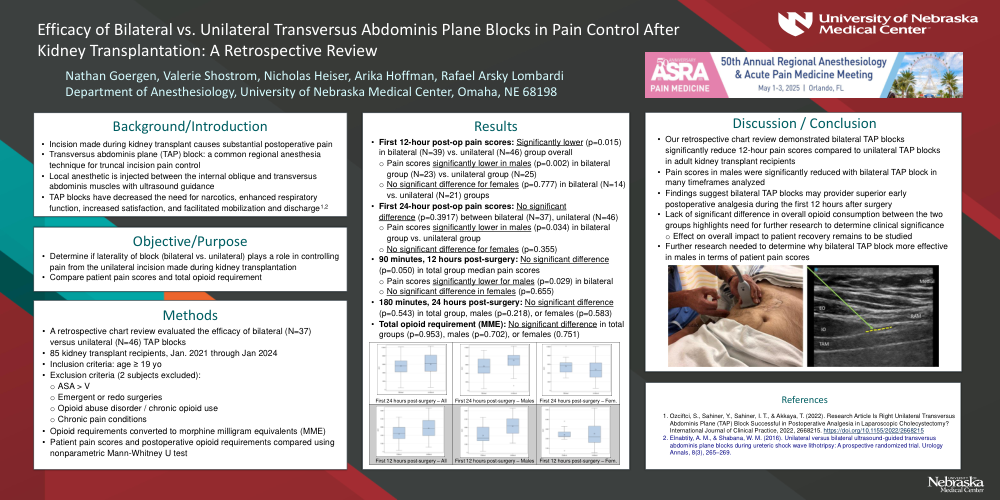
Efficacy of Bilateral vs. Unilateral Transversus Abdominis Plane Blocks in Pain Control After Kidney Transplantation: A Retrospective Review
Nathan Goergen, Valerie Shostrom, Nicholas Heiser, Arika Hoffman, Rafael Arsky Lombardi
Department of Anesthesiology, University of Nebraska Medical Center, Omaha, NE 68198
Background/Introduction
Incision made during kidney transplant causes substantial postoperative pain
Transversus abdominis plane (TAP) block: a common regional anesthesia technique for truncal incision pain control
Local anesthetic is injected between the internal oblique and transversus abdominis muscles with ultrasound guidance
TAP blocks have decreased the need for narcotics, enhanced respiratory function, increased satisfaction, and facilitated mobilization and discharge.
Objective/purpose
Determine if laterality of block (bilateral vs. unilateral) plays a role in controlling pain from the unilateral incision made during kidney transplantation
Compare patient pain scores and total opioid requirement
Methods
A retrospective chart review evaluated the efficacy of bilateral (N=37) versus unilateral (N=46) TAP blocks
85 kidney transplant recipients, Jan. 2021 through Jan 2024
Inclusion criteria: age ≥ 19 yo
Exclusion criteria (2 subjects excluded): o ASA > V
o Emergent or redo surgeries
o Opioid abuse disorder / chronic opioid use
o Chronic pain conditions
Results
First 12-hour post-op pain scores: Significantly lower (p=0.015) in bilateral (N=39) vs. unilateral (N=46) group overall o Pain scores significantly lower in males (p=0.002) in bilateral group (N=23) vs. unilateral group (N=25)
- o No significant difference for females (p=0.777) in bilateral (N=14) vs. unilateral (N=21) groups
- First 24-hour post-op pain scores: No significant difference (p=0.3917) between bilateral (N=37), unilateral (N=46) o Pain scores significantly lower in males (p=0.034) in bilateral group vs. unilateral group
- o No significant difference for females (p=0.355)
- 90 minutes, 12 hours post-surgery: No significant difference (p=0.050) in total group median pain scores o Pain scores significantly lower for males (p=0.029) in bilateral
- o No significant difference in females (p=0.655)
- 180 minutes, 24 hours post-surgery: No significant difference (p=0.543) in total group, males (p=0.218), or females (p=0.583)
- Total opioid requirement (MME): No significant difference in total groups (p=0.953), males (p=0.702), or females (0.751)
Discussion/Conclusion
Our retrospective chart review demonstrated bilateral TAP blocks significantly reduce 12-hour pain scores compared to unilateral TAP blocks in adult kidney transplant recipients
Pain scores in males were significantly reduced with bilateral TAP block in many timeframes analyzed
Findings suggest bilateral TAP blocks may provider superior early postoperative analgesia during the first 12 hours after surgery
Lack of significant difference in overall opioid consumption between the two groups highlights need for further research to determine clinical significance o Effect on overall impact to patient recovery remains to be studied
Further research needed to determine why bilateral TAP block more effective in males in terms of patient pain scores