Loading...

383 posters, 2 videos, 1 audios, 8 topics, 28 sessions, 328 authors, 225 institutions

ePostersLive by SciGen Technologies S.A. All rights reserved.

6629

INCREASING THE IQ OF SAPHENOUS NERVE BLOCKS WITH THE USE OF SMART GLASSES
Poster Presenter

Faria Nisar

Part of Topic

Scientific Abstracts > Regional Anesthesia

Increasing the IQ of Saphenous Nerve Blocks with the use of Smart glasses

Faria Nisar, MD; Nicolas Mas D Alessandro, MD; Hannah Hill, MPH; Justin Jones, MD


MetroHealth Medical Center affiliated with Case Western Reserve University School of Medicine, Cleveland, Ohio


Introduction & Background

•Saphenous Nerve Blocks: Standard for knee arthroplasty pain management.
•Current Practice: Performed using ultrasound guidance.
•Challenge: Providers must shift focus between the needle site and the ultrasound screen.
•Issue: Head movement delays the procedure.
•Innovation: Smart glasses connected to the ultrasound machine. Allows direct viewing of ultrasound images without looking away.
•Primary Objective: Evaluate if smart glasses reduce nerve block procedure time.
•Secondary Objective: Analyze provider’s head movement and ergonomics.
 

Methods

•IRB Approval: Obtained before the study.
•Data Collection: Recorded key time points, needle adjustments, and ergonomics.
•Study Design: Randomized between standard method and smart glasses.
•Operators: Residents of different training levels, supervised by an attending.
•Post-Procedure: Providers completed a survey on method preference.
 

Results

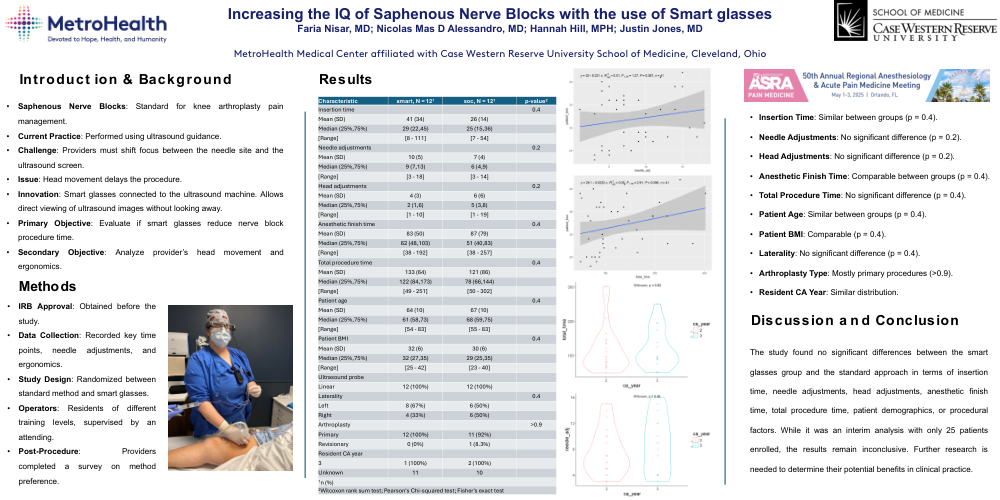
•Insertion Time: Similar between groups (p = 0.4).
•Needle Adjustments: No significant difference (p = 0.2).
•Head Adjustments: No significant difference (p = 0.2).
•Anesthetic Finish Time: Comparable between groups (p = 0.4).
•Total Procedure Time: No significant difference (p = 0.4).
•Patient Age: Similar between groups (p = 0.4).
•Patient BMI: Comparable (p = 0.4).
•Laterality: No significant difference (p = 0.4).
•Arthroplasty Type: Mostly primary procedures (>0.9).
•Resident CA Year: Similar distribution.


Discussion and Conclusion

The study found no significant differences between the smart glasses group and the standard approach in terms of insertion time, needle adjustments, head adjustments, anesthetic finish time, total procedure time, patient demographics, or procedural factors. While it was an interim analysis with only 25 patients enrolled, the results remain inconclusive. Further research is needed to determine their potential benefits in clinical practice.

asraspring2025 banner
Copyright © 2015-2026, ePostersLive® SciGen is a registered trademark of SciGen Technologies S.A. Patent pending.

This website and third-party tools we use rely on cookies for the best user experience. By selecting "I agree", you agree to cookie usage as described in our Privacy Policy.
