383 posters, 2 videos, 1 audios, 8 topics, 28 sessions, 328 authors, 225 institutions
ePostersLive by SciGen Technologies S.A. All rights reserved.
50th Annual Regional Anesthesiology and Acute Pain Medicine Meeting
May 1 - 3, 2025 | Orlando, Florida

6594
EFFICIENCY OF A STRUCTURED COURSE OF REGIONAL ANESTHESIA IN RESOURCE-LIMITED SETTINGS
Poster Presenter
Authors
Affiliations
Part of Topic
Scientific Abstracts > Regional Anesthesia
Efficiency of a structured course of Regional Anesthesia in a Resource-Limited Setting in Guatemala.
Erika Taco Vasquez MD1, Federico Jimenez MD1, Sandra Flores MD2, Juan Mora MD1, Barys Ihnatsenka MD1, Steven Robicsek MD, PhD1
1. Department of Anesthesiology, University of Florida College of Medicine, Gainesville
2. Rafael Landivar University, Guatemala City, Guatemala
Introduction:
Guatemala has a critical shortage of anesthesiology-trained physicians with a national density of 0.8 per 100,000 population. New anesthesiology programs were established to serve rural hospitals. However, they lacked equipment and skilled personnel to train in regional anesthesia techniques. This educational initiative was developed to address these deficiencies by providing virtual and hands-on training in regional anesthesia and point-of-care ultrasound (POCUS) to program directors, faculty, and senior residents of three rural hospitals, establishing regional anesthesia options to decrease the morbidity and mortality associated with general anesthesia.
Methods and results:
26 participants from three rural hospitals were enrolled in a 16-week training program that took place from July through early November of 2024.
On the second day, workshop trainers visited each rural hospital, an ultrasound machine was donated to each location. Trainers conducted a 3-day visit to implement a regional anesthesia service. Provide clinical instruction on eligible patients and establish a suitable workflow for the system.
The big idea:
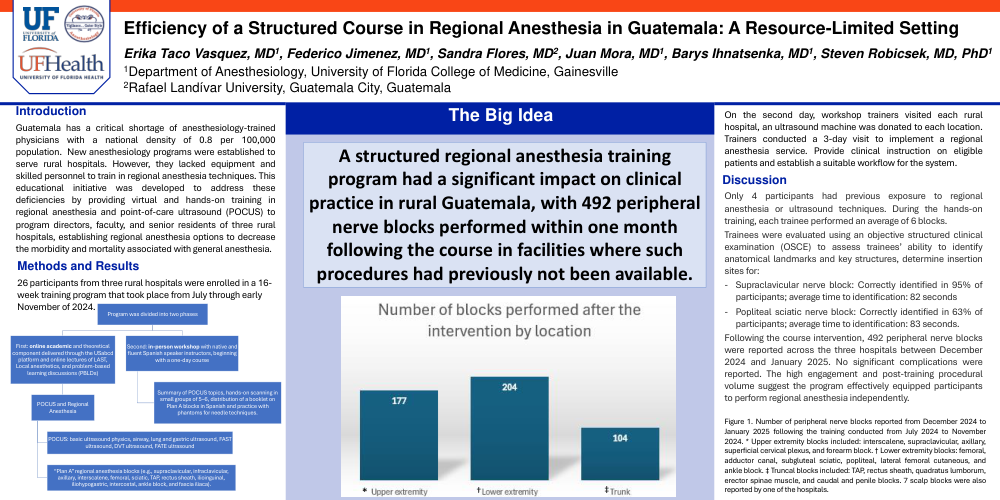
A structured program in Regional Anesthesia significantly impacted clinical practice in rural Guatemala. A total of 492 blocks were performed within two months of the intervention in facilities where such procedures were previously absent.
Discussion:
Only 4 participants had previous exposure to regional anesthesia or ultrasound techniques. During the hands-on training, each trainee performed an average of 6 blocks.
Trainees were evaluated using an objective structured clinical examination (OSCE) to assess trainees’ ability to identify anatomical landmarks and key structures, determine insertion sites for:
- Supraclavicular nerve block: Correctly identified in 95% of participants; average time to identification: 82 seconds
Following the course intervention, 492 peripheral nerve blocks were reported across the three hospitals between December 2024 and January 2025. No significant complications were reported. The high engagement and post-training procedural volume suggest the program effectively equipped participants to perform regional anesthesia independently.
1. Figure 1. Number of blocks reported from December 2024 to January 2025 following the training conducted from July 2024 to November 2024. * Upper extremity blocks included: interscalene, supraclavicular, axillary, superficial cervical plexus, and forearm block. † Lower extremity blocks: femoral, adductor canal, subgluteal sciatic, popliteal, lateral femoral cutaneous, and ankle block. ‡ Truncal blocks included: TAP, rectus sheath, quadratus lumborum, erector spinae muscle, and caudal and penile blocks. 7 scalp blocks were also reported by one of the hospitals.