383 posters, 2 videos, 1 audios, 8 topics, 28 sessions, 328 authors, 225 institutions
ePostersLive by SciGen Technologies S.A. All rights reserved.
50th Annual Regional Anesthesiology and Acute Pain Medicine Meeting
May 1 - 3, 2025 | Orlando, Florida

6546
TRANSMUSCULAR QUADRATUS LUMBORUM BLOCK DECREASES OXYCODONE REQUIREMENTS AFTER HEMIPELVECTOMY
Poster Presenter
Authors
Affiliations
Part of Topic
Scientific Abstracts > Regional Anesthesia
Transmuscular Quadratus Lumborum Block Decreases Oxycodone Requirements After Hemipelvectomy
- Quadratus Lumborum Block (QLB) is a relatively novel ultrasound-guided regional analgesic technique that has been described to provide effective somatic and visceral analgesia in a wide array of clinical scenarios including, but not limited to, proctosigmoidectomy, hip surgery, above-knee amputation, abdominal hernia repair, breast reconstruction, colostomy closure, radical nephrectomy, lower extremity vascular surgery, total hip arthroplasty, laparotomy, and colectomy.
- Several other case reports with a variety of indications for quadratus lumborum block document sensory blockade to include the T7–L2 dermatomes.
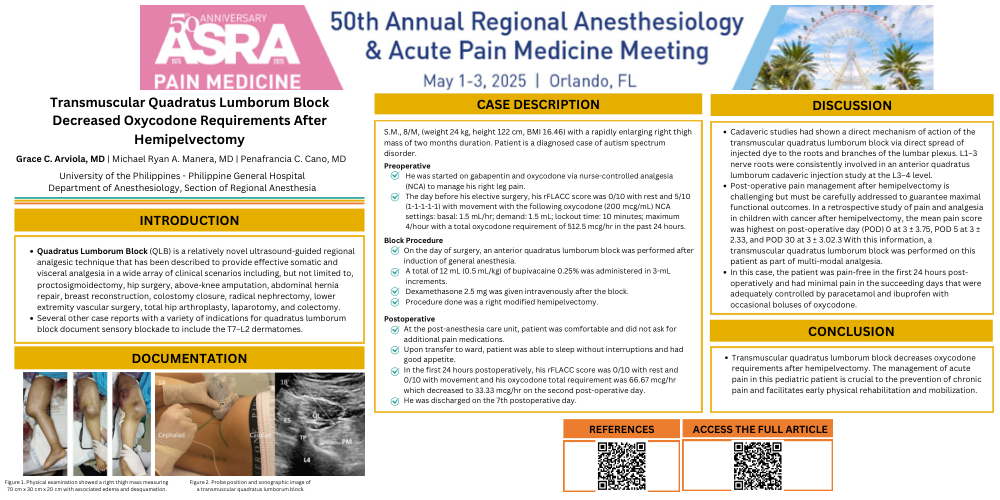
S.M., 8/M, (weight 24 kg, height 122 cm, BMI 16.46) with a rapidly enlarging right thigh mass of two months duration. Patient is a diagnosed case of autism spectrum disorder.
Preoperative
He was started on gabapentin and oxycodone via nurse-controlled analgesia (NCA) to manage his right leg pain.
The day before his elective surgery, his rFLACC score was 0/10 with rest and 5/10 (1-1-1-1-1) with movement with the following oxycodone (200 mcg/mL) NCA
settings: basal: 1.5 mL/hr; demand: 1.5 mL; lockout time: 10 minutes; maximum 4/hour with a total oxycodone requirement of 512.5 mcg/hr in the past 24 hours.
Block Procedure
On the day of surgery, an anterior quadratus lumborum block was performed after induction of general anesthesia.
A total of 12 mL (0.5 mL/kg) of bupivacaine 0.25% was administered in 3-mL increments.
Dexamethasone 2.5 mg was given intravenously after the block.
Procedure done was a right modified hemipelvectomy.
Postoperative
At the post-anesthesia care unit, patient was comfortable and did not ask for additional pain medications.
Upon transfer to ward, patient was able to sleep without interruptions and had good appetite.
In the first 24 hours postoperatively, his rFLACC score was 0/10 with rest and 0/10 with movement and his oxycodone total requirement was 66.67 mcg/hr which decreased to 33.33 mcg/hr on the second post-operative day. He was discharged on the 7th postoperative day.
Discussion
- Cadaveric studies had shown a direct mechanism of action of the transmuscular quadratus lumborum block via direct spread of injected dye to the roots and branches of the lumbar plexus. L1–3 nerve roots were consistently involved in an anterior quadratus lumborum cadaveric injection study at the L3–4 level.
- Post-operative pain management after hemipelvectomy is challenging but must be carefully addressed to guarantee maximal functional outcomes. In a retrospective study of pain and analgesia in children with cancer after hemipelvectomy, the mean pain score was highest on post-operative day (POD) 0 at 3 ± 3.75, POD 5 at 3 ± 2.33, and POD 30 at 3 ± 3.02.3 With this information, a transmuscular quadratus lumborum block was performed on this patient as part of multi-modal analgesia.
In this case, the patient was pain-free in the first 24 hours post-operatively and had minimal pain in the succeeding days that were adequately controlled by paracetamol and ibuprofen with occasional boluses of oxycodone.
Conclusion
- Transmuscular quadratus lumborum block decreases oxycodone requirements after hemipelvectomy. The management of acute pain in this pediatric patient is crucial to the prevention of chronic pain and facilitates early physical rehabilitation and mobilization.