383 posters, 2 videos, 1 audios, 8 topics, 28 sessions, 328 authors, 225 institutions
ePostersLive by SciGen Technologies S.A. All rights reserved.
50th Annual Regional Anesthesiology and Acute Pain Medicine Meeting
May 1 - 3, 2025 | Orlando, Florida

6541
THE INCIDENCE & IMPACT OF CONVERSION TO INSTRUMENTED AIRWAY IN AMBULATORY UPPER EXTREMITY ORTHOPEDIC SURGERY
Poster Presenter
Authors
Affiliations
University of Tennessee Health Science Center College of Medicine
Part of Topic
Scientific Abstracts > Regional Anesthesia
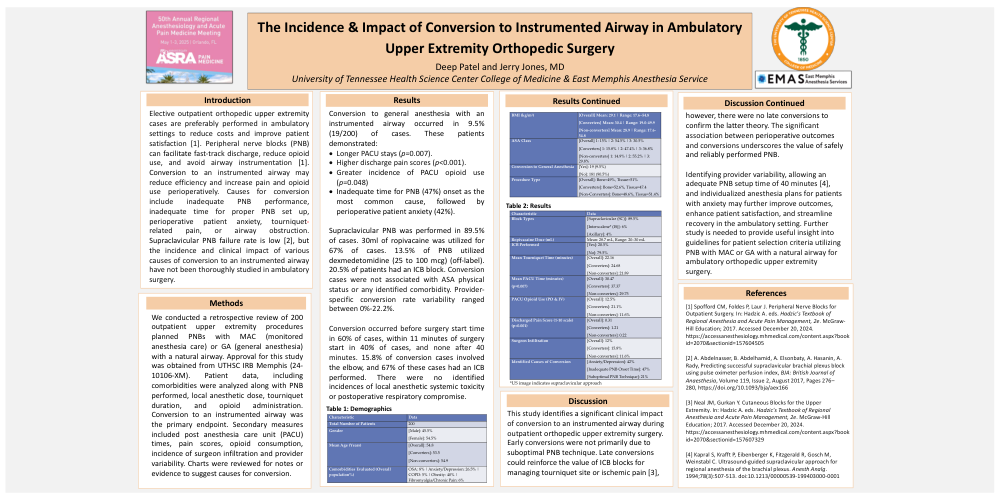
The Incidence & Impact of Conversion to Instrumented Airway in Ambulatory Upper Extremity Orthopedic Surgery
Deep Patel and Jerry Jones, MD
University of Tennessee Health Science Center College of Medicine & East Memphis Anesthesia Service
Elective outpatient orthopedic upper extremity cases are preferably performed in ambulatory settings to reduce costs and improve patient satisfaction [1]. Peripheral nerve blocks (PNB) can facilitate fast-track discharge, reduce opioid use, and avoid airway instrumentation [1]. Conversion to an instrumented airway may reduce efficiency and increase pain and opioid use perioperatively. Causes for conversion include inadequate PNB performance, inadequate time for proper PNB set up, perioperative patient anxiety, tourniquet-related pain, or airway obstruction. Supraclavicular PNB failure rate is low [2], but the incidence and clinical impact of various causes of conversion to an instrumented airway have not been thoroughly studied in ambulatory surgery.
We conducted a retrospective review of 200 outpatient upper extremity procedures planned PNBs with MAC (monitored anesthesia care) or GA (general anesthesia) with a natural airway. Approval for this study was obtained from UTHSC IRB Memphis (24-10106-XM). Patient data, including comorbidities were analyzed along with PNB performed, local anesthetic dose, tourniquet duration, and opioid administration. Conversion to an instrumented airway was the primary endpoint. Secondary measures included post anesthesia care unit (PACU) times, pain scores, opioid consumption, incidence of surgeon infiltration and provider variability. Charts were reviewed for notes or evidence to suggest causes for conversion.
Conversion to general anesthesia with an instrumented airway occurred in 9.5% (19/200) of cases. These patients demonstrated:
Supraclavicular PNB was performed in 89.5% of cases. 30ml of ropivacaine was utilized for 67% of cases. 13.5% of PNB utilized dexmedetomidine (25 to 100 mcg) (off-label). 20.5% of patients had an ICB block. Conversion cases were not associated with ASA physical status or any identified comorbidity. Provider-specific conversion rate variability ranged between 0%-22.2%.
Conversion occurred before surgery start time in 60% of cases, within 11 minutes of surgery start in 40% of cases, and none after 40 minutes. 15.8% of conversion cases involved the elbow, and 67% of these cases had an ICB performed. There were no identified incidences of local anesthetic systemic toxicity or postoperative respiratory compromise.
This study identifies a significant clinical impact of conversion to an instrumented airway during outpatient orthopedic upper extremity surgery. Early conversions were not primarily due to suboptimal PNB technique. Late conversions could reinforce the value of ICB blocks for managing tourniquet site or ischemic pain [3],
however, there were no late conversions to confirm the latter theory. The significant association between perioperative outcomes and conversions underscores the value of safely and reliably performed PNB.
Identifying provider variability, allowing an adequate PNB setup time of 40 minutes [4], and individualized anesthesia plans for patients with anxiety may further improve outcomes, enhance patient satisfaction, and streamline recovery in the ambulatory setting. Further study is needed to provide useful insight into guidelines for patient selection criteria utilizing PNB with MAC or GA with a natural airway for ambulatory orthopedic upper extremity surgery.
[1] Spofford CM, Foldes P, Laur J. Peripheral Nerve Blocks for Outpatient Surgery. In: Hadzic A. eds. Hadzic's Textbook of Regional Anesthesia and Acute Pain Management, 2e. McGraw-Hill Education; 2017. Accessed December 20, 2024. https://accessanesthesiology.mhmedical.com/content.aspx?bookid=2070§ionid=157604505
[2] A. Abdelnasser, B. Abdelhamid, A. Elsonbaty, A. Hasanin, A. Rady, Predicting successful supraclavicular brachial plexus block using pulse oximeter perfusion index, BJA: British Journal of Anaesthesia, Volume 119, Issue 2, August 2017, Pages 276–280, https://doi.org/10.1093/bja/aex166
[3] Neal JM, Gurkan Y. Cutaneous Blocks for the Upper Extremity. In: Hadzic A. eds. Hadzic's Textbook of Regional Anesthesia and Acute Pain Management, 2e. McGraw-Hill Education; 2017. Accessed December 20, 2024. https://accessanesthesiology.mhmedical.com/content.aspx?bookid=2070§ionid=157607329
[4] Kapral S, Krafft P, Eibenberger K, Fitzgerald R, Gosch M, Weinstabl C. Ultrasound-guided supraclavicular approach for regional anesthesia of the brachial plexus. Anesth Analg. 1994;78(3):507-513. doi:10.1213/00000539-199403000-0001