383 posters, 2 videos, 1 audios, 8 topics, 28 sessions, 328 authors, 225 institutions
ePostersLive by SciGen Technologies S.A. All rights reserved.
50th Annual Regional Anesthesiology and Acute Pain Medicine Meeting
May 1 - 3, 2025 | Orlando, Florida

6481
LOCAL ANESTHETIC ASSOCIATED DEATHS REPORTED TO THE NATIONAL POISON DATA SYSTEM (NPDS)
Poster Presenter
Authors
Affiliations
Part of Topic
Scientific Abstracts > Regional Anesthesia
Local anesthetic associated deaths reported to the National Poison Data System
Michael R. Fettiplace MD PhD
Guy Weinberg MD
Heather C. Nixon MD
Marina Gitman MD
INTRODUCTION
Local anesthetics (LA) are ubiquitous pain control agents in medicine but with the known complication of LA systematic toxicity. In 2010, multiple anesthesia societies introduced practice advisories [1][2] for treating LA systemic toxicity, but the impact of those recommendations is uncertain.
METHODS
This research was deemed non-human research by the University of Illinois at Chicago IRB (Study 2023-1026). We conducted a case-control study using data from the National Poison Data System (NPDS, 1983 – 2022), with the hypothesis that the 2010 recommendations contributed to a reduction in reporting and mortality from LAs. The odds ratio was calculated using the Yates continuity-corrected X2 test comparing reporting and deaths from LAs in 2010 – 2022 relative to 2001 – 2010. Confidence intervals were calculated using the Baptista-Pike method (GraphPad Prism). The sample size was determined using data from 1991 – 2000, with 19000 reports required to identify an odds ratio of 2 (alpha = 0.025, power = 80%). Poisson regression was used for confirmation, alongside exploratory analyses of individual cases of mortality based on epoch of publication.
RESULTS
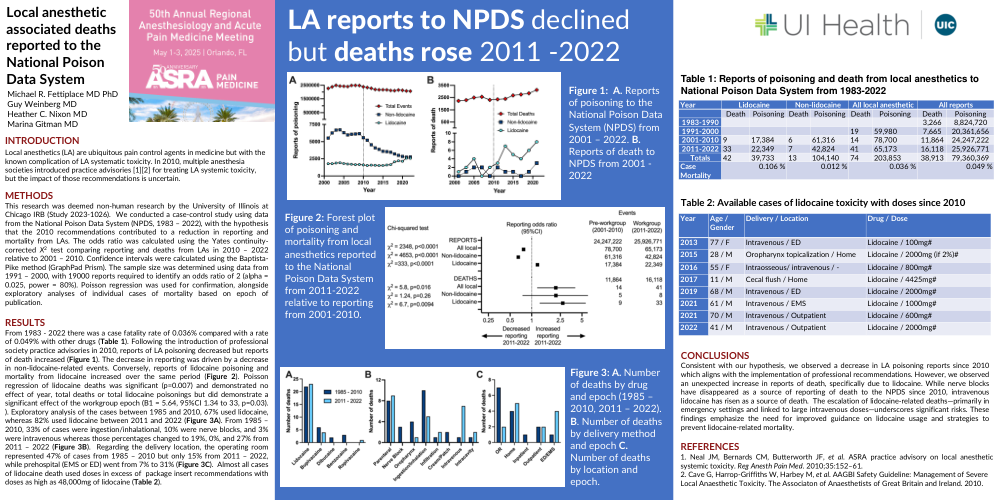
From 1983 - 2022 there was a case fatality rate of 0.036% compared with a rate of 0.049% with other drugs (Table 1). Following the introduction of professional society practice advisories in 2010, reports of LA poisoning decreased but reports of death increased (Figure 1). The decrease in reporting was driven by a decrease in non-lidocaine-related events. Conversely, reports of lidocaine poisoning and mortality from lidocaine increased over the same period (Figure 2). Poisson regression of lidocaine deaths was significant (p=0.007) and demonstrated no effect of year, total deaths or total lidocaine poisonings but did demonstrate a significant effect of the workgroup epoch (B1 = 5.64, 95%CI 1.34 to 33, p=0.03). ). Exploratory analysis of the cases between 1985 and 2010, 67% used lidocaine, whereas 82% used lidocaine between 2011 and 2022 (Figure 3A). From 1985 – 2010, 33% of cases were ingestion/inhalational, 10% were nerve blocks, and 3% were intravenous whereas those percentages changed to 19%, 0%, and 27% from 2011 – 2022 (Figure 3B). Regarding the delivery location, the operating room represented 47% of cases from 1985 – 2010 but only 15% from 2011 – 2022, while prehospital (EMS or ED) went from 7% to 31% (Figure 3C). Almost all cases of lidocaine death used doses in excess of package insert recommendations with doses as high as 48,000mg of lidocaine (Table 2).
CONCLUSIONS
Consistent with our hypothesis, we observed a decrease in LA poisoning reports since 2010 which aligns with the implementation of professional recommendations. However, we observed an unexpected increase in reports of death, specifically due to lidocaine. While nerve blocks have disappeared as a source of reporting of death to the NPDS since 2010, intravenous lidocaine has risen as a source of death. The escalation of lidocaine-related deaths—primarily in emergency settings and linked to large intravenous doses—underscores significant risks. These findings emphasize the need for improved guidance on lidocaine usage and strategies to prevent lidocaine-related mortality.
REFERENCES
1. Neal JM, Bernards CM, Butterworth JF, et al. ASRA practice advisory on local anesthetic systemic toxicity. Reg Anesth Pain Med. 2010;35:152–61.
2. Cave G, Harrop-Griffiths W, Harbey M, et al. AAGBI Safety Guideline: Management of Severe Local Anaesthetic Toxicity. The Associaton of Anaesthetists of Great Britain and Ireland. 2010.