383 posters, 2 videos, 1 audios, 8 topics, 28 sessions, 328 authors, 225 institutions
ePostersLive by SciGen Technologies S.A. All rights reserved.
50th Annual Regional Anesthesiology and Acute Pain Medicine Meeting
May 1 - 3, 2025 | Orlando, Florida

6413
A NEW ERA: AWAKE SPINE SURGERY AND ANESTHESIA CONSIDERATIONS
Poster Presenter
Authors
Affiliations
Part of Topic
Scientific Abstracts > Regional Anesthesia
A New Era: Awake Spine Surgery and Anesthesia Considerations.
Over 1.2 million spinal surgeries, including fusion, laminectomy, decompression, discectomy, are performed annually in the US, according to the National Center for Health Statistics (1). Recently, there has been growing interest in minimally invasive awake spinal surgery using spinal anesthesia (SA), which avoids the risks of general anesthesia (GA) and offers improved pain control and recovery (2,3). This relatively underexplored approach has significant potential to enhance patient outcomes and recovery. Our case report details the planning and successful use of spinal anesthesia with monitored anesthesia care for an awake lumbar decompression.
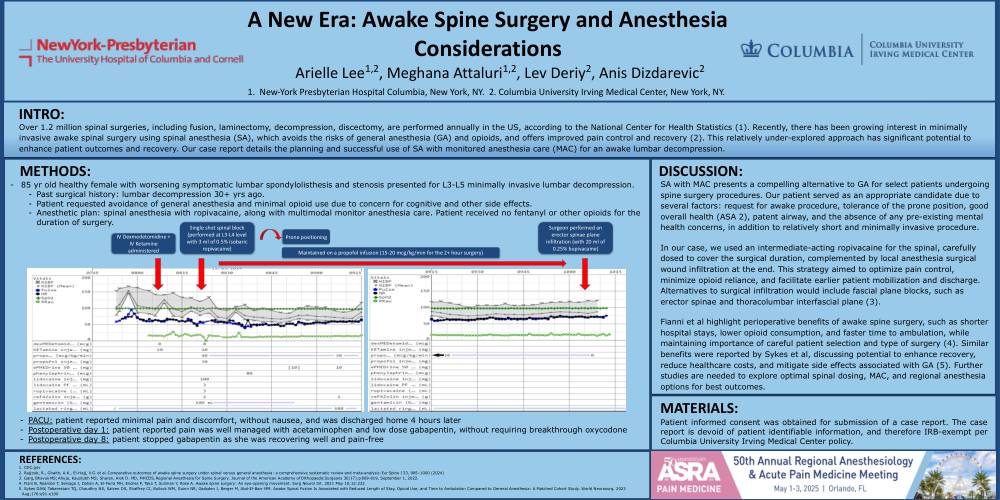
An 85-year-old otherwise healthy female with worsening symptomatic lumbar spondylolisthesis and stenosis presented for an L3-L5 minimally invasive lumbar decompression. Past surgical history included lumbar decompression over 30+ years ago. She requested avoidance of general anesthesia and minimal opioid use due to concern for cognitive and other side effects. Intraoperatively, the patient was started on intravenous dexmedetomidine and ketamine in small incremental boluses. Next, a single shot spinal block was performed at L3-L4 level with 3ml of 0.5% isobaric preservative free ropivacaine. Following prone positioning, she was started and maintained on propofol infusion, 15-20mcg/kg/min for the duration of the 2.25 hour surgery. She remained comfortable, breathing spontaneously, and hemodynamically stable throughout. At the end of the procedure, the surgeon performed an erector spinae plane infiltration with 20 ml of 0.25% bupivacaine. In PACU, the patient reported minimal pain and discomfort, without nausea, and was discharged home 4 hours later. Postoperative day 1, she reported that her pain was well managed with acetaminophen and low dose gabapentin, without requiring breakthrough oxycodone. By postoperative day 8, the patient stopped gabapentin as she was recovering well and pain-free.
Spinal anesthesia with monitored anesthesia care (MAC) presents a compelling alternative to general anesthesia for select patients undergoing spine surgery procedures. Our patient served as an appropriate candidate due to several factors: request for awake procedure, tolerance of the prone position, good overall health (ASA 2), patent airway, and the absence of any pre-existing mental health concerns, in addition to relatively short and minimally invasive procedure. In our particular case, we used an intermediate-acting ropivacaine for the spinal, carefully dosed to cover the surgical duration, complemented by local anesthesia surgical wound infiltration at the end. This strategy aimed to optimize pain control, minimize opioid reliance, and facilitate earlier patient mobilization and discharge. Alternative to surgical infiltration would include fascial plane blocks, such as erector spinae and thoracolumbar interfascial plane (4). Fianni et al highlight perioperative benefits of awake spine surgery, such as shorter hospital stays, lower opioid consumption, and faster time to ambulation, while maintaining importance of careful patient selection and type of surgery (5). Similar benefits were reported by Sykes et al, discussing potential to enhance recovery, reduce healthcare costs, and mitigate side effects associated with general anesthesia (6). Further studies are needed to explore optimal spinal dosing, MAC and regional anesthesia options for best outcomes.