383 posters, 2 videos, 1 audios, 8 topics, 28 sessions, 328 authors, 225 institutions
ePostersLive by SciGen Technologies S.A. All rights reserved.
50th Annual Regional Anesthesiology and Acute Pain Medicine Meeting
May 1 - 3, 2025 | Orlando, Florida

6732
DEVELOPMENT OF A NOVEL FEEDBACK TOOL FOR REGIONAL ANAESTHESIA TRAINING
Poster Presenter
Authors
Affiliations
Part of Topic
Scientific Abstracts > Education
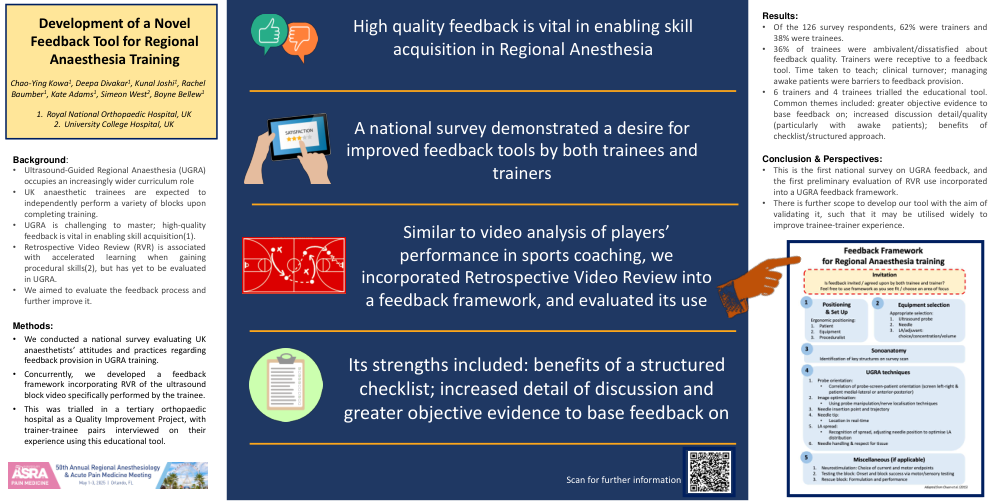
Development of a Novel Feedback Tool for Regional Anaesthesia Training
Background:
Ultrasound-Guided Regional Anaesthesia (UGRA) occupies an increasingly wider curriculum role
UK anaesthetic trainees are expected to independently perform a variety of blocks upon completing training.
UGRA is challenging to master; high-quality feedback is vital in enabling skill acquisition(1).
Retrospective Video Review (RVR) is associated with accelerated learning when gaining procedural skills(2), but has yet to be evaluated in UGRA.
We aimed to evaluate the feedback process and further improve it.
Methods:
We conducted a national survey evaluating UK anaesthetists’ attitudes and practices regarding feedback provision in UGRA training.
Concurrently, we developed a feedback framework incorporating RVR of the ultrasound block video specifically performed by the trainee.
This was trialled in a tertiary orthopaedic hospital as a Quality Improvement Project, with trainer-trainee pairs interviewed on their experience using this educational tool.
Results:
Of the 126 survey respondents, 62% were trainers and 38% were trainees.
36% of trainees were ambivalent/dissatisfied about feedback quality. Trainers were receptive to a feedback tool. Time taken to teach; clinical turnover; managing awake patients were barriers to feedback provision.
6 trainers and 4 trainees trialled the educational tool. Common themes included: greater objective evidence to base feedback on; increased discussion detail/quality (particularly with awake patients); benefits of checklist/structured approach.
Conclusion & Perspectives:
This is the first national survey on UGRA feedback, and the first preliminary evaluation of RVR use incorporated into a UGRA feedback framework.
There is further scope to develop our tool with the aim of validating it, such that it may be utilised widely to improve trainee-trainer experience.