383 posters, 2 videos, 1 audios, 8 topics, 28 sessions, 328 authors, 225 institutions
ePostersLive by SciGen Technologies S.A. All rights reserved.
50th Annual Regional Anesthesiology and Acute Pain Medicine Meeting
May 1 - 3, 2025 | Orlando, Florida

6699
IMPROVING REGIONAL ANESTHESIA UNDERSTANDING AND UTILIZATION IN THE SURGICAL ICU: AN EDUCATION PROJECT
Poster Presenter
Authors
Affiliations
Part of Topic
Scientific Abstracts > Education
|
Improving Regional Anesthesia Practice in the Surgical ICU: An Educational Project Kathy Zhang1, Aaron Schweitzer1, Lizbeth Hu1, Anis Dizdarevic1 1Columbia University Irving Medical Center Department of Anesthesiology |
|
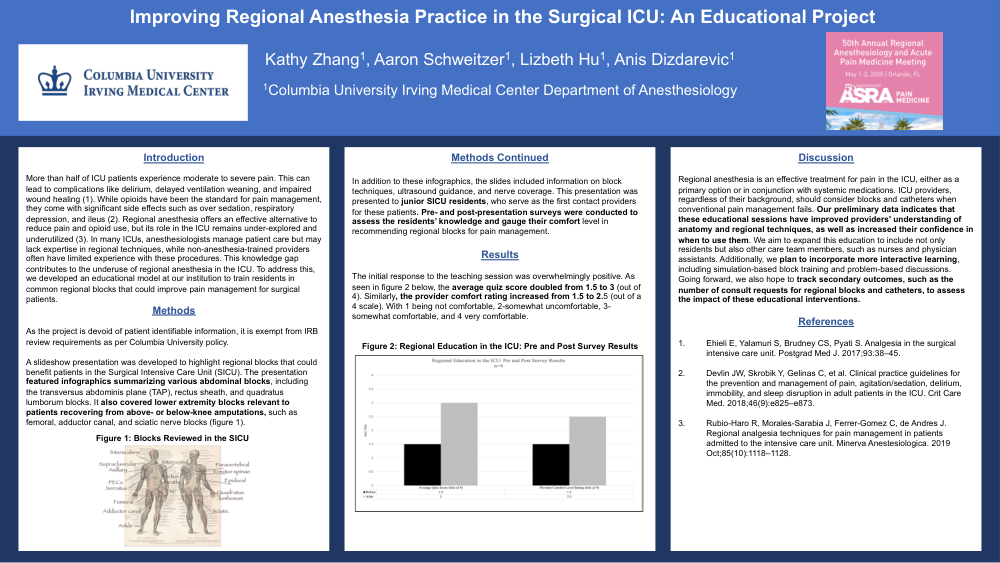
Introduction More than half of ICU patients experience moderate to severe pain. This can lead to complications like delirium, delayed ventilation weaning, and impaired wound healing (1). While opioids have been the standard for pain management, they come with significant side effects such as over sedation, respiratory depression, and ileus (2). Regional anesthesia offers an effective alternative to reduce pain and opioid use, but its role in the ICU remains under-explored and underutilized (3). In many ICUs, anesthesiologists manage patient care but may lack expertise in regional techniques, while non-anesthesia-trained providers often have limited experience with these procedures. This knowledge gap contributes to the underuse of regional anesthesia in the ICU. To address this, we developed an educational model at our institution to train residents in common regional blocks that could improve pain management for surgical patients. Methods As the project is devoid of patient identifiable information, it is exempt from IRB review requirements as per Columbia University policy. A slideshow presentation was developed to highlight regional blocks that could benefit patients in the Surgical Intensive Care Unit (SICU). The presentation featured infographics summarizing various abdominal blocks, including the transversus abdominis plane (TAP), rectus sheath, and quadratus lumborum blocks. It also covered lower extremity blocks relevant to patients recovering from above- or below-knee amputations, such as femoral, adductor canal, and sciatic nerve blocks (figure 1). In addition to these infographics, the slides included information on block techniques, ultrasound guidance, and nerve coverage. This presentation was presented to junior SICU residents, who serve as the first contact providers for these patients. Pre- and post-presentation surveys were conducted to assess the residents’ knowledge and gauge their comfort level in recommending regional blocks for pain management. Results The initial response to the teaching session was overwhelmingly positive. As seen in figure 2 below, the average quiz score doubled from 1.5 to 3 (out of 4). Similarly, the provider comfort rating increased from 1.5 to 2.5 (out of a 4 scale). With 1 being not comfortable, 2-somewhat uncomfortable, 3- somewhat comfortable, and 4 very comfortable. Discussion Regional anesthesia is an effective treatment for pain in the ICU, either as a primary option or in conjunction with systemic medications. ICU providers, regardless of their background, should consider blocks and catheters when conventional pain management fails. Our preliminary data indicates that these educational sessions have improved providers' understanding of anatomy and regional techniques, as well as increased their confidence in when to use them. We aim to expand this education to include not only residents but also other care team members, such as nurses and physician assistants. Additionally, we plan to incorporate more interactive learning, including simulation-based block training and problem-based discussions. Going forward, we also hope to track secondary outcomes, such as the number of consult requests for regional blocks and catheters, to assess the impact of these educational interventions. References
|