383 posters, 2 videos, 1 audios, 8 topics, 28 sessions, 328 authors, 225 institutions
ePostersLive by SciGen Technologies S.A. All rights reserved.
50th Annual Regional Anesthesiology and Acute Pain Medicine Meeting
May 1 - 3, 2025 | Orlando, Florida

6416
FAKE IT ‘TILL YOU MAKE IT: A RANDOMIZED PROSPECTIVE COHORT STUDY EXAMINING THE EDUCATIONAL ROLE OF ULTRASOUND SIMULATION
Poster Presenter
Authors
Affiliations
Part of Topic
Scientific Abstracts > Education
Fake it ‘till you make it: a randomized prospective cohort study examining the
Option 4
educational role of ultrasound simulation
Emily Barney Hall MD, Amanda Kumar MD
Introduction
• Traditional educational methods for regional anesthesia (RA) struggle to
address the procedural aspect of the specialty.
• There is a growing market for technology-guided training in RA.
• This educational prospective randomized trial addresses how we
approach novice RA learners with hopes to promote learner performance
and confidence, and in turn improve patient safety and outcomes.
Materials & Methods
• All participants completed a baseline survey. Participants were
randomized into Group 1 (2 hours of independent study using traditional
methods) or Group 2 (2 hours of access to the same materials in addition
to an ultrasound task trainer, Valkyrie eZSimulator).
• Both groups performed 3 procedures: in-plane nerve block, out-of-plane
nerve block and intravenous access, then completed a post-survey.
Results
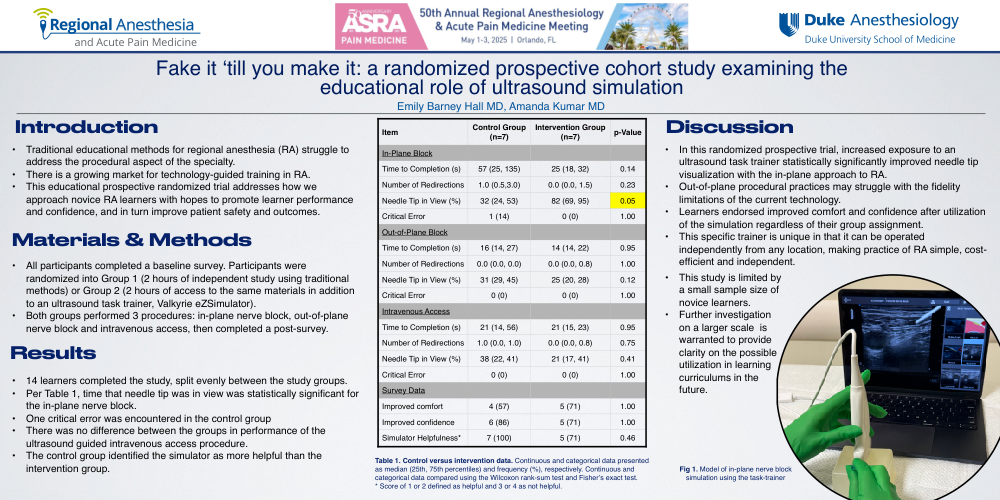
• 14 learners completed the study, split evenly between the study groups.
• Per Table 1, time that needle tip was in view was statistically significant for
the in-plane nerve block.
• One critical error was encountered in the control group
• There was no difference between the groups in performance of the
ultrasound guided intravenous access procedure.
• The control group identified the simulator as more helpful than the
intervention group.
Discussion
• In this randomized prospective trial, increased exposure to an
Option 4
ultrasound task trainer statistically significantly improved needle tip
visualization with the in-plane approach to RA.
• Out-of-plane procedural practices may struggle with the fidelity
limitations of the current technology.
• Learners endorsed improved comfort and confidence after utilization
of the simulation regardless of their group assignment.
• This specific trainer is unique in that it can be operated
independently from any location, making practice of RA simple, cost-
efficient and independent.
• This study is limited by
a small sample size of
novice learners.
• Further investigation
on a larger scale is
warranted to provide
clarity on the possible
utilization in learning
curriculums in the
future.