383 posters, 2 videos, 1 audios, 8 topics, 28 sessions, 328 authors, 225 institutions
ePostersLive by SciGen Technologies S.A. All rights reserved.
50th Annual Regional Anesthesiology and Acute Pain Medicine Meeting
May 1 - 3, 2025 | Orlando, Florida

6805
COMPARISON OF EFFICACY OF TRANSVERSUS ABDOMINIS PLANE BLOCK VS INTRATHECAL MORPHINE FOR ANALGESIA AFTER ROBOTIC COLORECTAL SURGERY
Poster Presenter
Authors
Affiliations
Part of Topic
Scientific Abstracts > Acute Pain
Comparison of efficacy of transversus abdominis plane block vs intrathecal morphine for analgesia after robotic colorectal surgery
Authors: Engy Said, MD; Brian H.Park, MD; Sara Weintraub, MD; Karishma Bhatia, MD; Maryum Haidari, B.S.;Wendy Abramson, MD; Jacklynn Sztain, MD; Rodney A. Gabriel, MD, MAS, FASRA;
INTRODUCTION
The transversusabdominisplane (TAP) block involves the injection of local anesthetic in the plane between the internal oblique and transverseabdominis muscles where the T6 to L1 thoracolumbar nerves lie. The TAP block is commonly used to manage post-operative pain for patients undergoing roboticabdominal surgery. (1)Intrathecal morphine (ITM)can also be used to manage post-operative abdominal pain and has been gainingpopularity given its potential for prolonged analgesia and opioid sparing effects (2). Few studies exist directly comparing TAP blocks to ITM in patients undergoing robotic abdominal surgery. This is a retrospective study that measures the association of ITM versus TAP with postoperative analgesia following robot-assisted colorectal surgery.
MATERIAL AND METHODS
The primary objective of this study was to measure the association of ITM versus TAP for opioid consumption and analgesia.Opioid consumption was defined as total morphine equivalents consumed from recovery room to end of postoperative day (POD) 1. Analgesia was defined as average reported pain scores using the numeric rating scale (NRS). All patients undergoing robotic colorectal surgeries at two of our surgery locations from 2022-2024 were considered in the study. Of those patients, only those who received preoperative TAP or ITM were included in the final study cohort. We excluded surgeries that converted to an open approach. Numeric rating scale and total morphine equivalent dose (MED) administered during the first three postoperative days were collected from the medical records. Milestones included the use of naloxone, days to full liquid diet, and days to foley removal. We created propensity-score matched cohorts controlling for age, sex, ASA status, BMI, and surgery. Continuous and categorical variables were compared using Wilcoxon signed rank test and chi-squared, respectively. All statistical analysis was performed using R (v.4.3.1)
RESULTS
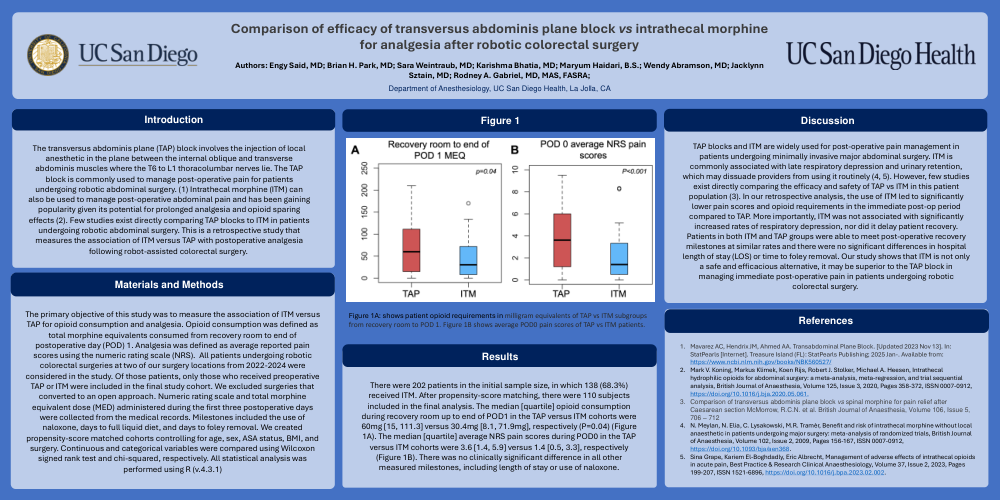
There were 202 patients in the initial sample size, in which 138 (68.3%) received ITM. After propensity-score matching, there were 110 subjects included in the final analysis. The median [quartile] opioid consumption during recovery room up to end of POD1 in the TAP versus ITM cohorts were 60mg [15, 111.3] versus 30.4mg [8.1, 71.9mg], respectively (P=0.04) (Figure 1A). The median [quartile] average NRS pain scores during POD0 in the TAP versus ITM cohorts were3.6 [1.4, 5.9] versus 1.4 [0.5, 3.3], respectively (Figure 1B). There was no clinically significant difference in all other measured milestones, including length of stay or use of naloxone.
DISCUSSION
TAP blocks and ITM are widely used for post-operative pain management in patients undergoing minimally invasive major abdominalsurgery. ITM is commonly associated with late respiratory depression and urinary retention, which may dissuade providers from using it routinely(4, 5).However, few studies exist directly comparing the efficacy and safety of TAP vs ITM in this patient population (3).In our retrospective analysis,the use of ITM led to significantly lower pain scores and opioid requirements in the immediate post-op period compared to TAP. More importantly, ITM was not associated with significantly increased rates of respiratory depression, nor did it delay patient recovery.Patients in both ITM and TAPgroups were able to meet post-operative recovery milestones at similar rates and there were no significant differences in hospital length of stay (LOS) or time to foley removal.Our study shows that ITM is not only a safe and efficacious alternative, it maybe superiorto the TAP block in managing immediate post-operative pain in patients undergoing robotic colorectal surgery.
REFERENCES
-
Mavarez AC, Hendrix JM, Ahmed AA. Transabdominal Plane Block. [Updated 2023 Nov 13]. In: StatPearls [Internet]. Treasure Island (FL): StatPearls Publishing; 2025 Jan-. Available from: https://www.ncbi.nlm.nih.gov/books/NBK560527/
-
Mark V. Koning, Markus Klimek, Koen Rijs, Robert J. Stolker, Michael A. Heesen, Intrathecal hydrophilic opioids for abdominal surgery: a meta-analysis, meta-regression, and trial sequential analysis, British Journal of Anaesthesia, Volume 125, Issue 3, 2020, Pages 358-372, ISSN 0007-0912, https://doi.org/10.1016/j.bja.2020.05.061.
-
Comparison of transversus abdominis plane block vs spinal morphine for pain relief after Caesarean section McMorrow, R.C.N. et al. British Journal of Anaesthesia, Volume 106, Issue 5, 706 – 712
-
N. Meylan, N. Elia, C. Lysakowski, M.R. Tramèr, Benefit and risk of intrathecal morphine without local anaesthetic in patients undergoing major surgery: meta-analysis of randomized trials, British Journal of Anaesthesia, Volume 102, Issue 2, 2009, Pages 156-167, ISSN 0007-0912, https://doi.org/10.1093/bja/aen368.
-
Sina Grape, Kariem El-Boghdadly, Eric Albrecht, Management of adverse effects of intrathecal opioids in acute pain, Best Practice & Research Clinical Anaesthesiology, Volume 37, Issue 2, 2023, Pages 199-207, ISSN 1521-6896, https://doi.org/10.1016/j.bpa.2023.02.002.