383 posters, 2 videos, 1 audios, 8 topics, 28 sessions, 328 authors, 225 institutions
ePostersLive by SciGen Technologies S.A. All rights reserved.
50th Annual Regional Anesthesiology and Acute Pain Medicine Meeting
May 1 - 3, 2025 | Orlando, Florida

6711
THE ED PHARM-ASSIST: EMERGENCY MEDICINE PHARMACISTS EFFECT ON REGIONAL ANESTHESIA TIME TO INTERVENTION IN THE EMERGENCY DEPARTMENT
Poster Presenter
Authors
Affiliations
Part of Topic
Scientific Abstracts > Acute Pain
The ED Pharm-Assist: Emergency Medicine Pharmacists effect on Regional Anesthesia time to intervention in the Emergency Department
Jonathan Maik D.O.1 , Robert O’Connell PharmD1
Department of Emergency medicine, SBH Health System.
Introduction
Regional Anesthesia is primarily used in the Emergency Department (ED) to treat acute pain in the setting of traumatic injury. Its incorporation into multimodal pain management is guideline based. Logistical limitations to its incorporation, such as the unscheduled nature of patient encounters, lack of ED physician access to automated drug dispensing machines, and competing triage priorities, all act as barriers to performing regional anesthesia in the ED efficiently.
ED pharmacists are primed to facility regional anesthesia in the ED. Their expertise allows them to fully integrate into patient care, assist in drug dosing, drug administration ad procedural setup.
Prior studies have found significant impact of ED Pharmacist presence on time to intervention for other critical conditions such as thrombolysis in AIS, door-to-balloon time in PCI, and time to antibiotics in Sepsis and Trauma
We reviewed cases of regional anesthesia in our ED to determine if there was an association with quicker procedure performance when one of our ED pharmacists was present.
Methods & Materials
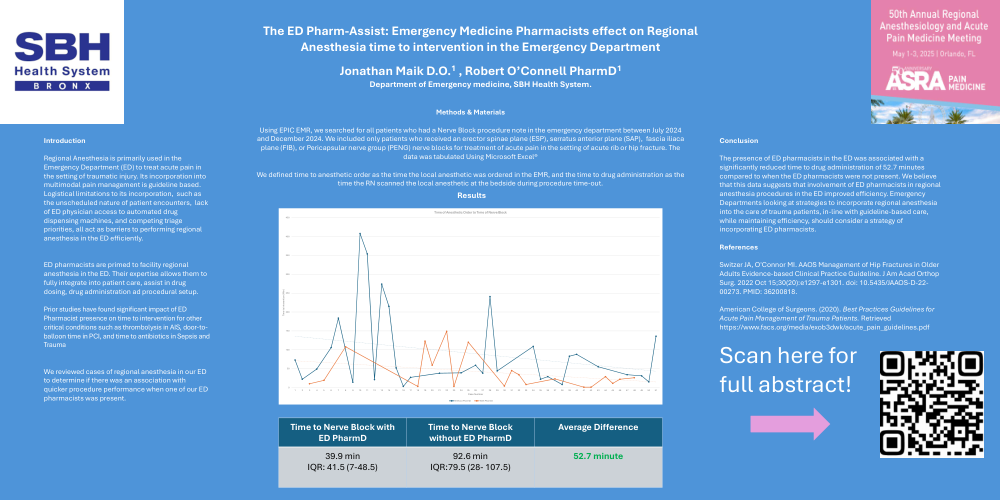
Using EPIC EMR, we searched for all patients who had a Nerve Block procedure note in the emergency department between July 2024 and December 2024. We included only patients who received an erector spinae plane (ESP), serratus anterior plane (SAP), fascia iliaca plane (FIB), or Pericapsular nerve group (PENG) nerve blocks for treatment of acute pain in the setting of acute rib or hip fracture. The data was tabulated Using Microsoft Excel®
We defined time to anesthetic order as the time the local anesthetic was ordered in the EMR, and the time to drug administration as the time the RN scanned the local anesthetic at the bedside during procedure time-out.
Conclusion
The presence of ED pharmacists in the ED was associated with a significantly reduced time to drug administration of 52.7 minutes compared to when the ED pharmacists were not present. We believe that this data suggests that involvement of ED pharmacists in regional anesthesia procedures in the ED improved efficiency. Emergency Departments looking at strategies to incorporate regional anesthesia into the care of trauma patients, in-line with guideline-based care, while maintaining efficiency, should consider a strategy of incorporating ED pharmacists.
References
Switzer JA, O'Connor MI. AAOS Management of Hip Fractures in Older Adults Evidence-based Clinical Practice Guideline. J Am Acad Orthop Surg. 2022 Oct 15;30(20):e1297-e1301. doi: 10.5435/JAAOS-D-22-00273. PMID: 36200818.
American College of Surgeons. (2020). Best Practices Guidelines for Acute Pain Management of Trauma Patients. Retrieved https://www.facs.org/media/exob3dwk/acute_pain_guidelines.pdf