383 posters, 2 videos, 1 audios, 8 topics, 28 sessions, 328 authors, 225 institutions
ePostersLive by SciGen Technologies S.A. All rights reserved.
50th Annual Regional Anesthesiology and Acute Pain Medicine Meeting
May 1 - 3, 2025 | Orlando, Florida

6528
PEDIATRIC PATIENT-CONTROLLED ANALGESIA IN ORTHOPEDICS: A RETROSPECTIVE REGISTRY STUDY OF ACUTE PAIN SERVICE UTILIZATION
Poster Presenter
Authors
Affiliations
Part of Topic
Scientific Abstracts > Acute Pain
Title: Pediatric Patient-Controlled Analgesia in Orthopedics: A Retrospective Registry Study of Acute Pain Service Utilization
Author List: Rim F, Kelly M, Chan W, Colamarino A, Kim D, Schuessler S, Langford D, Terry J, Fritz P, Popovic M, Poeran J, Memtsoudis S, Liu J, Waldman S, DelPizzo K, Liu S, Sideris A
Background
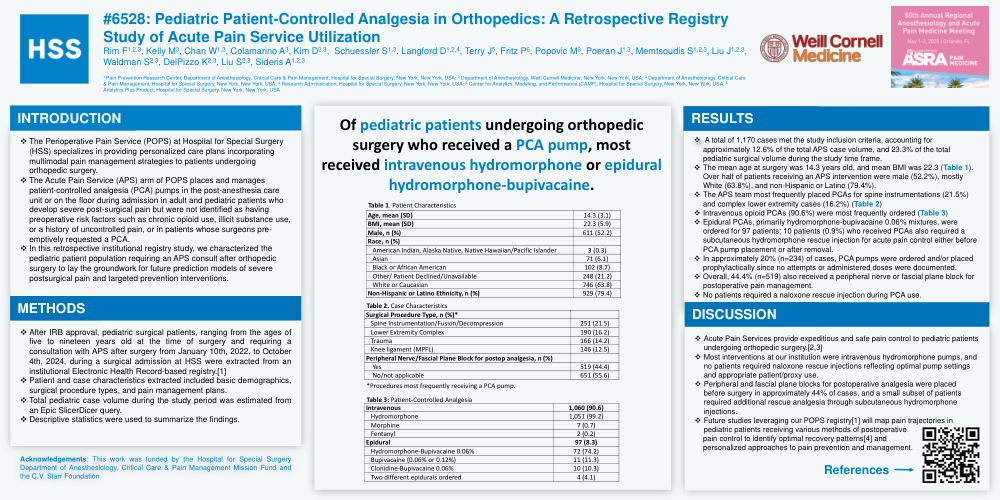
The Perioperative Pain Service (POPS) at Hospital for Special Surgery (HSS) specializes in providing personalized care plans incorporating multimodal pain management strategies to patients undergoing orthopedic surgery. The Acute Pain Service (APS) arm of POPS places and manages patient-controlled analgesia (PCA) pumps in the post-anesthesia care unit or on the floor during admission in adult and pediatric patients who develop severe post-surgical pain but were not identified as having preoperative risk factors such as chronic opioid use, illicit substance use, or a history of uncontrolled pain, or in patients whose surgeons pre-emptively requested a PCA. In this retrospective institutional registry study, we characterized the pediatric patient population requiring an APS consult after orthopedic surgery to lay the groundwork for future prediction models of severe postsurgical pain and targeted prevention interventions.
Methods
After IRB approval, pediatric surgical patients, ranging from the ages of five to nineteen years old at the time of surgery and requiring a consultation with APS after surgery from January 10th, 2022, to October 4th, 2024, during a surgical admission at HSS were extracted from an institutional Electronic Health Record-based registry.[1] Patient and case characteristics extracted included basic demographics, surgical procedure types, and pain management plans. Total pediatric case volume during the study period was estimated from an Epic SlicerDicer query. Descriptive statistics were used to summarize the findings.
Results
A total of 1,170 cases met the study inclusion criteria, accounting for approximately 12.6% of the total APS case volume, and 23.3% of the total pediatric surgical volume during the study time frame. The mean age at surgery was 14.3 years old, and mean BMI was 22.3 (table 1). Over half of patients receiving an APS intervention were male (52.2%), mostly White (63.8%), and non-Hispanic or Latino (79.4%). The APS team most frequently placed PCAs for spine instrumentations (21.5%) and complex lower extremity cases (16.2%), and most frequently ordered an intravenous opioid PCA (90.6%). Epidural PCAs, primarily hydromorphone-bupivacaine 0.06% mixtures, were ordered for 97 patients; 10 patients (0.9%) who received PCAs also required a subcutaneous hydromorphone rescue injection for acute pain control either before PCA pump placement or after removal. In approximately 20% (n=234) of cases, PCA pumps were ordered and/or placed prophylactically since no attempts or administered doses were documented. Overall, 44.4% (n=519) also received a peripheral nerve or fascial plane block for postoperative pain management. No patients required a naloxone rescue injection during PCA use.
Conclusions & Discussion
Acute Pain Services provide expeditious and safe pain control to pediatric patients undergoing orthopedic surgery.[2,3] Most interventions at our institution were intravenous hydromorphone pumps, and no patients required naloxone rescue injections reflecting optimal pump settings and appropriate patient/proxy use. Peripheral and fascial plane blocks for postoperative analgesia were placed before surgery in approximately 44% of cases, and a small subset of patients required additional rescue analgesia through subcutaneous hydromorphone injections. Future studies leveraging our POPS registry[1] will map pain trajectories in pediatric patients receiving various methods of postoperative pain control to identify optimal recovery patterns[4] and personalized approaches to pain prevention and management.
References
- Rim F, Kelly M, Chan W, Schuessler S, Plourde M, POPS Steering Committee, Liu S, Sideris A. EP022 Acute pain service utilization in an orthopedic specialty hospital. Regional Anesthesia & Pain Medicine 2023;48:A50-A51.
- Donado C, Solodiuk J, Rangel SJ, Nelson CP, Heeney MM, Mahan ST, Ullrich C, Tsegaye B, Berde CB. Patient- and Nurse-Controlled Analgesia: 22-Year Experience in a Pediatric Hospital. Hosp Pediatr. 2019 Feb;9(2):129-133.
- Sharp D, Jaffrani A. A PRISMA Systematic Review on the Safety and Efficacy of Patient-Controlled Analgesia (PCA) in Pediatrics. J Pediatr Nurs. 2021 Nov-Dec;61:219-223.
- Einhorn LM, Monitto CL, Ganesh A, Duan Q, Lee J, Ramamurthi RJ, Barnett K, Ding L, Chidambaran V. Multi-Institutional Study of Multimodal Analgesia Practice, Pain Trajectories, and Recovery Trends After Spine Fusion for Idiopathic Scoliosis. Anesth Analg. 2025 Jan 2. Epub ahead of print. PMID: 39745877.