383 posters, 2 videos, 1 audios, 8 topics, 28 sessions, 328 authors, 225 institutions
ePostersLive by SciGen Technologies S.A. All rights reserved.
50th Annual Regional Anesthesiology and Acute Pain Medicine Meeting
May 1 - 3, 2025 | Orlando, Florida

6890
SINGLE-CENTRE TRENDS IN NEURAXIAL TECHNIQUE-DRUG COMBINATIONS AND PERIPHERAL NERVE BLOCK COMBINATIONS FOR TOTAL HIP ARTHROPLASTY
Poster Presenter
Authors
Affiliations
Part of Topic
Scientific Abstracts > Regional Anesthesia
Introduction: Regional anesthesia —neuraxial anesthesia and peripheral nerve blocks (PNBs)—
has been associated with improved outcomes in total hip arthroplasty (THA). While expert-
consensus has recommended their implementation, consensus is missing regarding optimal
operationalization[1, 2]. Moreover, while studies have described increasing use of neuraxial
anesthesia alongside lagging growth in PNB utilization[3], a more detailed description of how
regional anesthesia is operationalized —e.g. type of neuraxial or peripheral nerve block, or
specific medications used— is missing. Our institution has a high volume of regional anesthesia,
making our data uniquely suited to describe granular regional anesthesia practice patterns. Such
data may inform others in their goal to implement or enhance regional anesthesia in their
practice. Thus, we aimed to describe 1) the most common neuraxial technique and medication
combinations, and 2) the most common PNB combinations in THA.
Methods: This single-center retrospective cohort study received Institutional Review Board
approval (IRB#2022-2392). Adult patients undergoing inpatient and outpatient THA between
January 1, 2021-January 19, 2023 were included. Exposures of interest were neuraxial anesthesia
—described as usage, neuraxial technique, neuraxial medication of choice and second neuraxial
medication, if any— and PNBs —described as usage, location/type and number of PNBs, up to
3—. We described the five most frequently used neuraxial technique-drug combination pairs and
the five most frequent PNB location/type combinations.
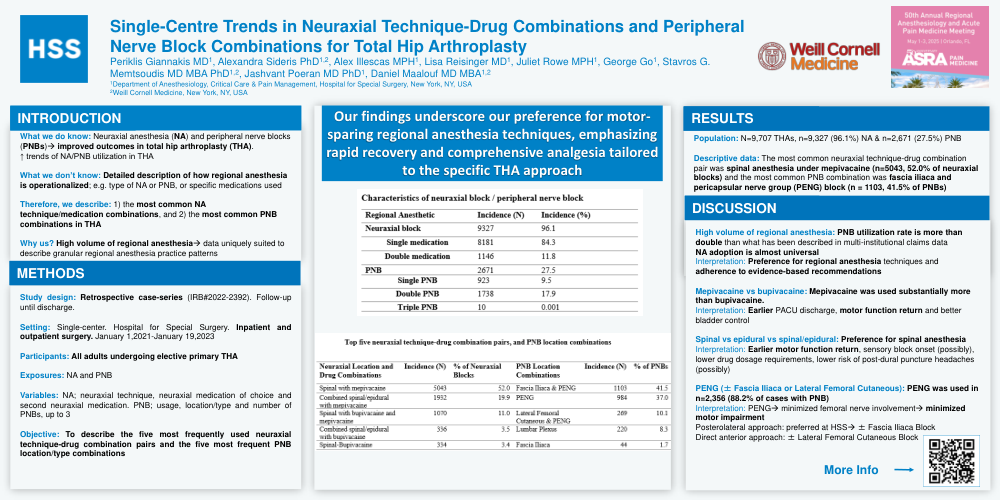
Results: Among N=9707 THAs (Table 1), n=9327 (96.1%) cases received neuraxial block,
mostly with a single neuraxial medication, while PNBs were used in n=2671 (27.5%) cases, for
the majority of which a two PNB combination was used (Table 2). The most common neuraxial
technique-drug combination pair was spinal anesthesia under mepivacaine (n=5043, 52.0% of
neuraxial blocks) and the most common PNB combination was fascia iliaca and pericapsular
nerve group (PENG) block (n = 1103, 41.5% of PNBs); the top 5 for neuraxial and PNBs are
described in more detail in Table 3.
Discussion: Using descriptive data from an institution with high volume of regional anesthesia,
our study provides unique granular descriptive data on how we have operationalized regional
anesthesia. Our PNB utilization rate is more than double than what has been described in multi-
institutional claims data[3], while our neuraxial block adoption is almost universal, indicating
our preference for regional anesthesia techniques and our adherence to evidence-based
recommendations[1, 2].
Mepivacaine was used substantially more than bupivacaine, as it has been linked to earlier
PACU discharge, motor function return and bladder control compared to bupivacaine[4]. Our
institutional preference for spinal anesthesia over spinal/epidural techniques shares the same
motive for earlier motor function return with the possible additional advantage of earlier sensory
block onset with lower drug dose requirements and the lower risk of post-dural puncture
headaches[4]. Our focus on motor-sparing regional anesthesia is also evident in our PNB
practice, as PENG blocks, which minimize femoral nerve involvement and thus motor
impairment, were used in all top three PNB combinations[5]. Finally, the frequent use of fascia
iliaca and PENG block combination, our most common PNB combination, can largely be
explained by our institution’s preference for the posterolateral approach in THAs [6].
The primary limitation of our data is their potentially restricted generalizability, as our
institutional preferences may not reflect broader national/international patterns. Moreover, this
analysis spans both inpatient and outpatient THA; it is unclear to what extent the continued
transition to outpatient THA will impact these patterns.
In conclusion, these descriptive data from an institution specialized in regional anesthesia may
inform others in their goal to implement or enhance regional anesthesia. Our findings underscore
an institutional preference for motor-sparing regional anesthesia techniques, emphasizing rapid
recovery and comprehensive analgesia tailored to the specific THA approach.
In conclusion, our findings underscore our preference for motor-sparing regional anesthesia
techniques, emphasizing rapid recovery and comprehensive analgesia tailored to the specific
THA approach.