383 posters, 2 videos, 1 audios, 8 topics, 28 sessions, 328 authors, 225 institutions
ePostersLive by SciGen Technologies S.A. All rights reserved.
50th Annual Regional Anesthesiology and Acute Pain Medicine Meeting
May 1 - 3, 2025 | Orlando, Florida

6660
EXTERNAL OBLIQUE INTERCOSTAL BLOCK: UTILITY FOR MANAGEMENT OF POST-OPERATIVE PAIN IN LIVER TRANSPLANTS
Poster Presenter
Authors
Affiliations
Part of Topic
Scientific Abstracts > Regional Anesthesia
External Oblique Intercostal Block Catheters for Liver Transplant Postoperative Pain Management
A Retrospective Study
Ashton Pike, Austin Peters, Nathalie Lunden, Carolyn Heeder, Ryan Ivie
INTRO
• Regional pain management in liver transplants remains difficult due to
inherent coagulopathy and limitations of existing block techniques
• This study evaluates the impact of external oblique intercostal (EOI)
catheter blocks on postoperative opioid consumption in liver transplant
patients
METHODS
• Single center, retrospective study
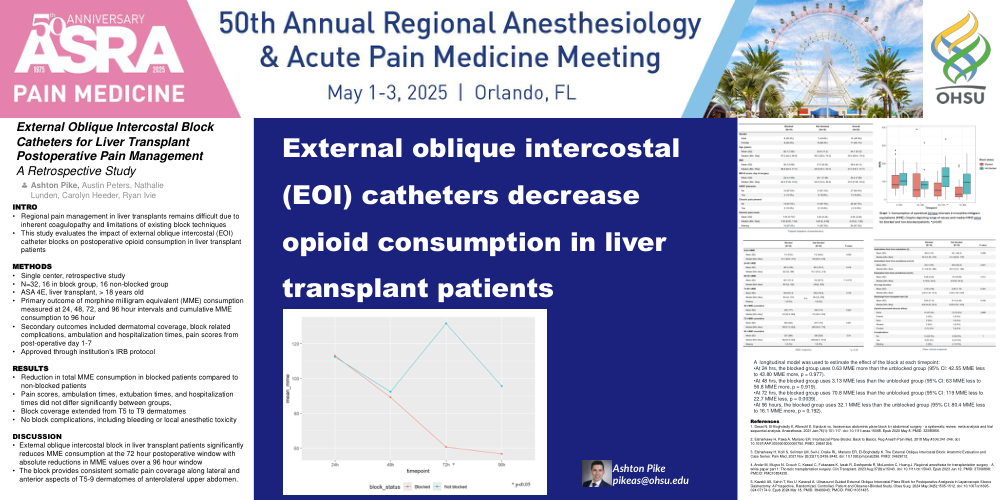
• N=32, 16 in block group, 16 non-blocked group
• ASA 4E, liver transplant, > 18 years old
• Primary outcome of morphine milligram equivalent (MME) consumption
measured at 24, 48, 72, and 96 hour intervals and cumulative MME
consumption to 96 hour
• Secondary outcomes included dermatomal coverage, block related
complications, ambulation and hospitalization times, pain scores from
post-operative day 1-7
• Approved through institution’s IRB protocol
RESULTS
• Reduction in total MME consumption in blocked patients compared to
non-blocked patients
• Pain scores, ambulation times, extubation times, and hospitalization
times did not differ significantly between groups,
• Block coverage extended from T5 to T9 dermatomes
• No block complications, including bleeding or local anesthetic toxicity
DISCUSSION
• External oblique intercostal block in liver transplant patients significantly
reduces MME consumption at the 72 hour postoperative window with
absolute reductions in MME values over a 96 hour window
• The block provides consistent somatic pain coverage along lateral and
anterior aspects of T5-9 dermatomes of anterolateral upper abdomen.
A longitudinal model was used to estimate the effect of the block at each timepoint: