383 posters, 2 videos, 1 audios, 8 topics, 28 sessions, 328 authors, 225 institutions
ePostersLive by SciGen Technologies S.A. All rights reserved.
50th Annual Regional Anesthesiology and Acute Pain Medicine Meeting
May 1 - 3, 2025 | Orlando, Florida

6562
NO CORRELATION BETWEEN PATIENT DEMOGRAPHICS AND SPINAL MEPIVACAINE DURATION IN TOTAL JOINT ARTHROPLASTIES: A RETROSPECTIVE REVIEW
Poster Presenter
Authors
Affiliations
Part of Topic
Scientific Abstracts > Regional Anesthesia
INTRODUCTION
•Strong trend toward performing same-day joint replacement surgeries at Ambulatory Surgery Centers (ASCs) where rapid throughput is paramount.
•Isobaric mepivacaine is a popular choice for spinal anesthesia in total knee arthroplasties (TKAs) and total hip arthroplasties (THAs) due to its intermediate duration of action.
•Traditionally, dosing for spinal anesthesia has been adjusted based on patient factors.
•Delayed recovery from spinal anesthesia may increase PACU length of stay, decreasing ASC throughput.
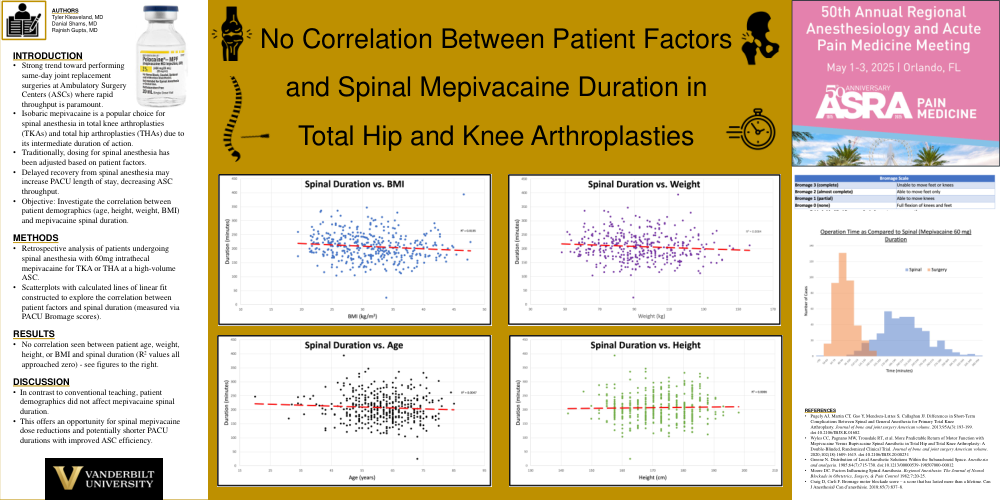
•Objective: Investigate the correlation between patient demographics (age, height, weight, BMI) and mepivacaine spinal duration.
METHODS
•Retrospective analysis of patients undergoing spinal anesthesia with 60mg intrathecal mepivacaine for TKA or THA at a high-volume ASC.
•Scatterplots with calculated lines of linear fit constructed to explore the correlation between patient factors and spinal duration (measured via PACU Bromage scores).
RESULTS
•No correlation seen between patient age, weight, height, or BMI and spinal duration (R2 values all approached zero) - see figures to the right.
DISCUSSION
•In contrast to conventional teaching, patient demographics did not affect mepivacaine spinal duration.
•This offers an opportunity for spinal mepivacaine dose reductions and potentially shorter PACU durations with improved ASC efficiency.