383 posters, 2 videos, 1 audios, 8 topics, 28 sessions, 328 authors, 225 institutions
ePostersLive by SciGen Technologies S.A. All rights reserved.
50th Annual Regional Anesthesiology and Acute Pain Medicine Meeting
May 1 - 3, 2025 | Orlando, Florida

6480
A RETROSPECTIVE REVIEW OF QUADRATUS LUMBORUM BLOCK FOR ANALGESIA AFTER MINIMALLY INVASIVE HYSTERECTOMY
Poster Presenter
Part of Topic
Scientific Abstracts > Regional Anesthesia
A Retrospective Review of Quadratus Lumborum Block for Analgesia after Minimally Invasive Hysterectomy
Introduction
• Analgesic efficacy of the quadratus lumborum block (QLB) for laparoscopic and robotic surgeries remain controversial [1-5].
• Hypothesis: preoperative bilateral anterior QLB will reduce postoperative opioid consumption and pain severity in minimally invasive hysterectomies (MIH).
Methods
• Retrospective analysis of 1,673 patients who underwent robotic or laparoscopic hysterectomies at UAB between Jan. 2, 2019 and Dec. 28, 2023.
• 316 (18.9%) patients received preoperative bilateral QLB with 50-60 mL 0.25% ropivacaine, and remaining 1,357 (81.1%) did not receive the block
• Primary outcome:
o Cumulative 24-hr postoperative MME
• Secondary outcome:
o Cumulative MME at other postoperative time intervals (1, 6, 12, 48 hrs)
o Pain scores at each time interval
o Time to ambulation
o Time to first postoperative opioid
o Incidence of nausea
• Statistical analyses were performed using two-sample t-tests, chi-square tests, and log-rank tests.
Results
• QLB group vs No Block group:
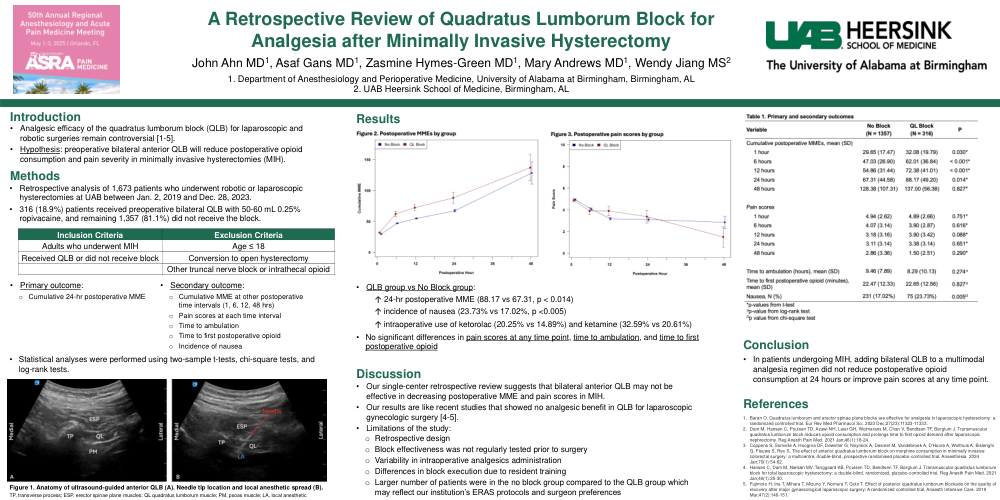
↑24-hr postoperative MME (88.17 vs 67.31, p < 0.014)
↑ incidence of nausea (23.73% vs 17.02%, p <0.005)
↑ intraoperative use of ketorolac (20.25% vs 14.89%) and ketamine (32.59% vs 20.61%)
• No significant differences in pain scores at any time point, time to ambulation, and time to first postoperative opioid
Discussion
• Our single-center retrospective review suggests that bilateral anterior QLB may not be effective in decreasing postoperative MME and pain scores in MIH.
• Our results are like recent studies that showed no analgesic benefit in QLB for laparoscopic gynecologic surgery [4-5].
• Limitations of the study:
o Retrospective design
o Block effectiveness was not regularly tested prior to surgery
o Variability in intraoperative analgesics administration
o Differences in block execution due to resident training
o Larger number of patients were in the no block group compared to the QLB group which may reflect our institution’s ERAS protocols and surgeon preferences
Conclusion
• In patients undergoing MIH, adding bilateral QLB to a multimodal analgesia regimen did not reduce postoperative opioid consumption at 24 hours or improve pain scores at any time point.