383 posters, 2 videos, 1 audios, 8 topics, 28 sessions, 328 authors, 225 institutions
ePostersLive by SciGen Technologies S.A. All rights reserved.
50th Annual Regional Anesthesiology and Acute Pain Medicine Meeting
May 1 - 3, 2025 | Orlando, Florida

6802
HARNESSING ARTIFICIAL INTELLIGENCE TO ADDRESS BURNOUT SYMPTOMOLOGY IN REGIONAL ANESTHESIA AND PAIN MEDICINE PHYSICIANS
Poster Presenter
Part of Topic
Scientific Abstracts > Emerging Technology
Harnessing Artificial intelligence to Address Burnout Symptomology in Regional Anesthesia and Pain Medicine Physicians
Samuel J Smith, BS; Kristopher Schroeder, MD, FASA, FASRA; Nathan Hurley, MD
Department of Anesthesiology, University of Wisconsin School of Medicine and Public Health
Introduction:
Anesthesiology is an exceptionally demanding field of medicine associated with high rates of physician burnout and dissatisfaction. Efforts to address burnout are ongoing, however the underlying causes of burnout are frequently poorly understood and those practicing regional anesthesia and pain management may be at elevated risk for burnout symptomology.
Objectives:
For any given hypothetical anesthesiologist life situations, assess the ability of ChatGPT to identify:
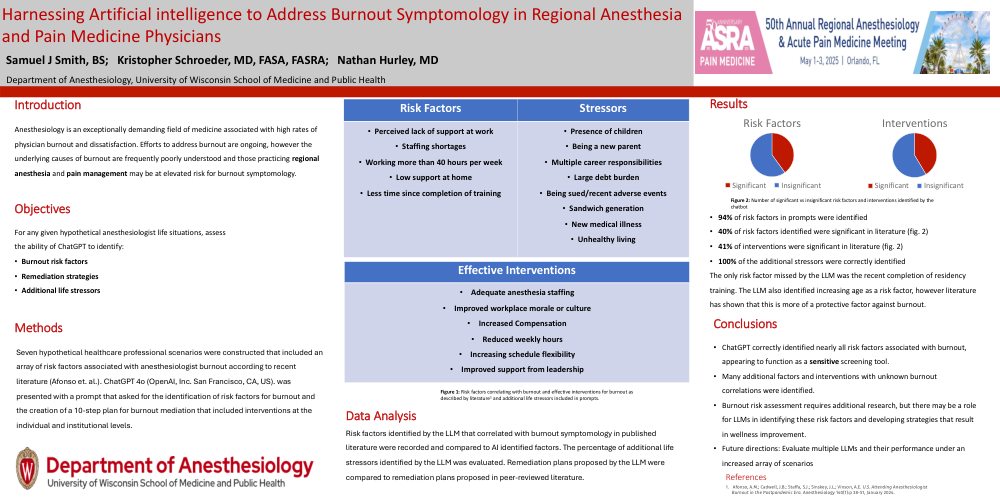
Seven hypothetical healthcare professional scenarios were constructed that included an array of risk factors associated with anesthesiologist burnout according to recent literature (Afonso et. al.). ChatGPT 4o (OpenAI, Inc. San Francisco, CA, US). was presented with a prompt that asked for the identification of risk factors for burnout and the creation of a 10-step plan for burnout mediation that included interventions at the individual and institutional levels.
Data Analysis:
Risk factors identified by the LLM that correlated with burnout symptomology in published literature were recorded and compared to AI identified factors. The percentage of additional life stressors identified by the LLM was evaluated. Remediation plans proposed by the LLM were compared to remediation plans proposed in peer-reviewed literature.
Results:
The only risk factor missed by the LLM was the recent completion of residency training. The LLM also identified increasing age as a risk factor, however literature has shown that this is more of a protective factor against burnout.
Conclusions: