383 posters, 2 videos, 1 audios, 8 topics, 28 sessions, 328 authors, 225 institutions
ePostersLive by SciGen Technologies S.A. All rights reserved.
50th Annual Regional Anesthesiology and Acute Pain Medicine Meeting
May 1 - 3, 2025 | Orlando, Florida

6625
MAIN FACTORS FOR PREVENTING DISLOCATION OF PERIPHERAL NERVE CATHETERS
Poster Presenter
Authors
Affiliations
Part of Topic
Scientific Abstracts > Emerging Technology
Preventing secondary dislocation of peripheral nerve block catheters
Internal fixation mechanisms
Kai H.W. Lange, Christian Rothe, Martin Wraber, Jakob Schlünsen, Tore V.C. Allerup
INTRO
-
Peripheral nerve block catheters have unacceptably high failure rates, preventing clinical adoption.
-
Secondary dislocation is a key problem and needs to be addressed for future nerve block catheter designs.
ANALYSIS
-
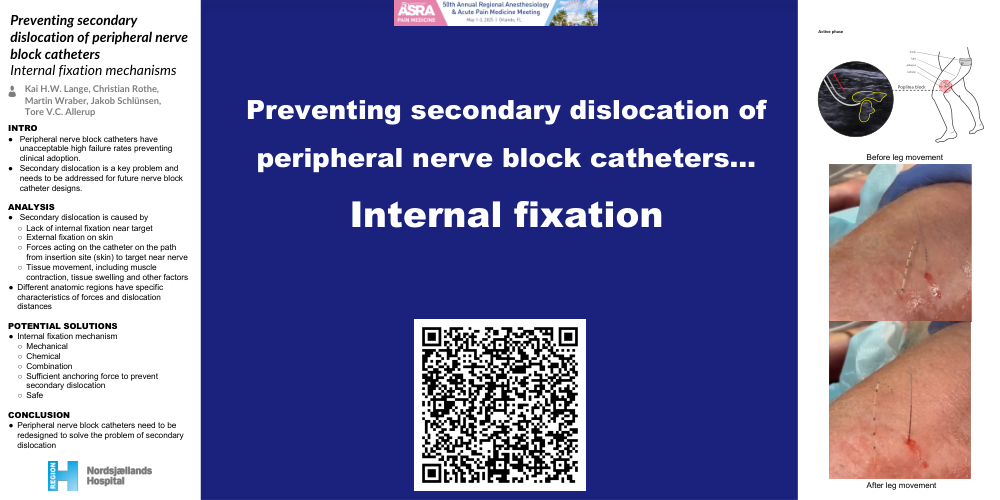
Secondary dislocation is caused by
-
Lack of internal fixation near target
-
External fixation on skin
-
Forces acting on the catheter on the path from insertion site (skin) to target near nerve
-
Tissue movement, including muscle contraction, tissue swelling and other factors
-
Different anatomic regions have specific characteristics of forces and dislocation distances
-
POTENTIAL SOLUTIONS
-
Internal fixation mechanism
-
Mechanical
-
Chemical
-
Combination
-
Sufficient anchoring force to prevent secondary dislocation
-
Safe
CONCLUSION
-
Peripheral nerve block catheters need to be redesigned to solve the problem of secondary dislocation