383 posters, 2 videos, 1 audios, 8 topics, 28 sessions, 328 authors, 225 institutions
ePostersLive by SciGen Technologies S.A. All rights reserved.
50th Annual Regional Anesthesiology and Acute Pain Medicine Meeting
May 1 - 3, 2025 | Orlando, Florida

6520
SAFE AND SUSTAINABLE: NEWER CADAVER PRESERVATION FOR FUTURE ANESTHESIA TRAINING
Poster Presenter
Authors
Affiliations
Part of Topic
Scientific Abstracts > Education
Safe and Sustainable: Newer Cadaver Preservation for Future Anesthesia Training
Introduction
With the growing field of regional anesthesiology requiring
anatomic expertise and ultrasound precision, cadaver
education has the potential to be a stalwart for learning.
Formaldehyde-based preservation methods are commonly
utilized, along with phenol-based and fresh-frozen methods.
- A newer embalming solution, referred to as Green,
preserves the colors, textures, and pliability of the body
tissues, and provides long term preservation of cadavers.
- Green techniques also are potentially less toxic than
formaldehyde, which is a known carcinogen.
- The non-toxic and alive-like properties of these cadavers
could prove beneficial in training for regional
anesthesiology by providing more realistic conditions for
ultrasound-guided nerve blocks.
We set out to compare the realistic qualities of the Green
cadaver and traditional cadaver when performing peripheral
nerve blocks.
Methods
- An 8-item questionnaire was developed to compare each
cadaver to a live human.
- This questionnaire was developed based upon literature
review and Inter-rater reliability.
- Ten regional anesthesiologist evaluators completed the
questionnaire.
-- Each rater performed ultrasound guided perineural
injections
- Each question was answered via a rating on a Likert scale
from 1 to 10. The gold standard (score of 10) is what one
would expect on a live patient.
- Two cadavers were studied, one preserved by the
traditional formaldehyde formulation, while the other
preserved in the Green (GreenMBalm® (Green Solutions,
Burlington, NC)) method
- Responses to each question were compared to each
other via the Kruskal-Wallis Rank Sum Test.
- An interclass correlation coefficient was also calculated
to test inter-rater reliability
Results
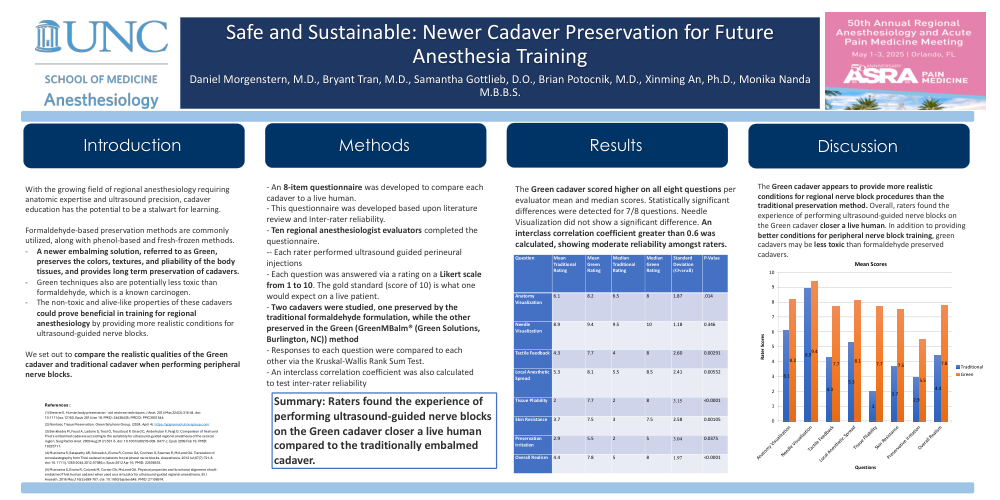
The Green cadaver scored higher on all eight questions per
evaluator mean and median scores. Statistically significant
differences were detected for 7/8 questions. Needle
Visualization did not show a significant difference. An
interclass correlation coefficient greater than 0.6 was
calculated, showing moderate reliability amongst raters.
Discussion
The Green cadaver appears to provide more realistic
conditions for regional nerve block procedures than the
traditional preservation method. Overall, raters found the
experience of performing ultrasound-guided nerve blocks on
the Green cadaver closer a live human. In addition to providing
better conditions for peripheral nerve block training, green
cadavers may be less toxic than formaldehyde preserved
cadavers.
Summary: Raters found the experience of
performing ultrasound-guided nerve blocks
on the Green cadaver closer a live human
compared to the traditionally embalmed
cadaver.