Loading...

383 posters, 2 videos, 1 audios, 8 topics, 28 sessions, 328 authors, 225 institutions

ePostersLive by SciGen Technologies S.A. All rights reserved.

6446

PROSPECTIVE OBSERVATIONAL STUDY OF POST SURGICAL PAIN IN WOMEN UNDERGOING MASTECTOMY SURGERY
Poster Presenter

Uchenna Umeh

Part of Topic

Scientific Abstracts > Chronic Pain

Prospective Observational Study of Post Surgical Pain in Women undergoing Mastectomy Surgery: Post Surgical Pain After Mastectomy (PPAM) Study

Umeh UO.1,2, Park HG.3 Cuevas R.4, Martinez H.4, Perez R.4, Cata J.5, Wang J.4,6 Doan LV.4

1Department of Anesthesiology, Critical Care, & Pain Management, Hospital for Special Surgery; 2Department of Anesthesiology, Weill Cornell Medicine; 3Department of Population Health, NYU Grossman School of Medicine; 4Department of Anesthesiology, Perioperative Care and Pain Medicine, NYU Grossman School of Medicine; 5Department of Anesthesiology and Perioperative Medicine, MD Anderson Cancer Center; 6Department of Neuroscience and Physiology, NYU Grossman School of Medicine

Introduction

-Breast cancer survivors who have undergone mastectomy with and without chemotherapy and radiation are at risk of developing Post Mastectomy Pain Syndrome (PMPS).
-Socio-demographic factors such as race, ethnicity, and neighborhood disadvantage are risk factors for the development of PMPS.
-This observational study assessed development of PMPS across different race, ethnic and socio-demographic categories such income, education, employment, insurance type and marital status for women undergoing mastectomy.
 
Methods

-Two center, prospective, observational study supported by the NIH HEAL initiative (award # UH3CA261067) and approved by the University of Utah IRB

-The study included women between 18 and 85 years of age, undergoing mastectomy surgery

-The primary outcomes were the Brief Pain Inventory (BPI) pain severity subscale and the presence of PMPS, defined as the binary indicator of BPI average item score > 0, at 3 months post-surgery

-All All analyses were conducted in R Statistical Software

Results

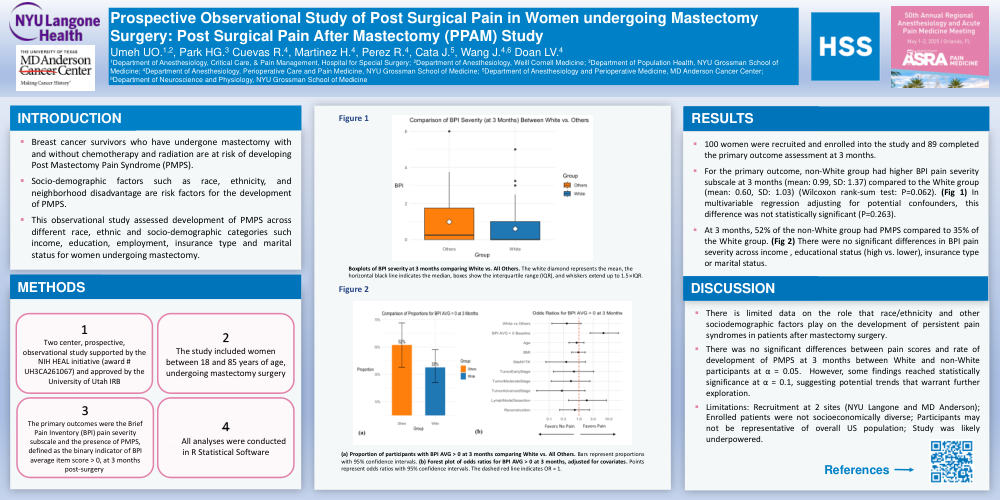
-100 women were recruited and enrolled into the study and 89 completed the primary outcome assessment at 3 months.
-For the primary outcome, non-White group had higher BPI pain severity subscale at 3 months (mean: 0.99, SD: 1.37) compared to the White group (mean: 0.60, SD: 1.03) (Wilcoxon rank-sum test: P=0.062). (Fig 1) In multivariable regression adjusting for potential confounders, this difference was not statistically significant (P=0.263).
-At 3 months, 52% of the non-White group had PMPS compared to 35% of the White group. (Fig 2) There were no significant differences in BPI pain severity across income , educational status (high vs. lower), insurance type or marital status.
 
Discussion
 
-There is limited data on the role that race/ethnicity and other sociodemographic factors play on the development of persistent pain syndromes in patients after mastectomy surgery.
-There was no significant differences between pain scores and rate of development of PMPS at 3 months between White and non-White participants at α = 0.05.  However, some findings reached statistically significance at α = 0.1, suggesting potential trends that warrant further exploration.
-Limitations: Recruitment at 2 sites (NYU Langone and MD Anderson); Enrolled patients were not socioeconomically diverse; Participants may not be representative of overall US population; Study was likely underpowered.
asraspring2025 banner
Copyright © 2015-2026, ePostersLive® SciGen is a registered trademark of SciGen Technologies S.A. Patent pending.

This website and third-party tools we use rely on cookies for the best user experience. By selecting "I agree", you agree to cookie usage as described in our Privacy Policy.
