383 posters, 2 videos, 1 audios, 8 topics, 28 sessions, 328 authors, 225 institutions
ePostersLive by SciGen Technologies S.A. All rights reserved.
50th Annual Regional Anesthesiology and Acute Pain Medicine Meeting
May 1 - 3, 2025 | Orlando, Florida

6579
THORACIC SPINAL ANAESTHESIA FOR OPEN PALLIATIVE COLORECTAL SURGERY – A CASE SERIES
Poster Presenter
Part of Topic
Scientific Abstracts > Case Series
Audio
THORACIC SPINAL ANAESTHESIA FOR OPEN PALLIATIVE COLORECTAL SURGERY – A CASE SERIES
Authors:
Presenting author: deGraft-Johnson, Papa Kobina Gyakye
Co-authors : Djagbletey, Robert; Chin, KiJinn
Introduction
One of the significant risk factors identified as being associated with poor outcomes in elective and emergency surgical patients is frailty.1 Although general anaesthesia with endotracheal intubation and muscle relaxation is the conventional approach to open colorectal surgery, general anaesthesia in the frail patient or those with advanced tumours for palliative colorectal surgery increases the risk of requiring postoperative high-dependency or intensive care with ventilatory support. In resource-limited environments such as Ghana, where intensive care facilities are scarce, this poses a dilemma for anaesthetists in the appropriate choice of anaesthetic technique for high-risk patients requiring colorectal surgery.
Thoracic spinal anaesthesia (TSA) is one option for providing surgical anaesthesia in open and laparoscopic abdominal surgery that can minimize adverse respiratory effects and maintain haemodynamic stability.2,3 We present the successful management of five cases of advanced colorectal cancers who had diversion colostomies under thoracic spinal anaesthesia without the need for postoperative intensive care support.
Material and Methods
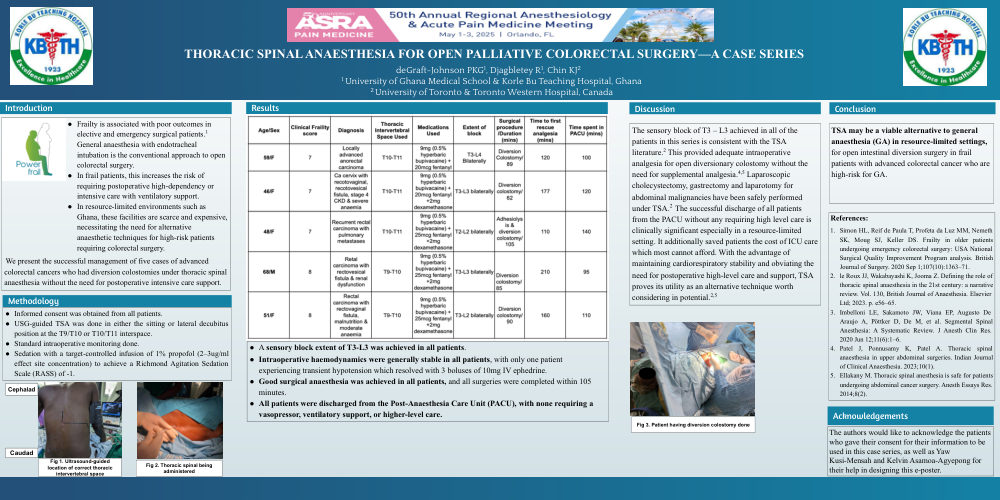
Informed consent was obtained from all patients for inclusion in this report. Prior to TSA, ultrasound guidance was used to accurately locate the interspace for injection. Under strict asepsis and after local skin infiltration with lidocaine, TSA was done in either the sitting or lateral decubitus position at the T9/T10 or T10/T11 interspace using a 25G or 26G pencil point needle. 0.5% isobaric or hyperbaric bupivacaine 9mg (1.8ml), 25mcg fentanyl and 2mg preservative-free dexamethasone was injected intrathecally. The extent of sensory block was tested pre-incision using loss of cold sensation. Intraoperative monitoring included non-invasive blood pressure (NIBP), pulse oximetry (SpO2) and electrocardiography (ECG). Patients received intranasal oxygen with capnography monitoring and were sedated with a target-controlled infusion of 1% propofol (2 – 3ug/ml effect site concentration) to achieve a Richmond Agitation Sedation Scale (RASS) of -1.
Results
A sensory block extent of T3 – L3 was achieved in all patients. Intraoperative haemodynamics were generally stable in all patients with only one patient experiencing transient hypotension within 5 minutes of intrathecal injection. This resolved with three 10mg IV ephedrine boluses and the patient was stable during the remainder of the anaesthetic. Good surgical anaesthesia was achieved in all patients and all surgeries were completed within 105 minutes. All patients were discharged from the Post Anaesthesia Care Unit (PACU) within 140 minutes with none requiring vasopressor or ventilatory support or higher-level care.
Discussion
The sensory block of T3 – L3 achieved in all of the patients in this series is consistent with the TSA literature.2 This provided adequate intraoperative analgesia for open diversionary colostomy without the need for supplemental analgesia.4,5 Laparoscopic cholecystectomy, gastrectomy and laparotomy for abdominal malignancies have been safely performed under TSA.2 With the advantage of maintaining cardiorespiratory stability and obviating the need for postoperative high-level care and support, TSA proves its utility as an anaesthetic technique worth considering in the cohort of high-risk patients requiring colorectal surgery.2,5
Conclusion
TSA may be a viable alternative to general anaesthesia (GA) for open intestinal diversion surgery in frail patients with advanced colorectal cancer who are high risk for GA.
References:
1. Simon HL, Reif de Paula T, Profeta da Luz MM, Nemeth SK, Moug SJ, Keller DS. Frailty in older patients undergoing emergency colorectal surgery: USA National Surgical Quality Improvement Program analysis. British Journal of Surgery. 2020 Sep 1;107(10):1363–71.
2. le Roux JJ, Wakabayashi K, Jooma Z. Defining the role of thoracic spinal anaesthesia in the 21st century: a narrative review. Vol. 130, British Journal of Anaesthesia. Elsevier Ltd; 2023. p. e56–65.
3. Imbelloni LE, Sakamoto JW, Viana EP, Augusto De Araujo A, Pöttker D, De M, et al. Segmental Spinal Anesthesia: A Systematic Review. J Anesth Clin Res. 2020 Jun 12;11(6):1–6.
4. Patel J, Ponnusamy K, Patel A. Thoracic spinal anaesthesia in upper abdominal surgeries. Indian Journal of Clinical Anaesthesia. 2023;10(1).
5. Ellakany M. Thoracic spinal anesthesia is safe for patients undergoing abdominal cancer surgery. Anesth Essays Res. 2014;8(2).