383 posters, 2 videos, 1 audios, 8 topics, 28 sessions, 328 authors, 225 institutions
ePostersLive by SciGen Technologies S.A. All rights reserved.
50th Annual Regional Anesthesiology and Acute Pain Medicine Meeting
May 1 - 3, 2025 | Orlando, Florida

6856
EVALUATING CERVICAL ESP BLOCKS FOR POSTERIOR CERVICAL SPINE SURGERY: A CASE SERIES
Poster Presenter
Authors
Affiliations
Part of Topic
Scientific Abstracts > Acute Pain
Introduction
•Spine surgery is associated with significant postoperative pain, warranting a robust multimodal approach to analgesia.
•Multiple studies support the use of Erector Spinae Plane Blocks (ESPBs) in lumbar spine surgery to decrease opiate consumption and improve recovery1.
•To date, no clinical studies have evaluated the efficacy of cervical ESPBs for cervical spine surgery.
Methods
•This was a single-center retrospective cohort study of ASA 2-3 patients undergoing elective PCDF for cervical myelopathy from July 2022 until October 2024
•Eight (8) patients underwent pre-incisional cervical ESP block with either Ropivacaine or Liposomal Bupivacaine and were compared to a match-paired institutional-specific cohort.
•Primary outcome was opiate consumption in oral morphine equivalents for the first 72 hours.
•Secondary outcomes included total inpatient average opiate consumption, PACU and hospital LOS, time to clearance by PT, cardiopulmonary adverse events, and unplanned ICU admission.
Results
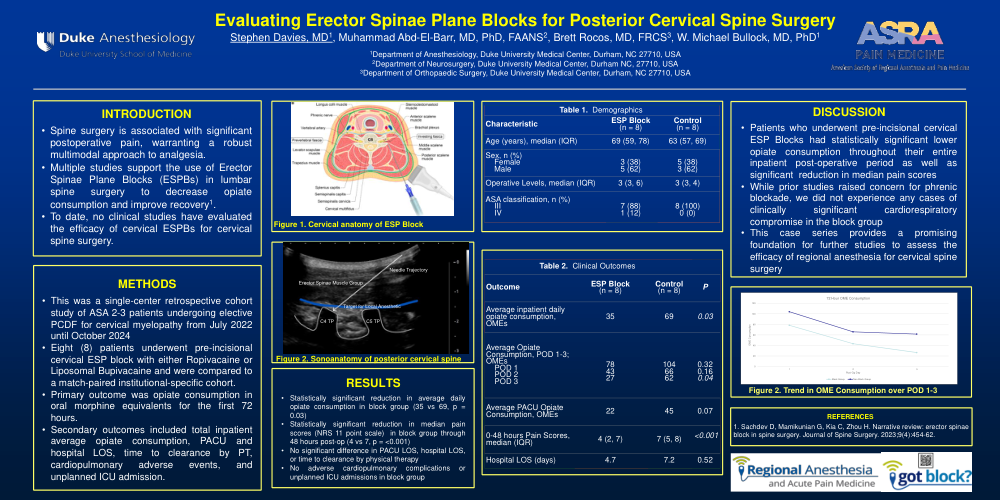
•Statistically significant reduction in average daily opiate consumption in block group (35 vs 69, p = 0.03)
•Statistically significant reduction in median pain scores (NRS 11 point scale) in block group through 48 hours post-op (4 vs 7, p = <0.001)
•No significant difference in PACU LOS, hospital LOS, or time to clearance by physical therapy
•No adverse cardiopulmonary complications or unplanned ICU admissions in block group
Discussion
•Patients who underwent pre-incisional cervical ESP Blocks had statistically significant lower opiate consumption throughout their entire inpatient post-operative period as well as significant reduction in median pain scores
•While prior studies raised concern for phrenic blockade, we did not experience any cases of clinically significant cardiorespiratory compromise in the block group
•This case series provides a promising foundation for further studies to assess the efficacy of regional anesthesia for cervical spine surgery