383 posters, 2 videos, 1 audios, 8 topics, 28 sessions, 328 authors, 225 institutions
ePostersLive by SciGen Technologies S.A. All rights reserved.
50th Annual Regional Anesthesiology and Acute Pain Medicine Meeting
May 1 - 3, 2025 | Orlando, Florida

6808
COMBINING PARAVERTEBRAL BLOCK WITH CESAREAN SECTION: A NOVEL APPROACH TO POSTOPERATIVE ANALGESIA
Poster Presenter
Authors
Affiliations
Part of Topic
Scientific Abstracts > Acute Pain
Combining Paravertebral Block with Cesarean Section: A Novel Approach to Postoperative Analgesia
Maya Menon MD; Nicholas Schott MD
Introduction
Traditionally, intrathecal morphine has been the gold standard for postoperative analgesia following cesarean section (C-section). While effective, some patients require alternative approaches due to conditions such as morphine allergy, opioid-induced hyperalgesia, or opioid use disorder. The transversus abdominis plane (TAP) block is commonly utilized for post-C-section analgesia; however, the paravertebral block (PVB) offers more comprehensive dermatomal and visceral analgesia, making it a promising alternative.
Case Report
A 33-year-old gravida 7, para 2-1-3 (G7P213) patient with a BMI of 35 and a history of opioid use disorder, currently undergoing methadone maintenance therapy, presented for a repeat C-section due to placental abnormalities. Her urine drug screen was positive for cocaine, and she had additional medical history of obstructive sleep apnea (OSA) and preeclampsia. The patient expressed a preference for non-opioid analgesia postoperatively.
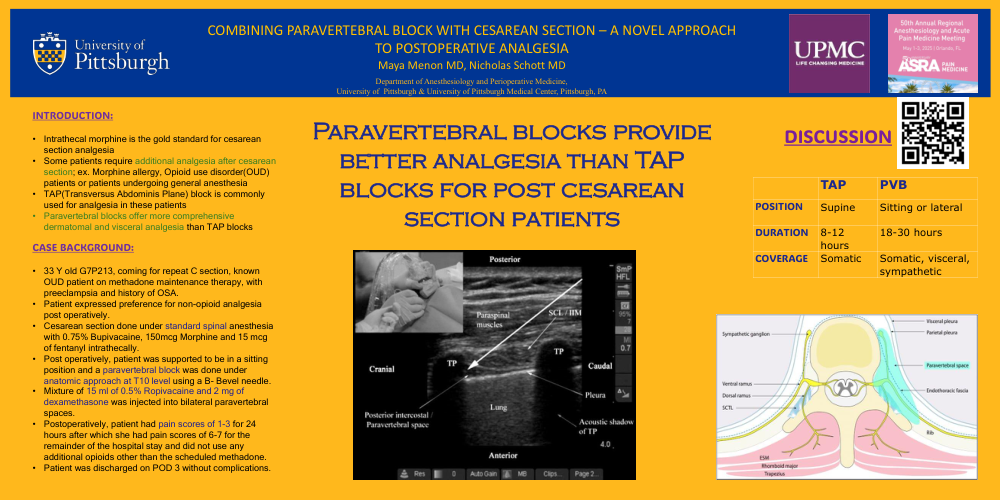
Following spinal anesthesia with 0.7% heavy bupivacaine (1.6 mL), 150 mg morphine, and 15 mcg fentanyl, the patient underwent a routine C-section with minimal blood loss. After the procedure, paravertebral blocks were performed at the T10 level using an anatomical approach with a B-bevel needle. A mixture of 15 mL of 0.5% ropivacaine and 2 mg of dexamethasone was administered bilaterally into the paravertebral spaces.
The procedure was uneventful, and the patient was repositioned. Postoperatively, she received ketorolac and acetaminophen for pain management but refused opioid analgesics. She continued to receive meperidine as scheduled.
On postoperative day 1 (POD 1), the patient reported pain scores of 1-3, which increased to 7 after 24 hours. However, pain scores did not exceed 6-7 for the remainder of her hospitalization. The patient was discharged on POD 3 without complications and expressed satisfaction with her pain management.
Discussion
Peripheral nerve blocks offer significant benefits for C-section analgesia, particularly in cases where standard multimodal analgesia with neuraxial morphine or non-opioid agents is ineffective or contraindicated. The paravertebral block, as compared to the TAP block, provides superior somatic and visceral analgesia, which is essential for abdominal surgeries like C-sections. Moreover, PVB offers a longer duration of analgesia (up to 24 hours) compared to the 18 hours typically provided by TAP blocks.
This approach not only enhances maternal satisfaction but also reduces opioid consumption, facilitates early ambulation, and decreases the risk of venous thromboembolism by minimizing postoperative pain. Given its efficacy in providing extended analgesia, PVB is a valuable option for patients with contraindications to traditional opioid-based analgesia.