Loading...

383 posters, 2 videos, 1 audios, 8 topics, 28 sessions, 328 authors, 225 institutions

ePostersLive by SciGen Technologies S.A. All rights reserved.

6540

THE EFFICACY OF PROXIMAL INTERCOSTAL NERVE BLOCKS FOR MINIMALLY INVASIVE CARDIAC SURGERY: A MULTICENTER RETROSPECTIVE COHORT STUDY
Part of Topic

Scientific Abstracts > Acute Pain

The Efficacy of Proximal Intercostal Nerve Blocks for Minimally Invasive Cardiac Surgery: A Multicenter Retrospective Cohort Study

Nellestein AM, Vlassakov K, Gerner P, Stone AS

Brigham and Women’s Hospital Department of Anesthesia

Introduction

•Minimally-invasive cardiac surgery (MICS) is performed through thoracotomy incisions instead of a sternotomy.
•MICS has been associated with lower postoperative pain scores, especially when regional anesthesia techniques are employed.1
•Continuous proximal intercostal blocks (cPICBs) have been effectively employed for post-thoracotomy analgesia but have not been investigated in patients recovering from MICS.
•This retrospective study compares patients who received cPICB to those that didn’t at two large academic health centers.
•The primary outcome was opioid consumption in the first 48 hours following surgery. Secondary outcomes included time to extubation, and 8, 12, 24, and 48 hour post-operative pain scores.
 
Materials and Methods
•Data were extracted from electronic health records from two large academic medical centers that perform MICS. Patients undergoing MICS between January and December 2024 were identified. Continuous regional anesthesia use was determined from day-of-surgery anesthesia records and postoperative acute pain service (APS) notes.
•Typically, PICBs are placed preoperatively by a dedicated regional anesthesia team. Bupivacaine 0.25% or Ropivacaine 0.5% is used for placement. Typically, two catheters are placed on the operative side of the chest wall, depending on surgical approach. Continuous infusions of 0.125% bupivacaine are started after surgery and the infusion rates are directed by the APS.
•Statistical analysis was performed using two-sample t-tests in Microsoft Excel.
 
Results

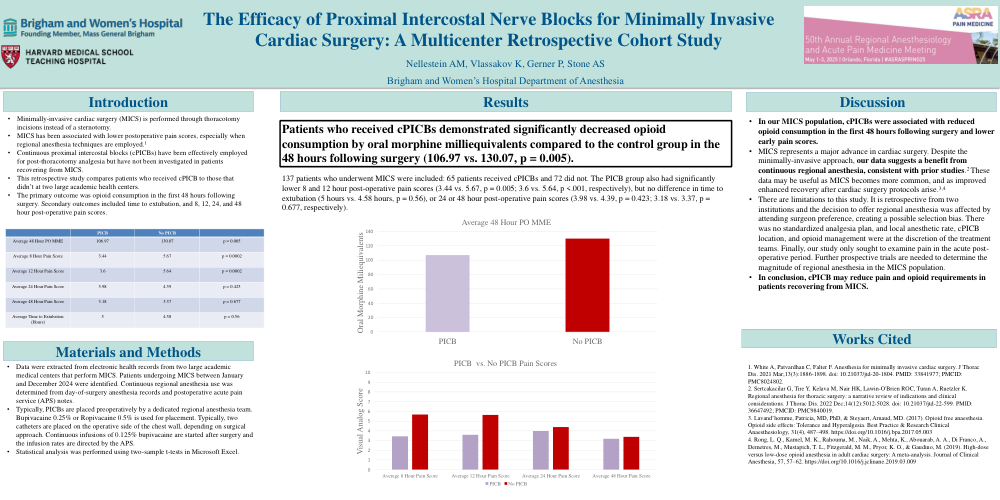
137 patients who underwent MICS were included: 65 patients received cPICBs and 72 did not. The PICB group also had significantly lower 8 and 12 hour post-operative pain scores (3.44 vs. 5.67, p = 0.005; 3.6 vs. 5.64, p <.001, respectively), but no difference in time to extubation (5 hours vs. 4.58 hours, p = 0.56), or 24 or 48 hour post-operative pain scores (3.98 vs. 4.39, p = 0.423; 3.18 vs. 3.37, p = 0.677, respectively). Patients who received cPICBs demonstrated significantly decreased opioid consumption by oral morphine milliequivalents compared to the control group in the 48 hours following surgery (106.97 vs. 130.07, p = 0.005).

Discussion

•In our MICS population, cPICBs were associated with reduced opioid consumption in the first 48 hours following surgery and lower early pain scores.
•MICS represents a major advance in cardiac surgery. Despite the minimally-invasive approach, our data suggests a benefit from continuous regional anesthesia, consistent with prior studies.2 These data may be useful as MICS becomes more common, and as improved enhanced recovery after cardiac surgery protocols arise.3,4
•There are limitations to this study. It is retrospective from two institutions and the decision to offer regional anesthesia was affected by attending surgeon preference, creating a possible selection bias. There was no standardized analgesia plan, and local anesthetic rate, cPICB location, and opioid management were at the discretion of the treatment teams. Finally, our study only sought to examine pain in the acute post-operative period. Further prospective trials are needed to determine the magnitude of regional anesthesia in the MICS population.
•In conclusion, cPICB may reduce pain and opioid requirements in patients recovering from MICS.
 
Works Cited

1. White A, Patvardhan C, Falter F. Anesthesia for minimally invasive cardiac surgery. J Thorac Dis. 2021 Mar;13(3):1886-1898. doi: 10.21037/jtd-20-1804. PMID: 33841977; PMCID: PMC8024802.

2. Sertcakacilar G, Tire Y, Kelava M, Nair HK, Lawin-O'Brien ROC, Turan A, Ruetzler K. Regional anesthesia for thoracic surgery: a narrative review of indications and clinical considerations. J Thorac Dis. 2022 Dec;14(12):5012-5028. doi: 10.21037/jtd-22-599. PMID: 36647492; PMCID: PMC9840019.

3. Lavand’homme, Patricia, MD, PhD, & Steyaert, Arnaud, MD. (2017). Opioid free anaesthesia. Opioid side effects: Tolerance and Hyperalgesia. Best Practice & Research Clinical Anaesthesiology, 31(4), 487–498. https://doi.org/10.1016/j.bpa.2017.05.003

4. Rong, L. Q., Kamel, M. K., Rahouma, M., Naik, A., Mehta, K., Abouarab, A. A., Di Franco, A., Demetres, M., Mustapich, T. L., Fitzgerald, M. M., Pryor, K. O., & Gaudino, M. (2019). High-dose versus low-dose opioid anesthesia in adult cardiac surgery: A meta-analysis. Journal of Clinical Anesthesia, 57, 57–62. https://doi.org/10.1016/j.jclinane.2019.03.009

asraspring2025 banner
Copyright © 2015-2026, ePostersLive® SciGen is a registered trademark of SciGen Technologies S.A. Patent pending.

This website and third-party tools we use rely on cookies for the best user experience. By selecting "I agree", you agree to cookie usage as described in our Privacy Policy.
