383 posters, 2 videos, 1 audios, 8 topics, 28 sessions, 328 authors, 225 institutions
ePostersLive by SciGen Technologies S.A. All rights reserved.
50th Annual Regional Anesthesiology and Acute Pain Medicine Meeting
May 1 - 3, 2025 | Orlando, Florida

6525
CLINICAL INDICATIONS FOR A PREOPERATIVE PAIN CONSULTATION: A REVIEW OF REGISTRY CASES AT AN ORTHOPEDIC SPECIALTY HOSPITAL
Poster Presenter
Authors
Affiliations
Part of Topic
Scientific Abstracts > Acute Pain
Clinical Indications for a Preoperative Pain Consultation: A Review of Registry Cases at an Orthopedic Specialty Hospital
Authors: Rim F, Chan W, Kim D, Kelly M, Schuessler S, Terry J, Fritz P, Langford D, Wu CL, Waldman S, Memtsoudis S, Liu J, Poeran J, Liu S, Sideris A
Introduction
Patients with a history of opioid tolerance, chronic pain and/or substance use disorder presenting for surgery are at increased risk for severe post-surgical pain and opioid-related adverse events.[1] Significant knowledge gaps exist in the perioperative pain management of these high-risk patients, but multiorganizational consensus emphasizes comprehensive and multidisciplinary care, including preoperative screening.[1] At our institution, patients with complex pain are referred to the Perioperative Pain Service (POPS) for a preoperative pain consultation where additional screening facilitates risk stratification.[2,3] Tailored multimodal pain management plans, incorporating regional anesthesia, are devised to optimize preoperative rehabilitation, postoperative pain control and mitigate adverse outcomes. To gain a richer understanding of the orthopedic surgical population presenting with complex pain, we performed a retrospective study leveraging an institutional registry[4] to characterize the indications for a preoperative pain consultation.
Methods
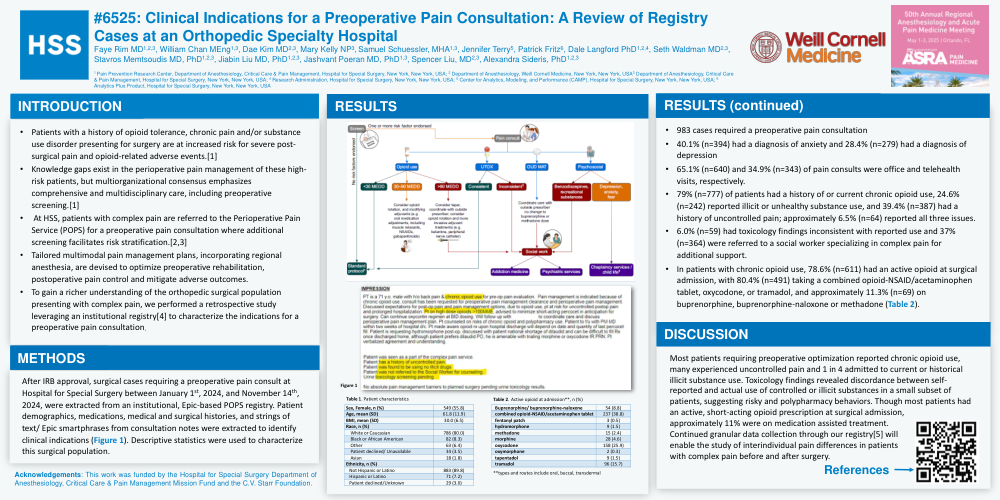
After IRB approval, surgical cases requiring a preoperative pain consult at Hospital for Special Surgery between January 1st, 2024, and November 14th, 2024, were extracted from an institutional, Epic-based POPS registry. Patient demographics, medications, medical and surgical histories, and strings of text/ Epic smartphrases from consultation notes were extracted to identify clinical indications (figure 1). Descriptive statistics were used to characterize this surgical population.
Results
A total of 983 cases performed during the study period required a preoperative pain consultation. Most patients were female, non-Hispanic, and White (table 1). Overall, 40.1% (n=394) had a diagnosis of anxiety and 28.4% (n=279) had a diagnosis of depression; 65.1% (n=640) and 34.9% (n=343) of pain consults were office and telehealth visits, respectively. Consult note extracts revealed that 79% (n=777) of patients had a history of or current chronic opioid use, 24.6% (n=242) reported illicit or unhealthy substance use, and 39.4% (n=387) had a history of uncontrolled pain; approximately 6.5% (n=64) reported all three issues. Overall, 6.0% (n=59) had toxicology findings inconsistent with reported use and 37% (n=364) were referred to a social worker specializing in complex pain for additional support. In patients with chronic opioid use, 78.6% (n=611) had an active opioid at surgical admission, with 80.4% (n=491) taking a combined opioid-NSAID/acetaminophen tablet, oxycodone, or tramadol, and approximately 11.3% (n=69) on buprenorphine, buprenorphine-naloxone or methadone (table 2). Approximately 0.8% (n=8) of patients did not have complex pain and were otherwise not considered high-risk but were candidates for the institution’s take-home catheter program requiring formal preoperative pain management clearance to proceed.
Discussion
POPS partners with the surgical team to screen patients, offering both in-person and telehealth visit options for preoperative pain consults. Most patients requiring preoperative optimization reported chronic opioid use, many experienced uncontrolled pain and 1 in 4 admitted to current or historical illicit substance use. Toxicology findings revealed discordance between self-reported and actual use of controlled or illicit substances in a small subset of patients, suggesting risky and polypharmacy behaviors. Though most patients had an active, short-acting opioid prescription at surgical admission, approximately 11% were on medication assisted treatment. Continued granular data collection through our registry[5] will enable the study of interindividual pain differences in patients with complex pain before and after surgery.
References
- Dickerson DM, Mariano ER, Szokol JW, Harned M, Clark RM, Mueller JT, Shilling AM, Udoji MA, Mukkamala SB, Doan L, Wyatt KEK, Schwalb JM, Elkassabany NM, Eloy JD, Beck SL, Wiechmann L, Chiao F, Halle SG, Krishnan DG, Cramer JD, Ali Sakr Esa W, Muse IO, Baratta J, Rosenquist R, Gulur P, Shah S, Kohan L, Robles J, Schwenk ES, Allen BFS, Yang S, Hadeed JG, Schwartz G, Englesbe MJ, Sprintz M, Urish KL, Walton A, Keith L, Buvanendran A. Multiorganizational consensus to define guiding principles for perioperative pain management in patients with chronic pain, preoperative opioid tolerance, or substance use disorder. Reg Anesth Pain Med. 2024 Oct 8;49(10):716-724. PMID: 37185214.
- Soffin EM, Waldman SA, Stack RJ, Liguori GA. An Evidence-Based Approach to the Prescription Opioid Epidemic in Orthopedic Surgery. Anesth Analg. 2017 Nov;125(5):1704-1713. PMID: 29049115.
- Rim F, Liu SS, Kelly M, Kim D, Sideris A, Langford DJ. Preoperative pain screening and optimisation by a perioperative pain service to support complex surgical patients: no patient left behind. Br J Anaesth. 2024 Feb;132(2):437-439. PMID: 38087742.
- Sideris A, Chan W, Kelly M, Schuessler S, Fritz P, POPS Steering Committee, Liu S, Rim F. EP037 Development of an automated registry in the electronic health record to track patients managed by the perioperative pain service: a research and quality improvement tool. Regional Anesthesia & Pain Medicine 2023;48:A59-A60.
- Rim F, Langford D, Kim D, Stack R, Chan W, Kelly M, Schuessler S, Fritz P, Trentalange M, Lim B, Liguori G, Wu CL, Waldman S, Liu J, Memtsoudis S, Liu S, Sideris A. Pain Catastrophizing and Widespread Pain in Complex Pain Patients Undergoing Elective Orthopedic Surgery. IASP 2024 World Congress on Pain. August 5-9, 2024. Amsterdam, Netherlands.