383 posters, 2 videos, 1 audios, 8 topics, 28 sessions, 328 authors, 225 institutions
ePostersLive by SciGen Technologies S.A. All rights reserved.
50th Annual Regional Anesthesiology and Acute Pain Medicine Meeting
May 1 - 3, 2025 | Orlando, Florida

6847
DIFFERENCES IN ANESTHESIA MODALITY ACROSS MANUAL, COMPUTER- AND ROBOTIC-ASSISTED TOTAL KNEE ARTHROPLASTY IN EXPERIENCED CENTERS
Poster Presenter
Authors
Affiliations
Part of Topic
Scientific Abstracts > Regional Anesthesia
Introduction: While trends in choice of anesthesia modality for total knee arthroplasty (TKA)
have been described, it is unclear whether surgical technique- manual (MA-TKA), computer-
assisted (CA-TKA), robotic-assisted (RA-TKA)-and associated surgical experience affect choice
of neuraxial or general anesthesia. Differences in surgical time, perioperative complications and
pain might lead to differences in anesthesia choice. Therefore, we aimed to compare anesthesia
modality choice across MA-TKA/CA-TKA/RA-TKA in hospitals with at least 1 year of
experience with RA-TKA.
Materials and Methods: After Institutional Review Board approval (IRB#2012-050), we
retrieved data on adults undergoing elective MA-TKA/CA-TKA/RA-TKA (2016-2023) for
primary osteoarthritis from the Premier Healthcare Database. We included patients with billing
codes of general, neuraxial and combined general/neuraxial anesthesia. Additional variables
collected were patient demographics, hospital characteristics and surgical time. Our primary
outcome was anesthesia modality; chi-squared tests assessed differences between TKA technique
groups. Additionally, pairwise MA-TKA/CA-TKA/RA-TKA comparisons were also assessed by
multivariable logistic regressions controlling for collected variables and hospital/surgeon
deidentified IDs. We also controlled for surgical time as a sensitivity analysis. We reported odds
ratios (OR) and 95% confidence intervals (CI).
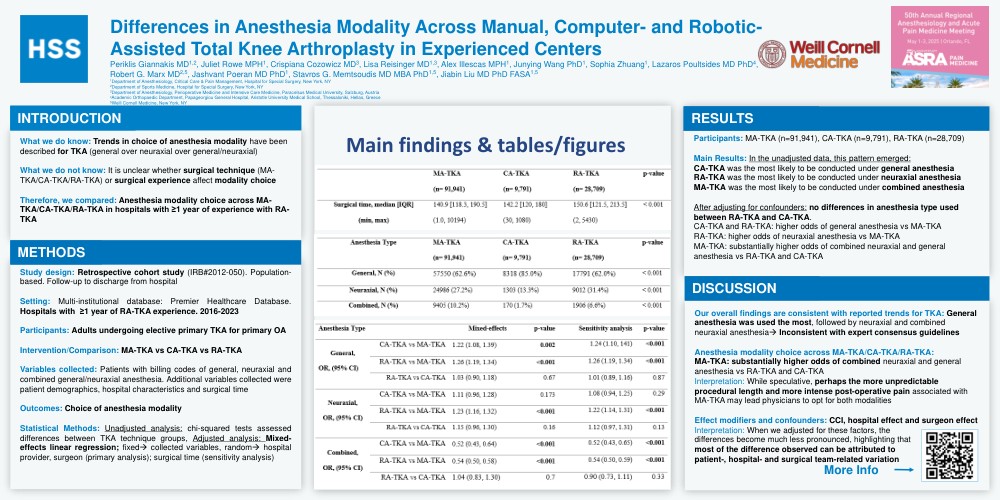
Results: Overall, n= 91,941, n= 9,791, and n= 28,709 MA-TKA, CA-TKA and RA-TKA cases
were included, respectively (Figure 1, Table 1). CA-TKA was the most likely to be conducted
under general anesthesia, RA-TKA had the highest rates of neuraxial anesthesia and MA-TKA
cases used combined anesthesia most (p < 0.001; Table 2). After adjusting for confounders, there
were no differences in anesthesia type used between RA-TKA and CA-TKA (Table 3). Both
CA-TKA and RA-TKA were associated with higher odds of general anesthesia compared with
MA-TKA, while RA-TKA was also associated with higher odds of neuraxial anesthesia versus
MA-TKA (Table 3). The most significant difference was observed in the likelihood of combined
anesthesia utilization, with CA-TKA (OR 0.52 95% CI 0.43-0.64; p < 0.001) and RA-TKA (OR
0.54 95% CI 0.50-0.58; p < 0.001) being less likely to be conducted under combined anesthesia
compared to MA-TKA. Adjusting for surgical time did not alter our results (Table 3).
Discussion: While group differences existed, general anesthesia was used the most in our overall
cohort, followed by neuraxial and combined, aligning with general TKA trends, despite expert-
consensus recommending neuraxial anesthesia. The difference between unadjusted and adjusted
analyses, and main analyses and sensitivity analyses suggested that a substantial portion of group
observed differences in anesthesia type could be attributed to hospital/surgeon and patient
variability.
Indeed, after confounder adjustment, no difference was observed in anesthesia modality between
RA-TKA and CA-TKA, suggesting similar trends in technology-assisted TKA. The most
substantial difference in our adjusted analysis was the increased likelihood of MA-TKA to be
conducted under combined anesthesia compared to both CA-TKA/RA-TKA. While speculative,
perhaps the more unpredictable procedural length and more intense post-operative pain
associated with MA-TKA may lead physicians to opt for both modalities.
In conclusion, there were no differences in anesthesia type between RA-TKA and CA-TKA, but
both favored general anesthesia over MA-TKA, with RA-TKA also favoring neuraxial
anesthesia, and both were less likely to use combined anesthesia.