383 posters, 2 videos, 1 audios, 8 topics, 28 sessions, 328 authors, 225 institutions
ePostersLive by SciGen Technologies S.A. All rights reserved.
50th Annual Regional Anesthesiology and Acute Pain Medicine Meeting
May 1 - 3, 2025 | Orlando, Florida

6792
ADDITION OF GENICULAR NERVE BLOCK IS ASSOCIATED WITH FASTER PHYSICAL THERAPY CLEARANCE FOLLOWING TOTAL KNEE ARTHROPLASTY
Poster Presenter
Authors
Affiliations
Part of Topic
Scientific Abstracts > Regional Anesthesia
Title: Addition of Genicular Nerve Block is Associated with Faster Physical Therapy Clearance Following Inpatient Total Knee Arthroplasty
Co-authors: Sideris A, Poeran J, Illescas A, Rowe J, Go G, Maalouf D
Introduction
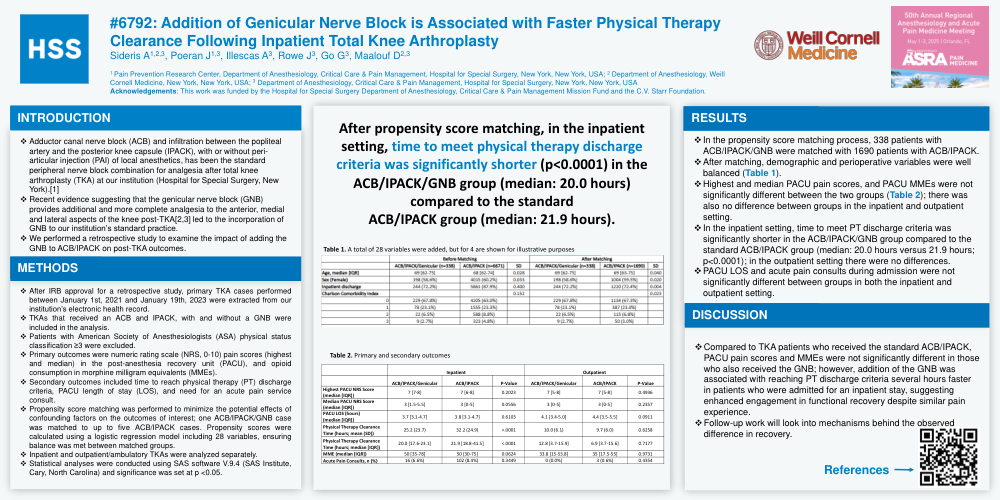
Adductor canal nerve block (ACB) and infiltration between the popliteal artery and the posterior knee capsule (IPACK), with or without peri-articular injection (PAI) of local anesthetics, has been the standard peripheral nerve block combination for analgesia after total knee arthroplasty (TKA) at our institution (Hospital for Special Surgery, New York).[1,] Recent evidence suggesting that the genicular nerve block (GNB) provides additional and more complete analgesia to the anterior, medial and lateral aspects of the knee post-TKA[2,3] led to the incorporation of GNB to our institution’s standard practice. We performed a retrospective study to examine the impact of adding the GNB to ACB/IPACK on post-TKA outcomes.
Methods
After IRB approval for a retrospective study, primary TKA cases performed between January 1st, 2021 and January 19th, 2023 were extracted from our institution’s electronic health record. TKAs that received an ACB and IPACK, with and without a GNB were included in the analysis. Patients with American Society of Anesthesiologists (ASA) physical status classification ≥3 were excluded. Primary outcomes were numeric rating scale (NRS, 0-10) pain scores (highest and median) in the post-anesthesia recovery unit (PACU), and opioid consumption in morphine milligram equivalents (MMEs). Secondary outcomes included time to reach physical therapy (PT) discharge criteria, PACU length of stay (LOS), and need for an acute pain service consult. Propensity score matching was performed to minimize the potential effects of confounding factors on the outcomes of interest; one ACB/IPACK/GNB case was matched to up to five ACB/IPACK cases. Propensity scores were calculated using a logistic regression model including 28 variables, ensuring balance was met between matched groups. Inpatient and outpatient/ambulatory TKAs were analyzed separately. Statistical analyses were conducted using SAS software V.9.4 (SAS Institute, Cary, North Carolina) and significance was set at p <0.05.
Results
In the propensity score matching process, 338 patients with ACB/IPACK/GNB were matched with 1690 patients with ACB/IPACK. After matching, demographic and perioperative variables were well balanced (Table 1). Highest and median PACU pain scores, and PACU MMEs were not significantly different between the two groups (Table 2); there was also no difference between groups in the inpatient and outpatient setting. In the inpatient setting, time to meet PT discharge criteria was significantly shorter in the ACB/IPACK/GNB group compared to the standard ACB/IPACK group (median: 20.0 hours versus 21.9 hours; p<0.0001); in the outpatient setting there were no differences. PACU LOS and acute pain consults during admission were not significantly different between groups in both the inpatient and outpatient setting.
Conclusion
Compared to TKA patients who received the standard ACB/IPACK, PACU pain scores and MMEs were not significantly different in those who also received the GNB; however, addition of the GNB was associated with reaching PT discharge criteria several hours faster in patients who were admitted for an inpatient stay, suggesting enhanced engagement in functional recovery despite similar pain experience. Follow-up work will look into mechanisms behind the observed difference in recovery.
References
- Kim DH, Beathe JC, Lin Y, YaDeau JT, Maalouf DB, Goytizolo E, Garnett C, Ranawat AS, Su EP, Mayman DJ, Memtsoudis SG. Addition of Infiltration Between the Popliteal Artery and the Capsule of the Posterior Knee and Adductor Canal Block to Periarticular Injection Enhances Postoperative Pain Control in Total Knee Arthroplasty: A Randomized Controlled Trial. Anesth Analg. 2019 Aug;129(2):526-535. PMID: 30234517.
- Rambhia M, Chen A, Kumar AH, Bullock WM, Bolognesi M, Gadsden J. Ultrasound-guided genicular nerve blocks following total knee arthroplasty: a randomized, double-blind, placebo-controlled trial. Reg Anesth Pain Med. 2021 Oct;46(10):862-866. Epub 2021 Jul 14. PMID: 34261807.
- Xue X, Lv X, Ma X, Zhou Y, Yu N. Postoperative pain relief after total knee arthroplasty: A Bayesian network meta-analysis and systematic review of analgesic strategies based on nerve blocks. J Clin Anesth. 2024 Sep;96:111490. Epub 2024 Apr 30. PMID: 38692069.