383 posters, 2 videos, 1 audios, 8 topics, 28 sessions, 328 authors, 225 institutions
ePostersLive by SciGen Technologies S.A. All rights reserved.
50th Annual Regional Anesthesiology and Acute Pain Medicine Meeting
May 1 - 3, 2025 | Orlando, Florida

6730
CONTINUOUS LONGITUDINAL RECTUS SHEATH BLOCKS: A CASE SERIES FOR NEW APPROACH
Poster Presenter
Authors
Affiliations
Part of Topic
Scientific Abstracts > Regional Anesthesia
Effective postoperative pain control is vital for
enhanced recovery after abdominal surgeries.
• Rectus sheath block (RSB) provides anterior
abdominal wall analgesia by targeting ventral rami
of spinal nerves (T7-L1).
• Traditional transverse RSB approaches may have
inconsistent dermatomal coverage and catheter
placement challenges.
• This case series introduces a novel longitudinal
RSB technique aimed at improving analgesic
efficacy and coverage.
• Written informed consent was obtained from the
patients for publication of this report.
Case 1
• 57-year-old female patient underwent exploratory
laparotomy, adhesiolysis, sarcoma resection, and
hernia repair via vertical midline incision (T6 to
below umbilicus).
• Continuous longitudinal rectus sheath block
placed from cephalad to caudad direction preextubation
with 5-inch ON-Q SilverSoaker
multiport catheter system.
• Post-op analgesia: bupivacaine 0.125% at 8 mLh-1,
acetaminophen, and lidocaine patch; no opioids
• Median pain score 1 [0–2] over 3 days; sensory
block extended to T12, beyond incision.
• Continuous longitudinal rectus sheath block offers
consistent dermatomal coverage with wider spread of
local anesthetic infusion for vertical abdominal
incisions.
• In this case series, both the patients had low pain
scores, minimal opioid use, and sensory blockade
extending to T12 dermatome.
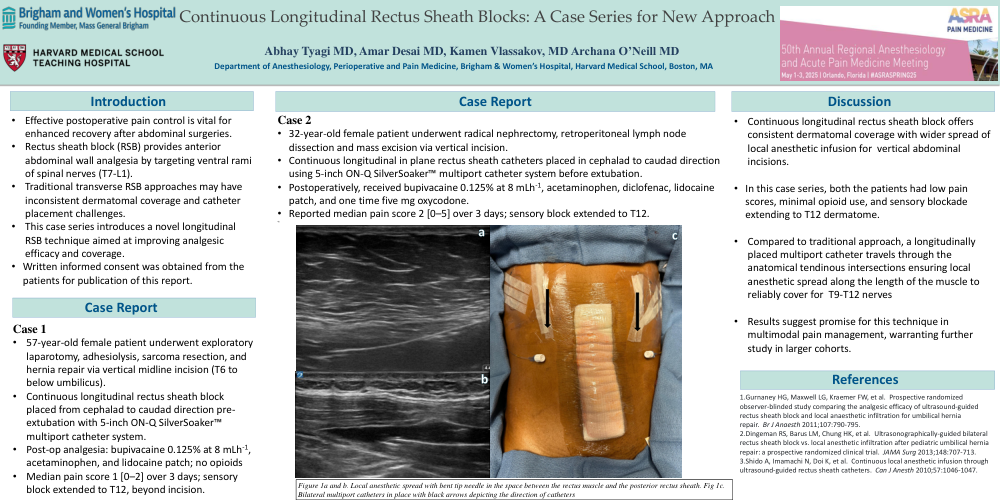
• Compared to traditional approach, a longitudinally
placed multiport catheter travels through the
anatomical tendinous intersections ensuring local
anesthetic spread along the length of the muscle to
reliably cover for T9-T12 nerves
• Results suggest promise for this technique in
multimodal pain management, warranting further
study in larger cohorts.
Case 2
• 32-year-old female patient underwent radical nephrectomy, retroperitoneal lymph node
dissection and mass excision via vertical incision.
• Continuous longitudinal in plane rectus sheath catheters placed in cephalad to caudad direction
using 5-inch ON-Q SilverSoaker multiport catheter system before extubation.
• Postoperatively, received bupivacaine 0.125% at 8 mLh-1, acetaminophen, diclofenac, lidocaine
patch, and one time five mg oxycodone.
• Reported median pain score 2 [0–5] over 3 days; sensory block extended to T12.