Loading...

383 posters, 2 videos, 1 audios, 8 topics, 28 sessions, 328 authors, 225 institutions

ePostersLive by SciGen Technologies S.A. All rights reserved.

6698

EFFECT OF EPINEPHRINE ON PHARMACOKINETICS AND SPREAD OF ROPIVACAINE IN ERECTOR SPINAE PLANE BLOCKS: A RANDOMIZED CONTROLLED TRIAL
Part of Topic

Scientific Abstracts > Regional Anesthesia

Effect of Epinephrine on Pharmacokinetics and Spread of Ropivacaine in Erector Spinae Plane Blocks: A Randomized Controlled Trial

Kevin Xu1, John Smith1, Michael Fettiplace2, Jonelle Thomas1,3, Cynthia Reed1,4, Nancy Ruth Jarbadan1,4, Sanjib Adhikary1,4

1.  The Pennsylvania State University College of Medicine

2.  Department of Anesthesiology, University of Illinois at Chicago

3.  Department of Radiology, Penn State Health Milton S. Hershey Medical Center

4.  Department of Anesthesiology and Perioperative Medicine, Penn State Health Milton S. Hershey Medical Center 

BACKGROUND

•Erector Spinae Plane (ESP) blocks are used for thoracic and abdominal postoperative pain relief, offering comparable efficacy to paravertebral blocks with improved safety profiles1,2.
•ESP block outcomes can be variable, especially regarding local anesthetic (LA) spread and systemic absorption.
•Ropivacaine is commonly used for ESP blocks, and the addition of epinephrine may:
•Delay systemic uptake
•Prolong analgesia3
•However, epinephrine’s effects on pharmacokinetics and anatomical spread via ESP blocks remain insufficiently studied4.  

OBJECTIVES

•Primary Objective: To assess the impact of epinephrine on systemic absorption (Cmax), pharmacokinetics, and volume of distribution (Vd) of ropivacaine.
•Secondary Objectives:
•Evaluate the difference in dermatomal spread and sensory block extent.
•Assess the anatomical distribution of injectate via MRI over time.

METHODS

•Design: Randomized, double-blinded, prospective controlled trial.
•Subjects: 12 healthy volunteers (18-60 yrs), screened and consented.
•Intervention: Single ESP block with 20 mL of 0.5% ropivacaine with epinephrine (RE Group) or without epinephrine (R Group) at the T5 transverse process.
•Blinding: Subjects, anesthesiologist, radiologist, and research staff were blinded.
•Blood sampling:
•Venous samples collected at 0, 20, 40, 60-, 90-, 120-, and 240-min post-injection.
•Analyzed via reverse-phase HPLC for serum ropivacaine concentrations.
•MRI Protocol:
•Performed at ~30 and ~90 min post-block.
•T1 anatomical + fluid-sensitive sequences from C4–L4 evaluated cranial-caudal and medial-lateral spread.
•Sensory Testing:
•Cold (isopropanol) and pinprick (toothpick) testing at 20, 60-, 120-, 240-, and 360-min post-injection.
•Cutaneous sensory blocked area measured with SketchAndCalc software.
•Statistical Analysis:
•Mann-Whitney U-test and Chi-square tests for group comparison.
•Pharmacokinetics modeled using two-phase decay curve fitting in Prism 10.

RESULTS

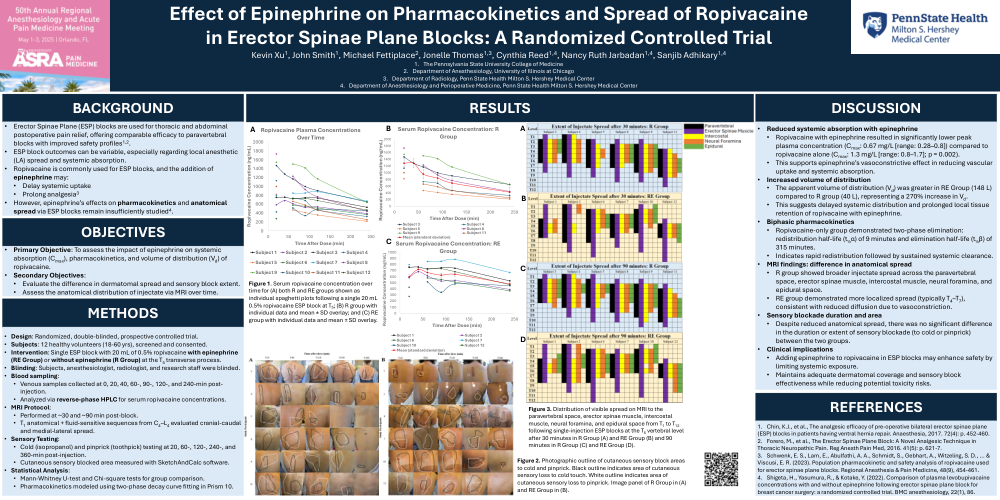
Figure 1. Serum ropivacaine concentration over time for (A) both R and RE groups shown as individual spaghetti plots following a single 20 mL 0.5% ropivacaine ESP block at T5; (B) R group with individual data and mean ± SD overlay; and (C) RE group with individual data and mean ± SD overlay.

Figure 2. Photographic outline of cutaneous sensory block areas to cold and pinprick. Black outline indicates area of cutaneous sensory loss to cold touch. White outline indicates area of cutaneous sensory loss to pinprick. Image panel of R Group in (A) and RE Group in (B).

Figure 3. Distribution of visible spread on MRI to the paravertebral space, erector spinae muscle, intercostal muscle, neural foramina, and epidural space from T1 to T12 following single-injection ESP blocks at the T5 vertebral level after 30 minutes in R Group (A) and RE Group (B) and 90 minutes in R Group (C) and RE Group (D).  

DISCUSSION

•Reduced systemic absorption with epinephrine
•Ropivacaine with epinephrine resulted in significantly lower peak plasma concentration (Cmax: 0.67 mg/L [range: 0.28–0.8]) compared to ropivacaine alone (Cmax: 1.3 mg/L [range: 0.8–1.7]; p = 0.002).
•This supports epinephrine’s vasoconstrictive effect in reducing vascular uptake and systemic absorption.
•Increased volume of distribution
•The apparent volume of distribution (Vd) was greater in RE Group (148 L) compared to R group (40 L), representing a 270% increase in Vd.
•This suggests delayed systemic distribution and prolonged local tissue retention of ropivacaine with epinephrine.
•Biphasic pharmacokinetics
•Ropivacaine-only group demonstrated two-phase elimination: redistribution half-life (t½α) of 9 minutes and elimination half-life (t½β) of 315 minutes.
•Indicates rapid redistribution followed by sustained systemic clearance.
•MRI findings: difference in anatomical spread
•R group showed broader injectate spread across the paravertebral space, erector spinae muscle, intercostal muscle, neural foramina, and epidural space.
•RE group demonstrated more localized spread (typically T4–T7), consistent with reduced diffusion due to vasoconstriction.
•Sensory blockade duration and area
•Despite reduced anatomical spread, there was no significant difference in the duration or extent of sensory blockade (to cold or pinprick) between the two groups.
•Clinical implications
•Adding epinephrine to ropivacaine in ESP blocks may enhance safety by limiting systemic exposure.
•Maintains adequate dermatomal coverage and sensory block effectiveness while reducing potential toxicity risks.

REFERENCES

1.  Chin, K.J., et al., The analgesic efficacy of pre-operative bilateral erector spinae plane (ESP) blocks in patients having ventral hernia repair. Anaesthesia, 2017. 72(4): p. 452-460.

2.  Forero, M., et al., The Erector Spinae Plane Block: A Novel Analgesic Technique in Thoracic Neuropathic Pain. Reg Anesth Pain Med, 2016. 41(5): p. 621-7.

3.  Schwenk, E. S., Lam, E., Abulfathi, A. A., Schmidt, S., Gebhart, A., Witzeling, S. D., ... & Viscusi, E. R. (2023). Population pharmacokinetic and safety analysis of ropivacaine used for erector spinae plane blocks. Regional Anesthesia & Pain Medicine, 48(9), 454-461.

4.  Shigeta, H., Yasumura, R., & Kotake, Y. (2022). Comparison of plasma levobupivacaine concentrations with and without epinephrine following erector spinae plane block for breast cancer surgery: a randomized controlled trial. BMC anesthesiology, 22(1), 86.


asraspring2025 banner
Copyright © 2015-2026, ePostersLive® SciGen is a registered trademark of SciGen Technologies S.A. Patent pending.

This website and third-party tools we use rely on cookies for the best user experience. By selecting "I agree", you agree to cookie usage as described in our Privacy Policy.
