383 posters, 2 videos, 1 audios, 8 topics, 28 sessions, 328 authors, 225 institutions
ePostersLive by SciGen Technologies S.A. All rights reserved.
50th Annual Regional Anesthesiology and Acute Pain Medicine Meeting
May 1 - 3, 2025 | Orlando, Florida

6672
PACU EFFICIENCY: ANESTHESIA PLAN, PREDICTORS OF RECOVERY TIME, AND OUTCOMES IN 3,063 AMBULATORY TOTAL JOINT ARTHROPLASTY PATIENTS
Poster Presenter
Part of Topic
Scientific Abstracts > Regional Anesthesia
PACU Efficiency: Anesthesia Plan, Predictors of Recovery Time, and Outcomes in 3,063 Ambulatory Total Joint Arthroplasty Patients
Anthony Rios B.S.1, Jerry Jones M.D.2
The University of Tennessee Health Science Center, College of Medicine1, Department of Anesthesia2 East Memphis Anesthesia Services, Memphis, TN
Introduction
Total Hip Arthroplasty (THA) and Total Knee Arthroplasty (TKA) are increasingly performed in ambulatory surgery centers (ASCs), making reliable home discharge essential [1,2]. However, there is limited guidance regarding patient selection criteria [3] and outcome data in ASCs [4, 5]. This study evaluates patient selection criteria, anesthesia strategies, and outcomes for total joint arthroplasty patients in an ASC and identifies factors influencing post-anesthesia care unit (PACU) times.
Methods
Following IRB approval, a retrospective analysis was conducted of medical records from a stand alone private practice ASC between January 2023 to November 2024. A total of 3,063 total joint arthroplasty patients were included, consisting of 914 THA and 2,149 TKA cases. Patient demographics, comorbidities, complications, estimated blood loss, PACU times, discharge pain scores, opioid usage, and individual surgeon and anesthesiologist PACU times were collected and analyzed. Statistical analyses were performed using SPSS version 29, with data stratified based on relevant variables.
Results
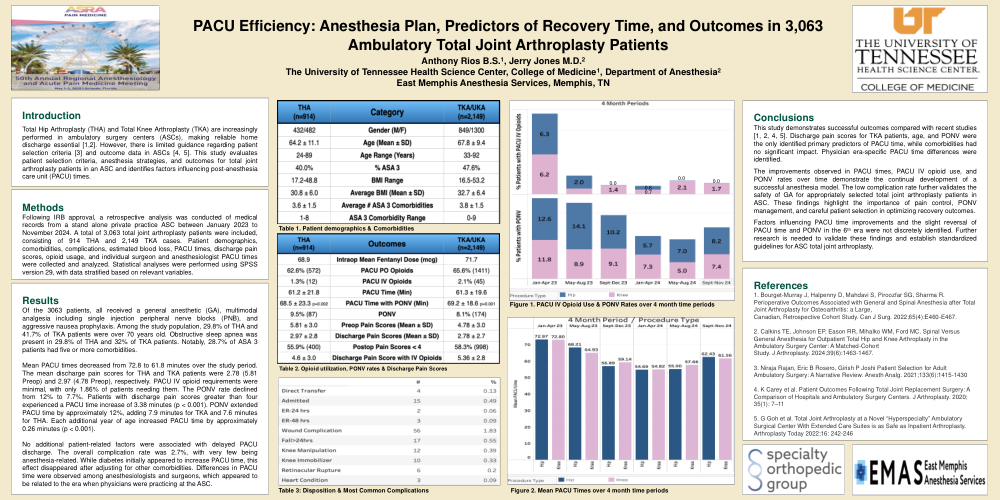
Of the 3063 patients, all received a general anesthetic (GA), multimodal analgesia including single injection peripheral nerve blocks (PNB), and aggressive nausea prophylaxis. Among the study population, 29.8% of THA and 41.7% of TKA patients were over 70 years old. Obstructive sleep apnea was present in 29.8% of THA and 32% of TKA patients. Notably, 28.7% of ASA 3 patients had five or more comorbidities.
Mean PACU times decreased from 72.8 to 61.8 minutes over the study period. The mean discharge pain scores for THA and TKA patients were 2.78 (5.81 Preop) and 2.97 (4.78 Preop), respectively. PACU IV opioid requirements were minimal, with only 1.86% of patients needing them. The PONV rate declined from 12% to 7.7%. Patients with discharge pain scores greater than four experienced a PACU time increase of 3.38 minutes (p < 0.001). PONV extended PACU time by approximately 12%, adding 7.9 minutes for TKA and 7.6 minutes for THA. Each additional year of age increased PACU time by approximately 0.26 minutes (p < 0.001).
No additional patient-related factors were associated with delayed PACU discharge. The overall complication rate was 2.7%, with very few being anesthesia-related. While diabetes initially appeared to increase PACU time, this effect disappeared after adjusting for other comorbidities. Differences in PACU time were observed among anesthesiologists and surgeons, which appeared to be related to the era when physicians were practicing at the ASC.
Conclusions
This study demonstrates successful outcomes compared with recent studies [1, 2, 4, 5]. Discharge pain scores for TKA patients, age, and PONV were the only identified primary predictors of PACU time, while comorbidities had no significant impact. Physician era-specific PACU time differences were identified.
The improvements observed in PACU times, PACU IV opioid use, and PONV rates over time demonstrate the continual development of a successful anesthesia model. The low complication rate further validates the safety of GA for appropriately selected total joint arthroplasty patients in ASC. These findings highlight the importance of pain control, PONV management, and careful patient selection in optimizing recovery outcomes.
Factors influencing PACU time improvements and the slight reversal of PACU time and PONV in the 6th era were not discretely identified. Further research is needed to validate these findings and establish standardized guidelines for ASC total joint arthroplasty.
References:
1. Bourget-Murray J, Halpenny D, Mahdavi S, Piroozfar SG, Sharma R. Perioperative Outcomes Associated with General and Spinal Anesthesia after Total Joint Arthroplasty for Osteoarthritis: a Large,
Canadian, Retrospective Cohort Study. Can J Surg. 2022;65(4):E460-E467.
2. Calkins TE, Johnson EP, Eason RR, Mihalko WM, Ford MC. Spinal Versus General Anesthesia for Outpatient Total Hip and Knee Arthroplasty in the Ambulatory Surgery Center: A Matched-Cohort
Study. J Arthroplasty. 2024;39(6):1463-1467.
3. Niraja Rajan, Eric B Rosero, Girish P Joshi Patient Selection for Adult Ambulatory Surgery: A Narrative Review. Anesth Analg. 2021;133(6):1415-1430
4. K Carey et al. Patient Outcomes Following Total Joint Replacement Surgery: A Comparison of Hospitals and Ambulatory Surgery Centers. J Arthroplasty. 2020; 35(1): 7–11
5. G Goh et al. Total Joint Arthroplasty at a Novel “Hyperspecialty” Ambulatory Surgical Center With Extended Care Suites is as Safe as Inpatient Arthroplasty. Arthroplasty Today 2022;16: 242-246