383 posters, 2 videos, 1 audios, 8 topics, 28 sessions, 328 authors, 225 institutions
ePostersLive by SciGen Technologies S.A. All rights reserved.
50th Annual Regional Anesthesiology and Acute Pain Medicine Meeting
May 1 - 3, 2025 | Orlando, Florida

6589
ASSOCIATION OF SURGICAL OUTCOMES AND EPIDURAL ANALGESIA EFFICACY, A SCORING ANALYSIS OF SUCCESS, PARTIAL SUCCESS, AND FAILURE
Poster Presenter
Authors
Affiliations
Part of Topic
Scientific Abstracts > Regional Anesthesia
INTRO
Postoperative epidural analgesia (EA) is among the most frequently performed procedures in daily anesthetic practice.
Traditionally, the evaluation of epidural analgesia effectiveness is categorized dichotomously as either successful or failed.
However, clinical experiences highlight significant variability in what constitutes a failure, emphasizing the complexity of
such evaluations.
Identifying partial or complete failures of epidural analgesia in the postoperative phase should incorporate clinically
relevant criteria, expert consensus, and implications for patient outcomes. Notably, institutional variations in defining and
assessing epidural analgesia failure introduce complexities in standardizing definitions and interpreting outcomes across
different centers. Moreover, local hospital culture and clinical practices significantly influence the recognition and
categorization of EA outcomes.
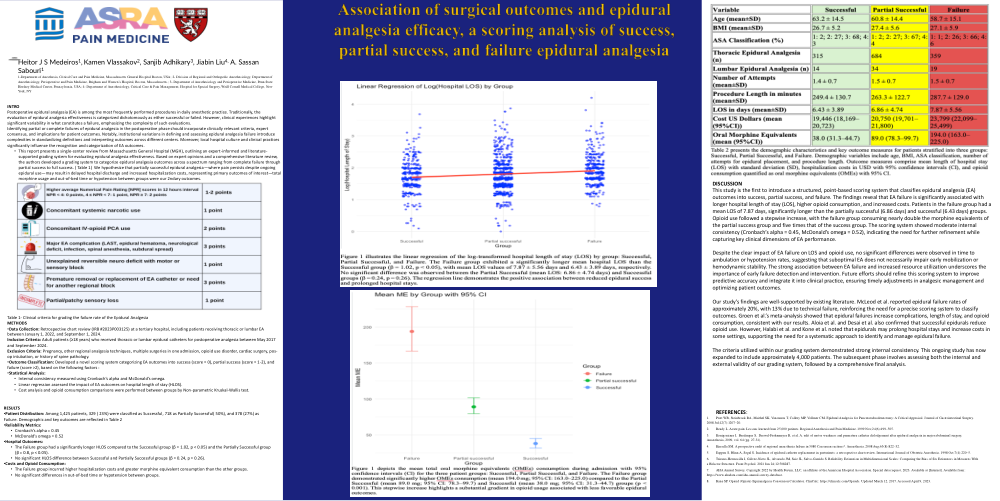
• This report presents a single-center review from Massachusetts General Hospital (MGH), outlining an expert-
informed and literature-supported grading system for evaluating epidural analgesia effectiveness. Based on expert
opinions and a comprehensive literature review, the authors developed a grading system to categorize epidural
analgesia outcomes across a spectrum ranging from complete failure through partial success to full success. ( Table
1) We hypothesize that partially successful epidural analgesia—where pain persists despite ongoing epidural use—
may result in delayed hospital discharge and increased hospitalization costs, representing primary outcomes of
interest—total morphine usage and out-of-bed time or hypotension between groups were our 2ndary outcomes.
METHODS
•Data Collection: Retrospective chart review (IRB #2023P003125) at a tertiary hospital, including patients receiving
thoracic or lumbar EA between January 1, 2022, and September 1, 2024.
Inclusion Criteria: Adult patients (≥18 years) who received thoracic or lumbar epidural catheters for postoperative
analgesia between May 2017 and September 2024.
Exclusion Criteria: Pregnancy, other regional analgesia techniques, multiple surgeries in one admission, opioid use
disorder, cardiac surgery, pos-op intubation, or history of spine pathology.
•Outcome Classification: Developed a novel scoring system categorizing EA outcomes into success (score = 0), partial
success (score = 1-2), and failure (score >2), based on the following factors :
•Statistical Analysis:
• Internal consistency measured using Cronbach’s alpha and McDonald’s omega.
• Linear regression assessed the impact of EA outcomes on hospital length of stay (HLOS).
• Cost analysis and opioid consumption comparisons were performed between groups by Non-parametric Kruskal-
Wallis test.
RESULTS
•Patient Distribution: Among 1,425 patients, 329 ( 23%) were classified as Successful, 718 as Partially Successful( 50%),
and 378 (27%) as Failure. Demographic and key outcomes are reflected in Table 2
•Reliability Metrics:
• Cronbach’s alpha = 0.45
• McDonald’s omega = 0.52
•Hospital Outcomes:
• The Failure group had a significantly longer HLOS compared to the Successful group (β = 1.02, p < 0.05) and the
Partially Successful group (β = 0.8, p < 0.05).
• No significant HLOS difference between Successful and Partially Successful groups (β = 0.24, p = 0.26).
•Costs and Opioid Consumption:
• The Failure group incurred higher hospitalization costs and greater morphine equivalent consumption than the
other groups.
• No significant differences in out-of-bed time or hypotension between groups.
DISCUSSION
This study is the first to introduce a structured, point-based scoring system that classifies
epidural analgesia (EA) outcomes into success, partial success, and failure. The findings
reveal that EA failure is significantly associated with longer hospital length of stay (LOS),
higher opioid consumption, and increased costs. Patients in the failure group had a mean
LOS of 7.87 days, significantly longer than the partially successful (6.86 days) and successful
(6.43 days) groups. Opioid use followed a stepwise increase, with the failure group
consuming nearly double the morphine equivalents of the partial success group and five
times that of the success group. The scoring system showed moderate internal consistency
(Cronbach’s alpha = 0.45, McDonald’s omega = 0.52), indicating the need for further
Non-Cognitive Predictors of Student Success:
refinement while capturing key clinical dimensions of EA performance.
A Predictive Validity Comparison Between Domestic and International Students
Despite the clear impact of EA failure on LOS and opioid use, no significant differences were
observed in time to ambulation or hypotension rates, suggesting that suboptimal EA does
not necessarily impair early mobilization or hemodynamic stability. The strong association
between EA failure and increased resource utilization underscores the importance of early
failure detection and intervention. Future efforts should refine this scoring system to
improve predictive accuracy and integrate it into clinical practice, ensuring timely
adjustments in analgesic management and optimizing patient outcomes.
Our study’s findings are well-supported by existing literature. McLeod et al. reported
epidural failure rates of approximately 20%, with 13% due to technical failure, reinforcing
the need for a precise scoring system to classify outcomes. Groen et al.’s meta-analysis
showed that epidural failures increase complications, length of stay, and opioid
consumption, consistent with our results. Aloia et al. and Desai et al. also confirmed that
successful epidurals reduce opioid use. However, Halabi et al. and Kone et al. noted that
epidurals may prolong hospital stays and increase costs in some settings, supporting the
need for a systematic approach to identify and manage epidural failure.
The criteria utilized within our grading system demonstrated strong internal consistency.
This ongoing study has now expanded to include approximately 4,000 patients. The
subsequent phase involves assessing both the internal and external validity of our grading
system, followed by a comprehensive final analysis.