383 posters, 2 videos, 1 audios, 8 topics, 28 sessions, 328 authors, 225 institutions
ePostersLive by SciGen Technologies S.A. All rights reserved.
50th Annual Regional Anesthesiology and Acute Pain Medicine Meeting
May 1 - 3, 2025 | Orlando, Florida

6550
DOES THE USE OF PERIPHERAL NERVE BLOCKS AFFECT OUTPATIENT TOTAL HIP AND KNEE ARTHROPLASTY OUTCOMES?
Poster Presenter
Authors
Affiliations
Part of Topic
Scientific Abstracts > Regional Anesthesia
INTRODUCTION:
Regional anesthetic techniques are commonly utilized in outpatient total joint arthroplasty (TJA) to enhance recovery and reduce pain. However, anesthesia practices can vary significantly due to factors such as a patient’s candidacy for regional anesthesia, surgeon preferences, and institutional protocols. This study aims to compare the impact of peripheral nerve blocks (PNBs) on acute and 90-day outcomes in patients undergoing outpatient (<24h stay) total hip arthroplasty (THA) and total knee arthroplasty (TKA). The goal is to evaluate the effectiveness of PNBs in improving postoperative outcomes in these surgical populations.
METHODS:
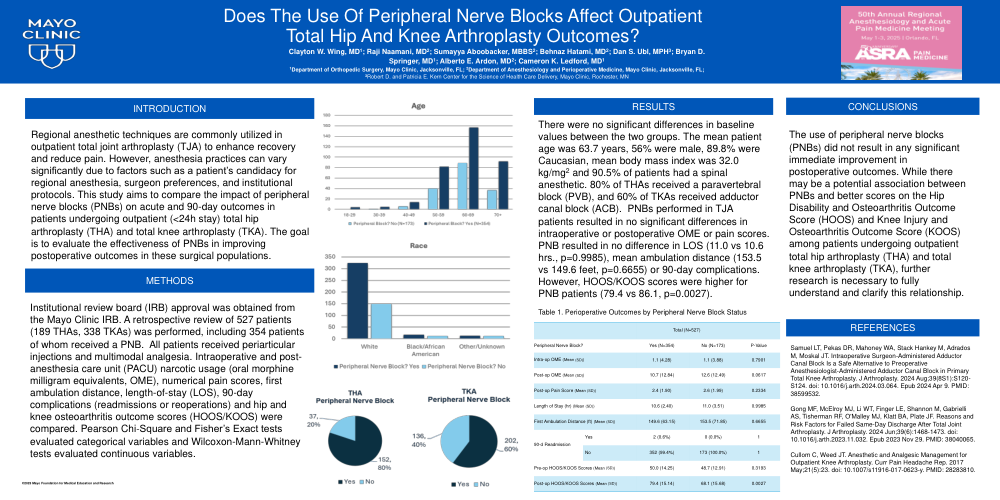
Institutional review board (IRB) approval was obtained from the Mayo Clinic IRB. A retrospective review of 527 patients (189 THAs, 338 TKAs) was performed, including 354 patients of whom received a PNB. All patients received periarticular injections and multimodal analgesia. Intraoperative and post-anesthesia care unit (PACU) narcotic usage (oral morphine milligram equivalents, OME), numerical pain scores, first ambulation distance, length-of-stay (LOS), 90-day complications (readmissions or reoperations) and hip and knee osteoarthritis outcome scores (HOOS/KOOS) were compared. Pearson Chi-Square and Fisher’s Exact tests evaluated categorical variables and Wilcoxon-Mann-Whitney tests evaluated continuous variables.
RESULTS:
There were no significant differences in baseline values between the two groups. The mean patient age was 63.7 years, 56% were male, 89.8% were Caucasian, mean body mass index was 32.0 kg/mg2 and 90.5% of patients had a spinal anesthetic. 80% of THAs received a paravertebral block (PVB), and 60% of TKAs received adductor canal block (ACB). PNBs performed in TJA patients resulted in no significant differences in intraoperative or postoperative OME or pain scores. PNB resulted in no difference in LOS (11.0 vs 10.6 hrs., p=0.9985), mean ambulation distance (153.5 vs 149.6 feet, p=0.6655) or 90-day complications. However, HOOS/KOOS scores were higher for PNB patients (79.4 vs 86.1, p=0.0027).
CONCLUSIONS:
The use of peripheral nerve blocks (PNBs) did not result in any significant immediate improvement in postoperative outcomes. While there may be a potential association between PNBs and better scores on the Hip Disability and Osteoarthritis Outcome Score (HOOS) and Knee Injury and Osteoarthritis Outcome Score (KOOS) among patients undergoing outpatient total hip arthroplasty (THA) and total knee arthroplasty (TKA), further research is necessary to fully understand and clarify this relationship.
REFERENCES:
Samuel LT, Pekas DR, Mahoney WA, Stack Hankey M, Adrados M, Moskal JT. Intraoperative Surgeon-Administered Adductor Canal Block Is a Safe Alternative to Preoperative Anesthesiologist-Administered Adductor Canal Block in Primary Total Knee Arthroplasty. J Arthroplasty. 2024 Aug;39(8S1):S120-S124. doi: 10.1016/j.arth.2024.03.064. Epub 2024 Apr 9. PMID: 38599532.
Gong MF, McElroy MJ, Li WT, Finger LE, Shannon M, Gabrielli AS, Tisherman RF, O'Malley MJ, Klatt BA, Plate JF. Reasons and Risk Factors for Failed Same-Day Discharge After Total Joint Arthroplasty. J Arthroplasty. 2024 Jun;39(6):1468-1473. doi: 10.1016/j.arth.2023.11.032. Epub 2023 Nov 29. PMID: 38040065.
Cullom C, Weed JT. Anesthetic and Analgesic Management for Outpatient Knee Arthroplasty. Curr Pain Headache Rep. 2017 May;21(5):23. doi: 10.1007/s11916-017-0623-y. PMID: 28283810.