Loading...

383 posters, 2 videos, 1 audios, 8 topics, 28 sessions, 328 authors, 225 institutions

ePostersLive by SciGen Technologies S.A. All rights reserved.

6885

ASSESSING KNOWLEDGE AFTER MIXED REGIONAL ANESTHESIA TRAINING IN RESOURCE LIMITED SETTINGS: A PRELIMINARY DESCRIPTION
Part of Topic

Scientific Abstracts > Education

Introduction: In 2021 a study by Zha et al. identified that public hospitals in Guatemala fail to meet the World Federation of Societies of Anesthesiologists (WFSA) standards for safe anesthetic care.1 To address these findings, the Universidad Rafael Landívar (URL) and the Guatemalan Health Ministry, established an anesthesiology residency program for rural hospitals. In these hospitals, over 50% of the surgeries are orthopedic, typically requiring general anesthesia or neuraxial techniques. The use of basic ultrasound-guided regional anesthesia (RA) is almost nonexistent due to insufficient training and limited access to appropriate equipment. We developed and implemented a formal training course in basic RA and Point of Care Ultrasound (POCUS) for anesthesiology residents and attending physicians from the URL.

Methods: 

The division of Regional Anesthesia at the University of Florida (UF):

-Designed a  RA and POCUS curriculum tailored to the needs of the anesthesia residents and staff at URL
-Translated relevant literature and e-learning  training materials to facilitate curriculum review
-Nonprofit foundation donated ultrasound machines to each of the three participating hospitals
-Hybrid online and in person course: Total 16-week course.
-Instructors traveled to Guatemala for a week and instructed/supervised over 200 U/S guided procedures
-Pre- and 3,6,12-month post course assessments (*3 months)
 
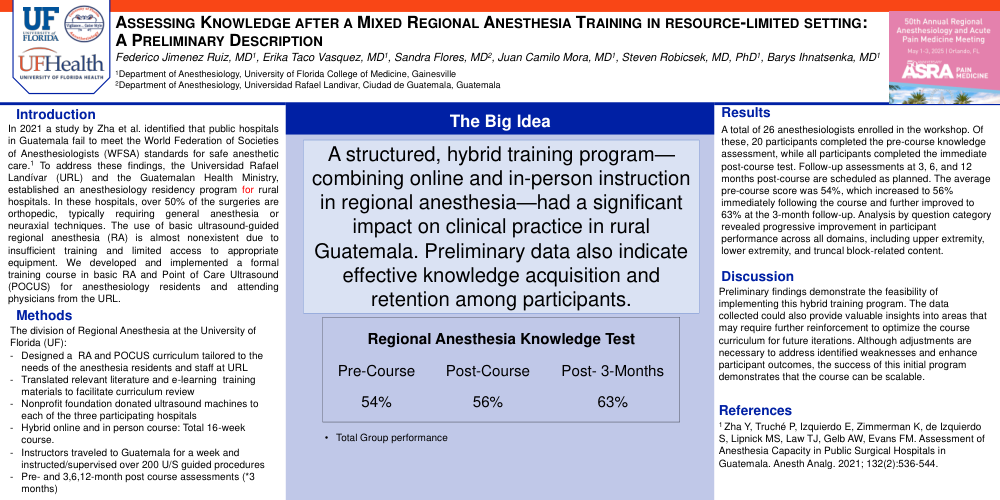
Results: A total of 26 anesthesiologists enrolled in the workshop. Of these, 20 participants completed the pre-course knowledge assessment, while all participants completed the immediate post-course test. Follow-up assessments at 3, 6, and 12 months post-course are scheduled as planned. The average pre-course score was 54%, which increased to 56% immediately following the course and further improved to 63% at the 3-month follow-up. Analysis by question category revealed progressive improvement in participant performance across all domains, including upper extremity, lower extremity, and truncal block-related content
 
Discussion:Preliminary findings demonstrate the feasibility of implementing this hybrid training program. The data collected could also provide valuable insights into areas that may require further reinforcement to optimize the course curriculum for future iterations. Although adjustments are necessary to address identified weaknesses and enhance participant outcomes, the success of this initial program demonstrates that the course can be scalable.
asraspring2025 banner
Copyright © 2015-2026, ePostersLive® SciGen is a registered trademark of SciGen Technologies S.A. Patent pending.

This website and third-party tools we use rely on cookies for the best user experience. By selecting "I agree", you agree to cookie usage as described in our Privacy Policy.
